The Lawmatics Blog
Insights on legal marketing, automating the law practice, and legal tech in general
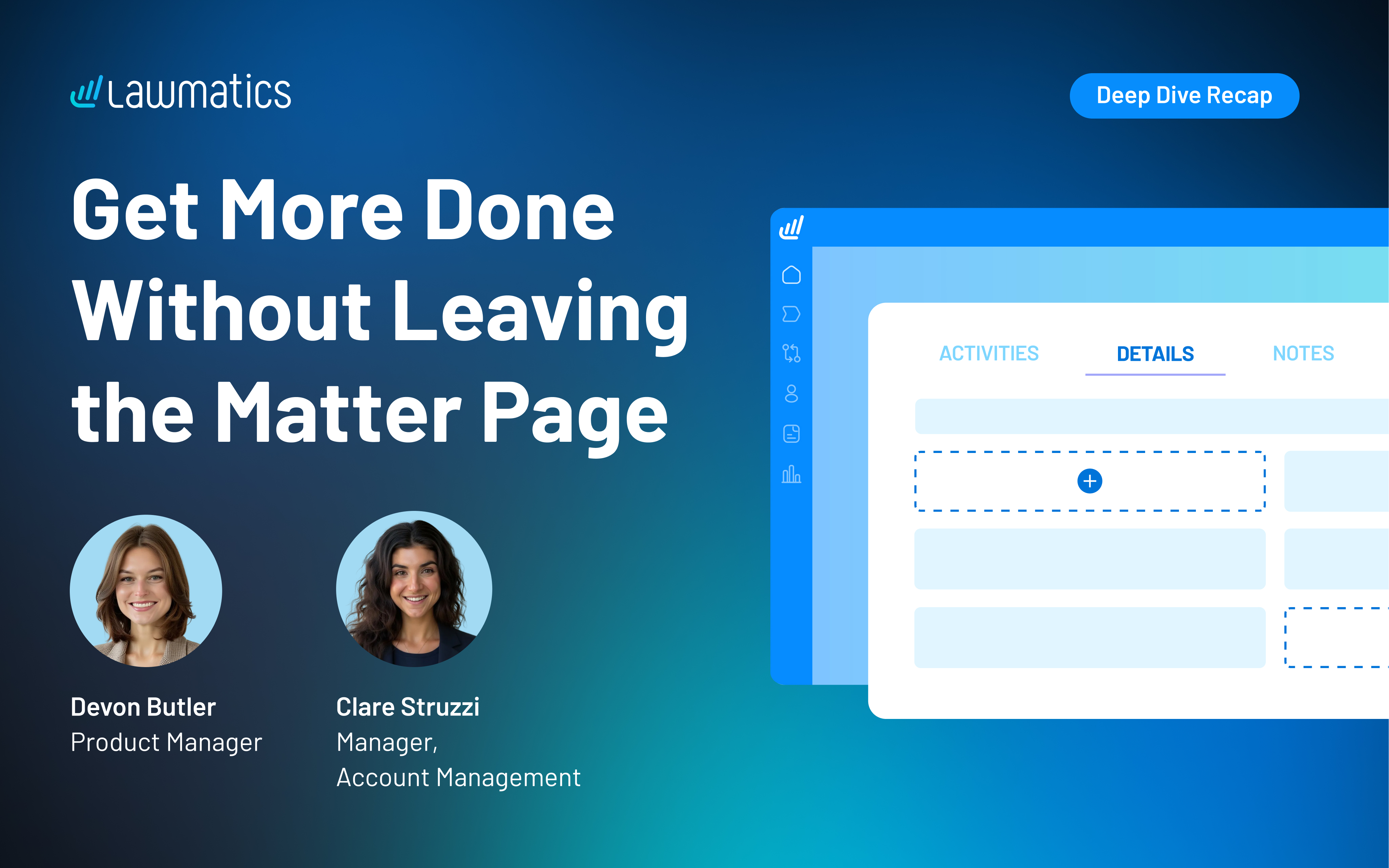


Last month, we walked through how to set up custom matter views. But building views is only half the equation — the real value comes from putting them to work. When intake staff, attorneys, and admins are all looking at the same long list of fields, it's easy to miss what matters, waste time hunting for the right information, or forget to fill out a field before firing off a contract.
In this Deep Dive webinar, Devon Butler, product manager at Lawmatics, and Clare Struzzi, who leads the account management team, showed how firms can use custom matter views to trigger automations, surface reporting fields, and tailor layouts by role and practice area.
Time stamps of key takeaways
5:53 – Why customize your Matter pages
Devon kicked off with four reasons to invest in custom matter views: cutting through the noise so each role only sees what they need, supporting cleaner reporting, strengthening team handoffs between intake and attorneys, and working faster directly from the Matter page without having to search for fields.
9:48 – Building practice-area-specific views
Clare walked through an estate planning intake view built specifically for intake specialists, showing how organized sections replace the old starred-fields approach. She highlighted how a field like "Next Steps Pre-Consult" can live right at the top of the view so the intake team can trigger automations directly from the details page — no need to reopen a form.
14:58 – Creating role-specific views
Devon and Clare showed how the attorney view for the same estate planning practice area includes different fields at the top — like "Next Steps Post-Consult" and a dedicated contract fields section where merge fields for engagement agreements can be reviewed and completed before sending. Clare also pointed out that sensitive information like Social Security numbers can be placed in sections that default to a collapsed view.
25:00 – Triggering automations and managing contract workflows
Devon walked through a live example of building an automation that fires when the "Next Steps Post-Consult" field is updated — automatically moving the matter to the correct pipeline stage and sending the engagement agreement. She also showed how duplicating automations makes it simple to handle variations, like sending a single-signer versus a joint estate plan document.
35:09 – Surfacing fields for cleaner reporting
The session wrapped with a look at how the reporting fields on custom views — source, campaign, estimated value, actual value — feed directly into the analytics page and custom reports. Devon demonstrated grouping a report by source to quickly see which referral sources are converting and where data gaps need attention.
Webinar slide deck
Last month, we walked through how to set up custom matter views. But building views is only half the equation — the real value comes from putting them to work. When intake staff, attorneys, and admins are all looking at the same long list of fields, it's easy to miss what matters, waste time hunting for the right information, or forget to fill out a field before firing off a contract.
In this Deep Dive webinar, Devon Butler, product manager at Lawmatics, and Clare Struzzi, who leads the account management team, showed how firms can use custom matter views to trigger automations, surface reporting fields, and tailor layouts by role and practice area.
Time stamps of key takeaways
5:53 – Why customize your Matter pages
Devon kicked off with four reasons to invest in custom matter views: cutting through the noise so each role only sees what they need, supporting cleaner reporting, strengthening team handoffs between intake and attorneys, and working faster directly from the Matter page without having to search for fields.
9:48 – Building practice-area-specific views
Clare walked through an estate planning intake view built specifically for intake specialists, showing how organized sections replace the old starred-fields approach. She highlighted how a field like "Next Steps Pre-Consult" can live right at the top of the view so the intake team can trigger automations directly from the details page — no need to reopen a form.
14:58 – Creating role-specific views
Devon and Clare showed how the attorney view for the same estate planning practice area includes different fields at the top — like "Next Steps Post-Consult" and a dedicated contract fields section where merge fields for engagement agreements can be reviewed and completed before sending. Clare also pointed out that sensitive information like Social Security numbers can be placed in sections that default to a collapsed view.
25:00 – Triggering automations and managing contract workflows
Devon walked through a live example of building an automation that fires when the "Next Steps Post-Consult" field is updated — automatically moving the matter to the correct pipeline stage and sending the engagement agreement. She also showed how duplicating automations makes it simple to handle variations, like sending a single-signer versus a joint estate plan document.
35:09 – Surfacing fields for cleaner reporting
The session wrapped with a look at how the reporting fields on custom views — source, campaign, estimated value, actual value — feed directly into the analytics page and custom reports. Devon demonstrated grouping a report by source to quickly see which referral sources are converting and where data gaps need attention.
Webinar slide deck

Will AI replace lawyers? Artificial intelligence (AI) will not replace lawyers, but it is fundamentally changing how they get legal work done. As AI becomes more embedded in research, document review, and client intake, firms are increasingly automating many traditional legal tasks. This article examines whether AI can truly replace lawyers, which legal functions are most affected, how law firms are using AI today, and what these trends mean for associate attorneys navigating an AI-driven legal industry.
AI is already reshaping how your firm gets work done. It’s changing how you handle research, drafting, intake, billing pressure, and the future of associate work.
For many firms, the real question is how to use AI without disrupting the way they already work. Firms are figuring out where AI adds value and where attorneys still need to stay hands-on, while navigating how these tools change the work without changing who’s ultimately responsible.
In this guide, we’ll examine where AI affects legal tasks, why associate attorneys feel the most pressure, how firms are using AI today, and what the next 12-24 months are likely to bring.
Will AI Replace Lawyers or Just Change the Job?
The short answer is no: AI will not replace lawyers. What it can do is automate or accelerate certain tasks lawyers have traditionally handled manually, and that distinction matters.
When people ask, "Will lawyers be replaced by AI?" or "Can AI replace lawyers?" they are usually reacting to how quickly these tools have improved at summarizing information, reviewing documents, and generating draft language.
But those capabilities are not the same as practicing law. Lawyers are still responsible for legal judgment, ethical obligations, advocacy, and client outcomes. And courts, clients, and regulators continue to hold licensed attorneys accountable.
A better question is: “Which parts of your work is AI already automating, and what does that mean for you?”
Why Associate Attorneys Feel Most at Risk
If any group in the profession feels exposed by AI, it is associate attorneys. Associates often spend a large share of their time on high-volume, repeatable work:
- Document review
- Contract comparison
- Drafting from templates
- Follow-up tied to matters in progress
Those are also the kinds of tasks AI is taking on.
It’s no surprise that many associates feel pressure as these tasks shift. Many associates are already under pressure to be faster, more accurate, and easier to justify to cost-conscious clients.
But "most exposed" does not mean associates are the most likely to be replaced. It means the tasks that make up their role are among the first to be reshaped by AI, while expectations for more substantive work rise earlier.
Legal Tasks AI Can Replace or Automate
AI is most effective at handling structured, repetitive, text-heavy, and rules-based work that slows your team down.
Legal research and case summarization
AI is already changing the first layer of legal research. Attorneys can use it for a faster first pass to:
- Scan cases, statutes, and regulations quickly
- Summarize large volumes of text
- Highlight recurring themes
- Spot potential issues faster
That means less time gathering information and more time testing whether the output is accurate, relevant, and persuasive. These are the kinds of outputs that actually move cases forward.
Contract review and document analysis
Contract review is another area where AI can help. AI can be useful in due diligence, compliance review, procurement workflows, and any matter involving large volumes of contracts or standard language, including:
- Identifying clauses
- Comparing language across document sets
- Flagging deviations from standard terms
- Surfacing inconsistencies that manual review might otherwise miss
Many firms are also exploring legal document automation software to streamline repetitive drafting and review tasks while keeping attorneys in control of the final output.
Intake, qualification, and administrative work
Some of the fastest wins come from automating intake and follow-up with predefined criteria, so no potential client gets lost. These are areas where automation and AI can reduce a major administrative burden:
- Client intake
- Lead qualification and routing
- Follow-up
- Automated scheduling and reminders
Legal Tasks AI Cannot Replace
For all the attention on automation, there are still core parts of legal practice that AI cannot replace.
AI cannot replace certain legal tasks
Legal work often involves high-stakes decisions where the details matter, and the right call isn’t always obvious. Many matters require attorneys to navigate uncertainty, emotional dynamics, and practical risk in ways that go beyond pattern recognition.
Lawyers do more than surface information. They interpret ambiguity, weigh tradeoffs, and make recommendations when the answer is not obvious. AI can help organize information and support analysis, but legal judgment still depends on attorneys.
Advocacy and negotiation
Legal advocacy is deeply human. Whether in court, at a mediation table, or in a negotiation, persuasion depends on judgment, timing, credibility, listening, and adaptation.
Strong advocates read tone, pressure, resistance, leverage, and opportunity. AI can assist with preparation, but it cannot respond to the human dynamics that shape negotiation and advocacy in the moment.
Ethical responsibility and accountability
The biggest boundary in legal practice around AI use is accountability. Lawyers have ethical duties to clients, courts, and the profession, including competence, confidentiality, candor, supervision, and professional judgment.
Those duties still rest with attorneys. They must verify the work, protect client information, exercise judgment, and stand behind the advice they give.
How Law Firms Are Using AI Today
Law firms are using AI in several practical ways today. It supports legal work by improving intake and connecting workflows inside a legal client relationship management (CRM) system.
AI as an assistant, not a replacement
In many firms, AI is being used to accelerate research, support drafting, improve consistency, and reduce time spent on routine tasks. It helps attorneys work more efficiently, but they still have to review outputs, make decisions, and stand behind the final work product.
AI in client intake, lead qualification, and routing
One of the clearest applications of AI for law firms is in client intake. AI can help firms improve the quality of information they collect, apply qualification criteria more consistently, and move leads through the right next steps with less manual effort.
For example, AI can:
- Evaluate urgency: Identify inquiries that may need faster attention based on timing, case type, or stated circumstances.
- Screen for practice fit: Help determine whether a matter aligns with the firm’s services before teams spend time reviewing it.
- Assess lead quality: Apply defined qualification standards consistently to help teams focus on stronger opportunities. Tools like QualifyAI support this process by helping firms automate intake screening and matter qualification without crossing into the realm of legal advice.
- Collect intake information: Use custom forms and structured workflows to gather client details and create more complete records from the start.
- Route inquiries intelligently: Sort leads by priority, stage, or next step and direct them to the right person or process.
- Automate follow-up: Trigger responses, reminders, and outreach to ensure promising leads do not stall due to delayed communication.
- Support scheduling: Move qualified leads into consultations with less back-and-forth and fewer manual touchpoints.
- Reduce administrative drag: Improve upstream intake so attorneys spend less time on triage and more time on billable work.
AI paired with legal CRM workflows
AI becomes more useful when it works inside a broader system. That works best when legal CRM software and legal software integrations connect intake, follow-up, and client information into a single centralized system.
When intake data flows directly into a centralized CRM, follow-up can happen automatically, and attorneys can work from more complete, organized information.
What Will Actually Change for Associate Attorneys in the Next 12-24 Months
The table below illustrates which legal tasks firms are already automating, which are likely to change in the next 12-24 months, and which still depend on human judgment.
| Legal task category | Examples of tasks | Level of AI impact | Timeline |
|---|---|---|---|
| Intake and administrative work | Intake data collection, lead qualification, follow-up, and scheduling | High | Already happening |
| Legal research and summarization | First-pass case law research, statute summaries, issue spotting | High | Already happening |
| Contract review and analysis | Clause identification, risk flagging, document comparison | High | Already happening |
| Drafting standard legal documents | Routine motions, template-based agreements with attorney review | Medium | 12-24 months |
| Litigation prep and discovery support | Document organization, evidence tagging, timeline creation | Medium | 12-24 months |
| Intake decision support | Applying firm-defined qualification rules without legal advice | Medium | Already happening |
| Legal judgment and strategy | Case strategy, risk assessment, application of law to facts | Low | Unlikely to be replaced |
| Client counseling and advocacy | Client advice, negotiation, courtroom advocacy | Low | Unlikely to be replaced |
| Ethical and professional accountability | Malpractice liability, ethical judgment, licensing responsibility | None | Not replaceable |
Fewer low-value tasks, higher expectations
Associates will likely spend less time on intake administration, document work, and other repetitive tasks that can be standardized. As a result, firms may expect associates to handle more substantive work earlier.
As routine work takes up less of the role, firms may place greater value on analytical skills, precision, and the ability to take on client-facing responsibility.
Faster feedback loops
AI-assisted systems can make performance more visible. When workflows are digitized and standardized, firms can see turnaround times, follow-up completion, response rates, matter progression, and other indicators sooner.
Faster feedback loops help strong associates stand out while also making expectations around consistency and execution clearer across the board.
Increased leverage for AI-literate associates
The associates who benefit most from AI will be the ones who adopt it quickly and use it responsibly. That starts with understanding how to prompt, review, verify, and refine outputs. It also involves knowing where automation adds value and where it introduces risk.
The real advantage comes from turning saved time into stronger work, not just faster work.
The real risks of AI in legal practice
AI can create leverage, but only if you understand the risks that come with it. Key concerns include:
- Hallucinations and inaccurate outputs: AI can produce confident-sounding errors, including fabricated citations, misread authority, or oversimplified legal distinctions. In legal work, every output requires attorney verification.
- Confidentiality and data privacy: Firms must handle client information carefully, and not every AI tool is appropriate for legal workflows. Tools can create risk when firms do not understand how data is processed, stored, or reused. That is why firms need clear policies, controlled workflows, and tools built for legal use cases.
- Unauthorized practice of law: AI cannot independently provide legal advice. Firms can use AI to support intake, qualification, and internal workflows, but if implementation crosses into unsupervised legal advice, the risk becomes regulatory exposure.
- Over-reliance and skill atrophy: Attorneys still need to build judgment, pattern recognition, and analytical strength. If AI is responsible for too much thinking, it can result in weaker legal reasoning over time.
How Associate Attorneys Can Future-Proof Their Careers
The strongest position is knowing where AI supports your legal work and where your judgment still matters most.
Focus on high-judgment legal work
The more your value depends on strategy, counseling, nuanced analysis, negotiation, and client communication, the harder you are to replace. Look for opportunities to build skills in asking better questions, improving communication, and taking ownership of recommendations.
Become AI-literate, not AI-dependent
Lawyers do not need to become AI experts. They need to understand how AI fits into their day-to-day workflows.
Learning how to evaluate outputs, identify weak reasoning, spot missing context, and supervise automated processes will better equip you to leverage AI without becoming dependent on it.
Use AI to protect billable work
AI should protect time for more meaningful work. When firms automate low-value administrative steps, intake bottlenecks, or repetitive drafting processes, you can focus your time where it adds the most value: analysis, advocacy, and client service.
The Future of Law in an AI-Driven Legal Profession
AI isn’t changing who’s responsible for legal work. It’s changing how efficiently you can get that work done.
For attorneys, AI is most useful when it automates administrative tasks and streamlines intake, follow-up, and qualification, allowing them to spend more time on substantive legal work.
As a legal CRM, Lawmatics helps firms automate intake, follow-up, and qualification through custom automations. You receive better information and fewer administrative bottlenecks, so you can spend more time practicing law.
To see how AI-supported intake fits into a modern Legal CRM, request a demo.
FAQ
Will AI replace lawyers entirely?
No. AI can automate parts of legal work, but it cannot replace legal judgment, ethical accountability, or advocacy. Lawyers are still responsible for advising clients, applying the law to specific facts, and standing behind the decisions and filings.
Are associate attorneys more vulnerable to AI?
Associate attorneys are more affected by AI-driven task automation because early-career roles often include more routine, document-heavy, and process-driven work. With AI, the structure of their work is changing, with more emphasis on analysis, judgment, and client-facing readiness.
Can AI practice law on its own?
No. AI cannot practice law independently or provide legal advice without attorney oversight. It can support research, intake, and administrative workflows, but licensed attorneys are still responsible for verifying outputs, protecting client information, and exercising professional judgment.
What legal work is safest from AI?
Legal work that depends on strategy, advocacy, negotiation, and client counseling is the least likely to be automated. These responsibilities require judgment, persuasion, relationship management, and the ability to respond to nuanced facts and human dynamics.
Should lawyers be worried about AI?
Lawyers should prepare for change, but not assume AI is replacing the profession. Firms and attorneys who learn how to use AI responsibly will be in a stronger position than those who ignore it.

Legal industry trends in 2026 point to a more tech-enabled, client-driven market. AI and automation are changing how work gets done, while firms face growing pressure around pricing, efficiency, cybersecurity, and competition. At the same time, legal operations and regulatory shifts are reshaping how firms operate and grow. For law firms, success will depend not just on legal expertise, but on stronger intake, clearer workflows, faster follow-up, and more measurable client service.
In 2026, the legal industry is under pressure to be faster, more efficient, and more measurable. Generative AI and automation are changing how legal work gets done, while clients are demanding clearer value and better service.
At the same time, firms navigate hybrid work, cybersecurity risk, legal tech consolidation, and evolving regulations.
This article breaks down the 10 legal industry trends shaping 2026 and explains what they mean for modern law firms. It covers how AI, pricing pressure, legal operations, and new competition are reshaping the market, as well as the operational shifts firms need to stay competitive.
Trend 1: Generative AI and Automation Transforming Legal Practice
What it is
Generative AI is a type of artificial intelligence that can generate new content from prompts and existing data.
Law firms and legal departments increasingly use generative AI for research, first drafts, summarization, contract review, and internal knowledge support. With it, they can more quickly draft and summarize, find answers, and revise documents.
Automation is evolving alongside it. Instead of handling one-off tasks, firms are using connected workflows to route inquiries, trigger follow-up, assemble documents, and move matters forward with less manual effort.
Why it’s a trend
The pace of adoption is accelerating because AI's productivity gains are immediate. Thomson Reuters reported that firms notably increased spending on technology and knowledge management in 2025 as they raced to deploy AI.
A 2025 study by the Association of Corporate Counsel (ACC) found that 52% of corporate legal departments actively use GenAI in their everyday work, nearly doubling year over year. In that same study, 91% cited efficiency as the most tangible benefit.
AI is increasingly becoming part of how firms produce, review, and deliver legal work.
Implications
AI is quickly becoming a baseline productivity tool. While it does not replace legal judgment, it does change expectations. Lawyers will be expected to produce cleaner work more quickly, and firms will need stronger quality control over anything AI touches.
This shift is not limited to legal research and drafting. Firms are also applying AI to operational workflows through tools like client intake software, legal document automation software, and platforms such as QualifyAI.
These tools help firms find, route, and prioritize leads more efficiently. Used well, they reduce manual work and help teams focus on higher-value matters.
The firms that succeed will be those that pair AI with clear governance, human review, and measurable client value. Long-term stability depends not just on adopting AI, but on using it in ways that improve outcomes and client service.
Trend 2: Hybrid Work and Evolving Talent Strategies
What it is
Hybrid work is still a reality in legal, but it is changing shape. Many firms have moved toward more defined in-office expectations while still preserving some flexibility.
At the same time, talent strategy now goes beyond hiring. Firms are paying closer attention to retention, manager quality, mentorship, burnout, and what younger lawyers expect from their careers.
Why it’s a trend
After several years of testing remote and hybrid work, many firms are reworking their policies to place more emphasis on in-person collaboration, training, and culture.
A Reuters article reported that more large U.S. firms were increasing in-office requirements. At the same time, newer generations value flexibility, remote work options, and a healthier work-life balance. Talent pressures are making that balance harder to ignore.
Lateral-heavy growth is expensive, and retention challenges are disruptive. Firms are realizing they cannot rely on compensation alone to keep people engaged.
As a result, talent strategies are evolving to focus more on career development, stronger mentorship, and workplace policies that make legal careers feel more sustainable over time.
Implications
Firms that handle hybrid work well will do more than set attendance rules. They will invest in structured training programs, clearer communication, stronger accountability for managers, and more intentional mentorship.
They are also more likely to formalize expectations around collaboration, feedback, and workflow visibility. This way, training and development do not suffer in a hybrid environment.
The goal is not office presence for its own sake. Firms are looking for stronger collaboration, better development, and clearer accountability. Those that combine structure with flexibility can better position themselves to recruit and retain talent.
Trend 3: Rise of Alternative Legal Service Providers and New Competition
What it is
Alternative legal service providers, or ALSPs, deliver certain legal-related services through specialized teams, process-driven workflows, and technology. By focusing on high-volume or repeatable work, they can provide these services more efficiently at scale.
Thomson Reuters reported that 35% of law firms use independent ALSPs, and 40% of those firms expect to increase that use in the next year.
Why it’s a trend
Clients are becoming more intentional about matching legal work to the right type of provider. Instead of sending every task to a traditional law firm, clients are giving routine work to providers that can handle it faster and at a lower cost.
That shift favors ALSPs because their delivery models are more efficient. AI and automation are providing a competitive edge by helping them complete repeatable work more quickly.
As clients face more pressure around budgets and turnaround times, those capabilities become more appealing.
Implications
Traditional law firms may continue to lose lower-margin, repeatable work unless they rethink how they deliver it. That does not mean firms are losing relevance. It means their value increasingly sits in strategy, advocacy, complex judgment, and relationship management.
To stay competitive, firms need a clearer delivery model for work that sits below that strategic level. That can include using legal document automation software, stronger intake processes, and technology that helps route work to the right team more efficiently.
Some firms may also build internal service teams. These teams allow the firm to lead the strategic relationship, while more process-driven support and automation handle lower-complexity work.
The opportunity is to protect margins and client relationships by combining high-value legal work with a more efficient operational model.
Trend 4: Client Demand for Value and Pricing Innovation
What it is
Clients want more predictability in both cost and service. They are asking for clearer budgets, better-defined scopes of work, faster turnaround times, and a stronger connection between what they pay and the value they receive.
As a result, firms are having more conversations about pricing models beyond the billable hour, more disciplined budgeting, and better systems for managing matters efficiently from start to finish.
Why it’s a trend
Clients are under pressure to control legal spend and justify costs more carefully. In-house legal teams and legal operations professionals are taking a more active role in controlling legal spend.
They’re reviewing budgets from outside law firms; tracking whether matters stay within scope; and evaluating firms on responsiveness, efficiency, and value.
At the same time, AI is making many legal tasks faster. That raises client expectations around pricing and value. If firms use technology to reduce time and effort, clients want to know how that benefit will translate into lower costs and better service.
That tension is already visible in the data. The ACC and Everlaw survey found that nearly 60% of respondents reported no noticeable savings yet from outside counsel’s use of GenAI. 58% said firms had not adjusted pricing to reflect those efficiencies.
Implications
This demand is about trust as much as pricing. Clients want to see that firms are using technology to improve service and outcomes, not just to preserve older pricing structures.
For law firms, this means clearer matter planning, stronger visibility into time and resources, and more consistent delivery. It also makes intake more important, since better information at the start helps firms set expectations, manage budgets, and improve service delivery.
To support that shift, many firms are investing in legal CRM software that provides better visibility into lead management, reporting, and the full client journey.
Trend 5: Heightened Cybersecurity and Data Privacy Imperatives
What it is
Cybersecurity is now part of client service. Law firms are not only protecting their own operations. They are also handling highly sensitive information that clients expect to remain secure.
Why it’s a trend
Threats are increasing, and the consequences are becoming more public. In January 2026, SecurityWeek reported that JPMorgan disclosed a breach involving an outside law firm.
According to the report, files copied from the law firm’s shared drive contained personal information, including names, contact details, and account numbers.
That kind of event reinforces a hard reality: A security lapse at one firm can quickly become a client trust issue for many organizations.
Implications
Security expectations will continue to tighten. Firms will need stronger controls around approved tools, access management, data handling, vendor review, and incident response.
This control is especially important as hybrid work, cloud systems, and AI tools expand the number of places sensitive information can move.
Trend 6: Regulatory Reform of Legal Services
What it is
Some jurisdictions are testing new rules around who can own, deliver, or support legal services. In practice, that can mean limited programs that allow nontraditional providers, such as companies or nonprofits, to offer certain legal services under court supervision.
These reforms test whether new business models can expand access to legal help without increasing consumer harm. In the broader market, they also reflect growing pressure to modernize rules built for a more traditional law firm model.
Why it’s a trend
Regulatory reform remains part of the legal industry conversation because courts and regulators are still actively testing new delivery models.
In December 2024, the Washington Supreme Court approved a pilot that allows companies and nonprofits to offer legal services under monitored conditions for the first time in state history. Arizona and Utah have also established programs that test new legal service delivery models under court oversight.
These efforts show that regulatory reform is moving beyond theory and into real-world experiments that could reshape parts of the legal market.
Implications
Regulatory reform does not mean the market will change overnight. But it does mean firms should pay attention to where reform is happening and what types of services may become more exposed to new competition.
For law firms, the takeaway is to watch for reforms that could open the door to new competition, especially in standardized, high-volume practice areas.
Firms that rely heavily on that work may need to differentiate more clearly through technology, client experience, and delivery model as the rules around legal services continue to evolve.
Trend 7: Law Firm Financial Boom Meets Market Pressures
What it is
Many law firms have posted strong financial results, but that performance does not tell the whole story. Beneath the headline performance, firms are facing rising costs, client pressure on rates, and growing questions about whether recent growth is sustainable.
Why it’s a trend
Thomson Reuters’ 2026 analysis points to a legal market with strong demand and record profits, while also raising concerns about the durability of that growth.
Law firms are spending more on AI and technology while continuing to face client pressure on rates. Whether that growth holds up over time will depend on how well firms turn those investments into better outcomes, service, and value for clients.
Implications
Law firm leaders are likely to look more closely at profitability by matter, staffing efficiency, and which workflows actually support sustainable growth.
That makes operations more strategic. Consistent intake, faster follow-up, better reporting, and cleaner handoffs can all help firms protect margins and support more sustainable growth.
Trend 8: Surge in Legal Tech Investment and Platform Consolidation
What it is
Legal tech is consolidating. Instead of relying on disconnected tools, firms increasingly want law-specific platforms that integrate key workflows, such as intake, communication, and reporting.
Why it’s a trend
Firms want fewer systems, less duplication, and cleaner data. They are looking for tools that work together smoothly, so information does not get lost between teams, systems, or stages of work.
This shift is happening as legal tech becomes more central to how firms compete and operate. Bloomberg Law’s 2026 outlook points to a market shaped by major changes in AI, litigation, corporate law, and regulation.
Implications
For firms, consolidation can reduce tool switching and support more consistent operations. As firms look to reduce tool sprawl, legal software integrations are becoming more important for connecting intake, billing, reporting, and matter workflows across platforms.
At the same time, platform decisions affect more than convenience. They shape governance, data quality, and operational visibility. When information lives across disconnected systems, it becomes harder to maintain consistent processes, manage permissions, track activity, and report on performance with confidence.
That is why platform strategy matters. Firms need connected systems that create a clear source of truth across intake, follow-up, reporting, and automation.
Trend 9: Empowered In-House Legal Operations and Tech Adoption
What it is
As legal operations mature, internal teams play a larger role in deciding how to source, track, and evaluate legal work. They are building processes, tracking performance, managing vendors, and investing in technology that improves visibility and control.
Why it’s a trend
This shift is being driven by rising workloads, tighter budgets, and growing pressure on in-house teams to run legal work more efficiently.
The Thomson Reuters Legal Department Operations Index found that legal operations work is expanding beyond cost control into systems, processes, and technology. It also found that 73% of respondents planned to use technology to automate legal tasks and reduce costs, and 46% expected more work to be in-house.
Implications
For law firms, this trend raises expectations from in-house legal teams around responsiveness, transparency, and ease of doing business. Firms that communicate clearly, move quickly, and provide better visibility into work in progress put themselves in a better position as legal operations teams gain influence.
Trend 10: Commitment to DEI and Well-Being in the Legal Profession
What it is
Diversity, equity, and inclusion (DEI) is a set of practices firms use to create a workplace where people from different backgrounds have fair access to opportunities, support, and advancement. In legal, this can include improving representation, building more inclusive firm cultures, and reducing barriers to hiring, development, and leadership.
Why it’s a trend
DEI remains a focus because both clients and employees are pushing firms to create more inclusive, supportive, and accountable workplaces. Clients want greater transparency around representation, while employees are closely examining the firm's culture and advancement opportunities.
At the same time, burnout remains a serious issue. Firms are more carefully considering workload, support systems, and the day-to-day conditions that affect whether attorneys can do their best work.
Together, those pressures are pushing firms to address DEI and well-being through concrete policies and management practices, not just broad statements of intent.
Implications
The most effective firms will treat inclusion and well-being as operating priorities, not just recruiting language. That can show up in clearer expectations, stronger mentorship, and systems that reduce avoidable administrative strain.
DEI matters because retention is not only about compensation. It is also about whether lawyers can do strong work in an environment that feels supportive, healthy, and built for long-term success.
How Law Firms Can Stay Competitive as the Legal Industry Evolves
The firms that adapt best in 2026 will be the ones that build a more resilient, modern way of operating. That starts with using AI thoughtfully, strengthening client intake and follow-up, and giving lawyers better visibility into the client journey.
Firms will also need to show value in ways clients can feel, including faster responses, clearer communication, and more predictable service.
For firms adapting to these changes, Lawmatics provides a legal CRM that supports the client journey from first contact through signed engagement. It brings together client intake, automation, and reporting in a single platform, helping firms operate with greater consistency, visibility, and efficiency.
Request a demo to see how Lawmatics can help your firm stay competitive in a changing legal market.
FAQ
What are the biggest legal industry trends in 2026?
The biggest trends include wider use of generative AI, stronger pricing pressure from clients, more influence from legal operations, tighter cybersecurity expectations, platform consolidation in legal tech, and growing competition from alternative service models.
How will these trends affect law firms the most?
They raise expectations around speed, transparency, pricing discipline, security, and client experience. Firms will need stronger workflows and better operational visibility, not just strong legal work.
What legal work will AI impact first?
Research, summarization, first drafts, contract review, and other repeatable tasks are among the clearest early use cases. The ACC and Everlaw findings specifically point to drafting and legal research as major areas for efficiency.
Why are clients pushing harder on value?
They face greater budget pressure, better operational oversight, and greater visibility into what technology should make possible. Many corporate legal teams do not yet see savings from outside counsel’s use of AI, which is increasing pressure on firms to link efficiency to pricing or outcomes.
Why are ALSPs growing so quickly?
They offer focused delivery models for process-heavy work, often at lower cost and with better scalability. As clients unbundle work and AI improves execution speed, that model becomes more appealing.
What should law firms do to stay competitive in 2026?
Invest in better systems, improve intake and follow-up, create clear AI guardrails, strengthen security practices, and make client value easier to see. In practical terms, that means combining legal judgment with operational discipline.

Automated legal intake uses software-driven workflows to standardize how law firms capture, qualify, schedule, and onboard new clients. This guide covers four key areas: lead capture, qualification and routing, scheduling and follow-up, and onboarding with documents and e-signatures. Together, these workflows help firms improve speed-to-lead, reduce missed opportunities, and increase consultation and signed engagement rates.
A strong intake process helps law firms respond faster, stay organized, and create a more consistent experience for prospective clients. Delays in follow-up or missing details during intake make it harder to keep momentum at a critical stage of the client journey.
Automated legal intake brings structure to how inquiries are captured, qualified, routed, and moved forward. Instead of relying on scattered emails, phone tag, and manual reminders, firms can create repeatable workflows that help every lead get a timely, consistent experience.
This consistency leads to faster response times, fewer dropped leads, better consult conversion, and less administrative drag on attorneys and staff. For managing partners, it also provides clearer visibility into what is working and where leads get stuck.
This guide breaks down four practical ways to automate the law firm intake process using a legal client relationship management (CRM) system, without forcing your firm to replace the systems you already use.
What Is Automated Legal Intake?
Automated legal intake is a practice that uses technology to move a new lead through the intake process more efficiently, with fewer manual steps. Instead of treating intake as a single form or one-time administrative task, it treats intake as a connected process that carries a lead from inquiry to onboarding.
What legal intake automation covers
Legal intake automation can include:
- Lead capture across channels
- Qualification and routing
- Conflict check triggers
- Scheduling and reminders
- Document collection and ID checks when needed
- Engagement letters and e-signature
- Handoff and reporting
What legal intake automation is not
Legal intake automation is not about replacing attorney judgment on lead fit, case strategy, or case value. It’s not about making final decisions without review. It’s not about creating a single form that solves intake on its own without follow-up workflows.
Good intake automation gives your team a more consistent way to gather the right details, move faster, and avoid preventable handoff issues with human oversight built into the process. Attorneys still decide which matters to pursue. Automation simply helps them get better information, sooner.
Why Intake Automation Matters for Law Firms
For many firms, intake is where bottlenecks start to slow growth. A lead comes in after hours. A voicemail sits too long. A staff member follows up, but not with consistent intake questions. A high-value inquiry gets buried under lower-priority submissions.
These inconsistencies make it harder to move leads forward efficiently and deliver a consistent intake experience. Automation can help law firms standardize intake, reduce staff burnout, and improve visibility for managing partners.
Increase conversion by improving speed-to-lead
Leads can go cold fast, and manual follow-up gaps are one of the most common reasons opportunities disappear.
The faster your firm responds, the better your odds of moving a lead to consultation. Automated acknowledgments, routing rules, and follow-up workflows help firms respond quickly, even after hours or on weekends.
Reduce operational drag and staff burnout
Manual intake creates a lot of invisible work: back-and-forth emails, repeated phone calls, duplicate data entry, and constant interruptions for attorneys who should be focused on billable work.
Automation speeds up the process by making the next steps happen automatically and consistently.
Create consistent intake outcomes across the firm
When every intake runs differently, results become unpredictable.
Standardized questions, required fields, and repeatable handoffs help firms ensure every intake is consistent. That consistency improves both client experience and internal accountability.
Improve visibility for managing partners
A better intake process should include reporting.
Managing partners need visibility into lead source performance, conversion rates, consult outcomes, and bottlenecks by matter type or office. Intake automation makes that data measurable and visible to leaders.
4 Ways to Automate the Intake Process
Automated legal intake works best when it supports the full journey. These four areas show where law firms can reduce manual work, improve initial response time, and create a more consistent path from inquiry to signed client.
1. Automate lead capture with online intake forms
The first step in automated legal intake is standardizing the information that enters your pipeline. That starts with online intake forms that collect the right information, in the right format, from the start.
Standardize what you collect
A strong intake form captures contact information and core details without leaving important gaps. Required fields ensure leads enter the pipeline complete, while conditional logic can adapt questions based on practice area, case type, or urgency. That gives your team cleaner data and a more usable starting point.
Use progressive intake to reduce abandonment
Not every lead needs a long form on first contact. Progressive intake lets you start with a shorter form to open the conversation. Then, use automated follow-up forms to gather more detailed case information. A staged approach reduces abandonment while still collecting the information your firm needs.
Reduce errors with structured data capture
When intake data is clean from the outset, downstream tasks become easier, improving accuracy and reducing the need for later clarification. Use structured data fields for dates, locations, parties, and case categories.
Metrics to track
For this stage of the law firm intake process, track:
- Form completion rate
- Intake form abandonment rate
- Percentage of submissions with complete required fields
- Lead source conversion rate from form submit to consult
2. Automate qualification, routing, and conflict check workflows
Once a lead enters the system, the next step is to ensure it reaches the right person and moves into the right workflow. This is where legal intake automation begins to create operational value.
Automate triage
Routing rules can assign leads to the right team member without manual sorting. High-value inquiries can be prioritized immediately, while lower-fit matters can follow a different path. Automate triage by practice area, matter type, urgency, or location.
Use QualifyAI to standardize lead qualification
QualifyAI helps firms standardize early lead qualification through structured, AI-powered lead evaluation. It acts as your intake agent, asking firm-approved questions and capturing key case details to quickly and efficiently route leads.
QualifyAI also uses predictive lead scoring to flag your most promising prospects right away. The result is more consistency at first contact without removing human judgment from the process.
Route qualified and unqualified leads into the correct workflows
Qualified leads can automatically move into scheduling or follow-up sequences, while complex matters are routed for review. Non-qualified leads can be tagged and handled appropriately, preventing calendar clutter and preserving staff time.
Trigger conflict checks earlier and more reliably
Conflict checks become more reliable when names, entities, and matter details are captured early and consistently. AI-assisted qualification can gather those details up front, and workflow rules can automatically trigger conflict check tasks once the required fields are present.
Firms can also block scheduling or engagement steps until the conflict review is complete, reducing the risk of incomplete intake.
Metrics to track
For this stage of the law firm intake process, track:
- Time-to-first-response
- Percentage of leads qualified before human review
- Lead-to-consult conversion rate
- Percentage of leads routed correctly on first pass
3. Automate scheduling, reminders, and follow-up
Even firms with strong initial response processes can lose momentum between inquiry and consultation. Scheduling friction, no-shows, and missed-call gaps can quietly drain conversion.
Make scheduling self-serve
Self-serve scheduling works best when it is tied to the right calendar owner, appointment type, and intake path. Practice-area-specific booking options can help route leads into the correct consult type, while automated pre-work can be delivered as soon as the appointment is booked.
Reduce no-shows with automated reminders
Once a consult is scheduled, the follow-up should not rely on memory. If a lead goes quiet, escalation rules can trigger outreach before the meeting is lost entirely. Use automations to keep appointments on track, including confirmation messages, reminders, and reschedule links.
Close gaps caused by missed calls and after-hours inquiries
Some of the most preventable losses happen outside business hours or after missed calls. Automation helps firms respond right away, gather initial details, and better guide leads toward next steps.
For leads that are not yet ready to book, drip email marketing software can keep follow-up consistent with educational touchpoints and next-step prompts.
Metrics to track
At this stage, focus on measuring:
- Consultation show rate
- Average days from inquiry to consult
- No-show rate by channel
4. Automate onboarding: Documents, e-signatures, and handoff
The intake process does not end when a consult is booked. To turn a prospective client into a retained client, firms need a smooth onboarding experience that keeps things moving without adding more manual work.
Automate document collection
Different case types require different supporting documents. Automated checklists and reminders help firms request the right documents at the right time, while secure portals or upload links reduce reliance on email attachments.
Legal document automation software helps firms standardize document requests and generate engagement materials. That makes onboarding faster and easier for both staff and clients.
Automate engagement agreements and e-signature
When a lead reaches “ready to retain” status, the next step should be immediate. Automated workflows can send engagement letters, track signature status, and use e-signature software to help firms move leads forward as soon as agreements are signed. Once signed, the lead can proceed automatically rather than waiting for manual status checks.
Standardize the matter kickoff and internal handoff
Good onboarding also means a clean internal handoff. Automated task creation, owners, and due dates ensure staff have the right information before work begins. Syncing key intake details into connected systems also reduces re-keying and lowers the odds of avoidable errors.
Metrics to track
For this stage of the law firm intake process, track:
- Consult-to-signed conversion rate
- Time from consult to signed agreement
- Onboarding completion time
What to Look for in Client Intake Software
Not all client intake software is built for the full intake lifecycle. Some tools stop at form capture, while others automate one or two isolated steps but leave your team to complete the rest manually. Here are a few key features to look for in client intake software:
- Workflow depth, not just forms: Look for workflow depth: routing, follow-up, scheduling, document requests, task automation, escalation rules, and audit trails.
- Reporting that ties intake to growth: The right system should show how intake affects growth. That includes lead-source visibility, funnel reporting, consult-show rate, and signed-engagement reporting.
- Integrations that support your existing tech stack: Most firms want intake automation that works alongside existing case management platforms, calendars, email systems, and forms. Legal software integrations reduce adoption friction and help firms improve intake without major disruption.
- Security and permissions: For law firms, security is critical. Role-based access, secure document handling, and consistent data governance are essential features when evaluating legal intake solutions.
Where Lawmatics Fits: Automated Intake Inside a Legal CRM
Lawmatics is built for firms that want intake automation to live inside a broader system for managing relationships, follow-up, and growth. It’s an all-in-one CRM platform for law firms that supports the full client journey from first contact to final signature.
Built as a legal CRM, not a bolt-on intake tool
Lawmatics is legal CRM software designed to manage the full relationship lifecycle, not just intake forms. Intake workflows live in the same system that tracks leads, consultations, and retained clients, giving managing partners a clearer view of pipeline and conversion performance.
End-to-end intake automation from first contact to retained client
Lawmatics supports intake automation throughout the full client journey, starting with a custom form builder that helps firms create intake forms tailored to their workflows, practice areas, and qualification criteria.
From there, firms can automate routing, follow-up, scheduling, reminders, and reporting. That way, leads move from inquiry to consultation to signed engagement with less manual work and more consistency.
Automation that supports growth without adding headcount
Custom automations help firms reduce repetitive administrative work, prevent follow-up from stalling, and create more consistent intake execution across the team. That supports growth without forcing attorneys and staff to spend more of the day managing logistics.
Reporting that connects intake activity to revenue outcomes
Lawmatics also gives firms visibility into lead-source performance, qualification rates, consult conversion rates, speed-to-lead, and intake bottlenecks. With automated pipeline management, firms can see how leads progress from initial inquiry to consultation to signed engagement without relying on manual tracking across disconnected tools.
Designed to work alongside existing case management systems
For firms that already rely on case management software, Lawmatics has deep integrations with all of the major case management systems. That makes it possible to automate intake inside a legal CRM while preserving the rest of your tech stack.
The Case for Automating Legal Intake
Automated legal intake is one of the fastest ways to improve conversion, consistency, and operational capacity without adding headcount. The strongest approach goes beyond forms and connects capture, qualification, scheduling, onboarding, and reporting into a single workflow.
For firms dealing with missed follow-up, inconsistent intake, and limited visibility into what drives signed clients, that kind of automation is not just convenient. It is foundational.
Request a demo to see how Lawmatics helps automate intake inside a legal CRM while working alongside the systems your firm already uses.
FAQ
How do I automate legal intake?
Legal intake is automated by using workflows that standardize how new inquiries are captured, qualified, routed, scheduled, and moved into client onboarding. This helps law firms reduce manual work, improve response times, and create a more consistent intake experience from first contact through next steps.
What should a law firm automate first in the intake process?
Start with lead capture, speed-to-lead follow-up, and scheduling. Then, automate routing, conflict check triggers, document requests, and engagement agreement workflows.
Can intake automation improve conversion rates?
Yes. Faster response times, consistent follow-up, and fewer scheduling delays typically increase lead-to-consult conversion and consultation show rates.
How does a legal CRM help with legal intake automation?
A legal CRM centralizes lead records and automates follow-ups, task creation, scheduling workflows, document requests, and reporting, so intake becomes repeatable and measurable.
Can automated intake work with case management software?
Yes. Many firms automate intake in a legal CRM, then sync key details into their case management platform once a lead becomes a client.
What metrics should managing partners track after automating intake?
Track time-to-first-response, lead-to-consult conversion rate, consultation show rate, consult-to-signed conversion rate, and lead source performance.

Lawmatics today announced it has been named a winner in the 2026 Artificial Intelligence Excellence Awards, in the category of Automation. Presented by the Business Intelligence Group, the award recognizes organizations, products, teams, and individuals that are applying artificial intelligence in ways that drive real, measurable impact.
The 2026 Artificial Intelligence Excellence Awards honor achievement across a broad range of industries and use cases, spotlighting the companies and leaders moving AI beyond experimentation and into practical, accountable deployment. This year’s program recognized winners across 36 industries and more than 15 countries.
Lawmatics was recognized for QualifyAI, an agentic AI feature built natively into the Lawmatics platform that automatically evaluates and prioritizes incoming leads for law firms based on each firm's specific criteria, including practice area, case type, and client profile. Through this work, the company has helped law firms reduce the time spent on manual lead review, increase the speed and consistency of prospect follow-up, and convert more leads into clients.
“AI has arrived! 2026 is about execution, accountability, and results,” said Russ Fordyce, Chief Recognition Officer, Business Intelligence Group. “Lawmatics stood out because its work in Automation reflects where the market is headed: practical AI that solves real problems, earns trust, and delivers measurable value. This recognition highlights a team that is not just participating in the AI shift, but helping define what meaningful progress looks like.”
“We are honored to be recognized in the 2026 Artificial Intelligence Excellence Awards for our work in Automation,” said Matt Spiegel, founder and CEO of Lawmatics. “This award reflects the talent of our team, the trust of our customers, and our commitment to building AI solutions that create real outcomes, not just headlines. We believe the future of AI belongs to organizations that can pair innovation with responsibility, and we are proud to be part of that movement.”
The Artificial Intelligence Excellence Awards celebrate the people and organizations leading the next phase of AI adoption, where innovation is judged not just by novelty, but by impact. Winners are selected based on how effectively they are using AI to improve performance, reduce friction, solve meaningful problems, and move their industries forward.
To learn more about the 2026 Artificial Intelligence Excellence Awards, visit:https://www.bintelligence.com/posts/2026-artificial-intelligence-excellence-awards-honoring-the-organizations-products-teams-and-individuals-defining-what-ai-can-actually-do

Lawmatics, the leading CRM and client acquisition platform for law firms, today announced the most significant expansion of its platform to date, adding three native AI tools that redefine how firms acquire clients, manage intake, and run day-to-day operations. Built natively inside the Lawmatics platform, QualifyAI, EngageAI, and MerlinAI give law firms the ability to instantly qualify new leads, engage prospects across every channel, and manage their operations through natural language prompts. Together, these agentic and generative AI tools help firms convert more leads into clients and operate at their full potential.
Law firms — particularly small and midsize practices — face a persistent gap between the volume of leads they receive and their capacity to respond to all of them effectively. Intake coordinators and attorneys managing high caseloads often cannot follow up with every prospect quickly enough, and leads that go cold represent real lost revenue. At the same time, the administrative burden of intake, reporting, and workflow management consumes hours that could otherwise be spent serving clients. With its AI suite, Lawmatics gives firms the capacity to respond to every opportunity, without adding to anyone's workload.
“Law firms don't lose potential new clients because of bad lawyering. They lose leads because of manual processes,” said Matt Spiegel, founder and CEO of Lawmatics. “QualifyAI, EngageAI, and MerlinAI give every firm on our platform the ability to operate at their full potential — converting more leads, serving more clients, and building the kind of practice they set out to build.”
QualifyAI is an agentic AI that evaluates incoming leads against a firm's specific criteria — including practice area, case type, and client profile — and automatically prioritizes the highest-value opportunities. Already recognized with an Excellence in AI Award from Business Intelligence Group, an independent organization that honors innovation across technology sectors, QualifyAI is the first of the three tools to reach general availability and is live for all Lawmatics customers today.
“Since rolling out QualifyAI, our firm has seen better quality leads coming through, higher conversion and close rates, and we’ve lost less time on poor-fit inquiries,” said Glenn Gilmour, Director of Operations at Johannesmeyer & Sawyer, PLLC and a Lawmatics customer.
EngageAI deploys AI-powered outreach agents across email, phone, text, and chat, ensuring every prospect receives a timely response and continues moving through the intake process regardless of staff availability. MerlinAI, an in-platform copilot, allows users to build automations, generate reports, and surface insights using simple conversational prompts. EngageAI and MerlinAI are in production and will be released to customers in the coming months.
Subscribe to get our best content in your inbox
Law firms love Lawmatics
Our customers give their clients the client-focused experience they deserve. Learn how they do it all with Lawmatics.
.avif)
.avif)

.avif)

Ready to grow your law firm with Lawmatics?
Schedule a demo of legal’s most trusted growth platform.