



News & Updates


Will AI replace lawyers? Artificial intelligence (AI) will not replace lawyers, but it is fundamentally changing how they get legal work done. As AI becomes more embedded in research, document review, and client intake, firms are increasingly automating many traditional legal tasks. This article examines whether AI can truly replace lawyers, which legal functions are most affected, how law firms are using AI today, and what these trends mean for associate attorneys navigating an AI-driven legal industry.
AI is already reshaping how your firm gets work done. It’s changing how you handle research, drafting, intake, billing pressure, and the future of associate work.
For many firms, the real question is how to use AI without disrupting the way they already work. Firms are figuring out where AI adds value and where attorneys still need to stay hands-on, while navigating how these tools change the work without changing who’s ultimately responsible.
In this guide, we’ll examine where AI affects legal tasks, why associate attorneys feel the most pressure, how firms are using AI today, and what the next 12-24 months are likely to bring.
Will AI Replace Lawyers or Just Change the Job?
The short answer is no: AI will not replace lawyers. What it can do is automate or accelerate certain tasks lawyers have traditionally handled manually, and that distinction matters.
When people ask, "Will lawyers be replaced by AI?" or "Can AI replace lawyers?" they are usually reacting to how quickly these tools have improved at summarizing information, reviewing documents, and generating draft language.
But those capabilities are not the same as practicing law. Lawyers are still responsible for legal judgment, ethical obligations, advocacy, and client outcomes. And courts, clients, and regulators continue to hold licensed attorneys accountable.
A better question is: “Which parts of your work is AI already automating, and what does that mean for you?”
Why Associate Attorneys Feel Most at Risk
If any group in the profession feels exposed by AI, it is associate attorneys. Associates often spend a large share of their time on high-volume, repeatable work:
- Document review
- Contract comparison
- Drafting from templates
- Follow-up tied to matters in progress
Those are also the kinds of tasks AI is taking on.
It’s no surprise that many associates feel pressure as these tasks shift. Many associates are already under pressure to be faster, more accurate, and easier to justify to cost-conscious clients.
But "most exposed" does not mean associates are the most likely to be replaced. It means the tasks that make up their role are among the first to be reshaped by AI, while expectations for more substantive work rise earlier.
Legal Tasks AI Can Replace or Automate
AI is most effective at handling structured, repetitive, text-heavy, and rules-based work that slows your team down.
Legal research and case summarization
AI is already changing the first layer of legal research. Attorneys can use it for a faster first pass to:
- Scan cases, statutes, and regulations quickly
- Summarize large volumes of text
- Highlight recurring themes
- Spot potential issues faster
That means less time gathering information and more time testing whether the output is accurate, relevant, and persuasive. These are the kinds of outputs that actually move cases forward.
Contract review and document analysis
Contract review is another area where AI can help. AI can be useful in due diligence, compliance review, procurement workflows, and any matter involving large volumes of contracts or standard language, including:
- Identifying clauses
- Comparing language across document sets
- Flagging deviations from standard terms
- Surfacing inconsistencies that manual review might otherwise miss
Many firms are also exploring legal document automation software to streamline repetitive drafting and review tasks while keeping attorneys in control of the final output.
Intake, qualification, and administrative work
Some of the fastest wins come from automating intake and follow-up with predefined criteria, so no potential client gets lost. These are areas where automation and AI can reduce a major administrative burden:
- Client intake
- Lead qualification and routing
- Follow-up
- Automated scheduling and reminders
Legal Tasks AI Cannot Replace
For all the attention on automation, there are still core parts of legal practice that AI cannot replace.
AI cannot replace certain legal tasks
Legal work often involves high-stakes decisions where the details matter, and the right call isn’t always obvious. Many matters require attorneys to navigate uncertainty, emotional dynamics, and practical risk in ways that go beyond pattern recognition.
Lawyers do more than surface information. They interpret ambiguity, weigh tradeoffs, and make recommendations when the answer is not obvious. AI can help organize information and support analysis, but legal judgment still depends on attorneys.
Advocacy and negotiation
Legal advocacy is deeply human. Whether in court, at a mediation table, or in a negotiation, persuasion depends on judgment, timing, credibility, listening, and adaptation.
Strong advocates read tone, pressure, resistance, leverage, and opportunity. AI can assist with preparation, but it cannot respond to the human dynamics that shape negotiation and advocacy in the moment.
Ethical responsibility and accountability
The biggest boundary in legal practice around AI use is accountability. Lawyers have ethical duties to clients, courts, and the profession, including competence, confidentiality, candor, supervision, and professional judgment.
Those duties still rest with attorneys. They must verify the work, protect client information, exercise judgment, and stand behind the advice they give.
How Law Firms Are Using AI Today
Law firms are using AI in several practical ways today. It supports legal work by improving intake and connecting workflows inside a legal client relationship management (CRM) system.
AI as an assistant, not a replacement
In many firms, AI is being used to accelerate research, support drafting, improve consistency, and reduce time spent on routine tasks. It helps attorneys work more efficiently, but they still have to review outputs, make decisions, and stand behind the final work product.
AI in client intake, lead qualification, and routing
One of the clearest applications of AI for law firms is in client intake. AI can help firms improve the quality of information they collect, apply qualification criteria more consistently, and move leads through the right next steps with less manual effort.
For example, AI can:
- Evaluate urgency: Identify inquiries that may need faster attention based on timing, case type, or stated circumstances.
- Screen for practice fit: Help determine whether a matter aligns with the firm’s services before teams spend time reviewing it.
- Assess lead quality: Apply defined qualification standards consistently to help teams focus on stronger opportunities. Tools like QualifyAI support this process by helping firms automate intake screening and matter qualification without crossing into the realm of legal advice.
- Collect intake information: Use custom forms and structured workflows to gather client details and create more complete records from the start.
- Route inquiries intelligently: Sort leads by priority, stage, or next step and direct them to the right person or process.
- Automate follow-up: Trigger responses, reminders, and outreach to ensure promising leads do not stall due to delayed communication.
- Support scheduling: Move qualified leads into consultations with less back-and-forth and fewer manual touchpoints.
- Reduce administrative drag: Improve upstream intake so attorneys spend less time on triage and more time on billable work.
AI paired with legal CRM workflows
AI becomes more useful when it works inside a broader system. That works best when legal CRM software and legal software integrations connect intake, follow-up, and client information into a single centralized system.
When intake data flows directly into a centralized CRM, follow-up can happen automatically, and attorneys can work from more complete, organized information.
What Will Actually Change for Associate Attorneys in the Next 12-24 Months
The table below illustrates which legal tasks firms are already automating, which are likely to change in the next 12-24 months, and which still depend on human judgment.
| Legal task category | Examples of tasks | Level of AI impact | Timeline |
|---|---|---|---|
| Intake and administrative work | Intake data collection, lead qualification, follow-up, and scheduling | High | Already happening |
| Legal research and summarization | First-pass case law research, statute summaries, issue spotting | High | Already happening |
| Contract review and analysis | Clause identification, risk flagging, document comparison | High | Already happening |
| Drafting standard legal documents | Routine motions, template-based agreements with attorney review | Medium | 12-24 months |
| Litigation prep and discovery support | Document organization, evidence tagging, timeline creation | Medium | 12-24 months |
| Intake decision support | Applying firm-defined qualification rules without legal advice | Medium | Already happening |
| Legal judgment and strategy | Case strategy, risk assessment, application of law to facts | Low | Unlikely to be replaced |
| Client counseling and advocacy | Client advice, negotiation, courtroom advocacy | Low | Unlikely to be replaced |
| Ethical and professional accountability | Malpractice liability, ethical judgment, licensing responsibility | None | Not replaceable |
Fewer low-value tasks, higher expectations
Associates will likely spend less time on intake administration, document work, and other repetitive tasks that can be standardized. As a result, firms may expect associates to handle more substantive work earlier.
As routine work takes up less of the role, firms may place greater value on analytical skills, precision, and the ability to take on client-facing responsibility.
Faster feedback loops
AI-assisted systems can make performance more visible. When workflows are digitized and standardized, firms can see turnaround times, follow-up completion, response rates, matter progression, and other indicators sooner.
Faster feedback loops help strong associates stand out while also making expectations around consistency and execution clearer across the board.
Increased leverage for AI-literate associates
The associates who benefit most from AI will be the ones who adopt it quickly and use it responsibly. That starts with understanding how to prompt, review, verify, and refine outputs. It also involves knowing where automation adds value and where it introduces risk.
The real advantage comes from turning saved time into stronger work, not just faster work.
The real risks of AI in legal practice
AI can create leverage, but only if you understand the risks that come with it. Key concerns include:
- Hallucinations and inaccurate outputs: AI can produce confident-sounding errors, including fabricated citations, misread authority, or oversimplified legal distinctions. In legal work, every output requires attorney verification.
- Confidentiality and data privacy: Firms must handle client information carefully, and not every AI tool is appropriate for legal workflows. Tools can create risk when firms do not understand how data is processed, stored, or reused. That is why firms need clear policies, controlled workflows, and tools built for legal use cases.
- Unauthorized practice of law: AI cannot independently provide legal advice. Firms can use AI to support intake, qualification, and internal workflows, but if implementation crosses into unsupervised legal advice, the risk becomes regulatory exposure.
- Over-reliance and skill atrophy: Attorneys still need to build judgment, pattern recognition, and analytical strength. If AI is responsible for too much thinking, it can result in weaker legal reasoning over time.
How Associate Attorneys Can Future-Proof Their Careers
The strongest position is knowing where AI supports your legal work and where your judgment still matters most.
Focus on high-judgment legal work
The more your value depends on strategy, counseling, nuanced analysis, negotiation, and client communication, the harder you are to replace. Look for opportunities to build skills in asking better questions, improving communication, and taking ownership of recommendations.
Become AI-literate, not AI-dependent
Lawyers do not need to become AI experts. They need to understand how AI fits into their day-to-day workflows.
Learning how to evaluate outputs, identify weak reasoning, spot missing context, and supervise automated processes will better equip you to leverage AI without becoming dependent on it.
Use AI to protect billable work
AI should protect time for more meaningful work. When firms automate low-value administrative steps, intake bottlenecks, or repetitive drafting processes, you can focus your time where it adds the most value: analysis, advocacy, and client service.
The Future of Law in an AI-Driven Legal Profession
AI isn’t changing who’s responsible for legal work. It’s changing how efficiently you can get that work done.
For attorneys, AI is most useful when it automates administrative tasks and streamlines intake, follow-up, and qualification, allowing them to spend more time on substantive legal work.
As a legal CRM, Lawmatics helps firms automate intake, follow-up, and qualification through custom automations. You receive better information and fewer administrative bottlenecks, so you can spend more time practicing law.
To see how AI-supported intake fits into a modern Legal CRM, request a demo.
FAQ
Will AI replace lawyers entirely?
No. AI can automate parts of legal work, but it cannot replace legal judgment, ethical accountability, or advocacy. Lawyers are still responsible for advising clients, applying the law to specific facts, and standing behind the decisions and filings.
Are associate attorneys more vulnerable to AI?
Associate attorneys are more affected by AI-driven task automation because early-career roles often include more routine, document-heavy, and process-driven work. With AI, the structure of their work is changing, with more emphasis on analysis, judgment, and client-facing readiness.
Can AI practice law on its own?
No. AI cannot practice law independently or provide legal advice without attorney oversight. It can support research, intake, and administrative workflows, but licensed attorneys are still responsible for verifying outputs, protecting client information, and exercising professional judgment.
What legal work is safest from AI?
Legal work that depends on strategy, advocacy, negotiation, and client counseling is the least likely to be automated. These responsibilities require judgment, persuasion, relationship management, and the ability to respond to nuanced facts and human dynamics.
Should lawyers be worried about AI?
Lawyers should prepare for change, but not assume AI is replacing the profession. Firms and attorneys who learn how to use AI responsibly will be in a stronger position than those who ignore it.

Legal industry trends in 2026 point to a more tech-enabled, client-driven market. AI and automation are changing how work gets done, while firms face growing pressure around pricing, efficiency, cybersecurity, and competition. At the same time, legal operations and regulatory shifts are reshaping how firms operate and grow. For law firms, success will depend not just on legal expertise, but on stronger intake, clearer workflows, faster follow-up, and more measurable client service.
In 2026, the legal industry is under pressure to be faster, more efficient, and more measurable. Generative AI and automation are changing how legal work gets done, while clients are demanding clearer value and better service.
At the same time, firms navigate hybrid work, cybersecurity risk, legal tech consolidation, and evolving regulations.
This article breaks down the 10 legal industry trends shaping 2026 and explains what they mean for modern law firms. It covers how AI, pricing pressure, legal operations, and new competition are reshaping the market, as well as the operational shifts firms need to stay competitive.
Trend 1: Generative AI and Automation Transforming Legal Practice
What it is
Generative AI is a type of artificial intelligence that can generate new content from prompts and existing data.
Law firms and legal departments increasingly use generative AI for research, first drafts, summarization, contract review, and internal knowledge support. With it, they can more quickly draft and summarize, find answers, and revise documents.
Automation is evolving alongside it. Instead of handling one-off tasks, firms are using connected workflows to route inquiries, trigger follow-up, assemble documents, and move matters forward with less manual effort.
Why it’s a trend
The pace of adoption is accelerating because AI's productivity gains are immediate. Thomson Reuters reported that firms notably increased spending on technology and knowledge management in 2025 as they raced to deploy AI.
A 2025 study by the Association of Corporate Counsel (ACC) found that 52% of corporate legal departments actively use GenAI in their everyday work, nearly doubling year over year. In that same study, 91% cited efficiency as the most tangible benefit.
AI is increasingly becoming part of how firms produce, review, and deliver legal work.
Implications
AI is quickly becoming a baseline productivity tool. While it does not replace legal judgment, it does change expectations. Lawyers will be expected to produce cleaner work more quickly, and firms will need stronger quality control over anything AI touches.
This shift is not limited to legal research and drafting. Firms are also applying AI to operational workflows through tools like client intake software, legal document automation software, and platforms such as QualifyAI.
These tools help firms find, route, and prioritize leads more efficiently. Used well, they reduce manual work and help teams focus on higher-value matters.
The firms that succeed will be those that pair AI with clear governance, human review, and measurable client value. Long-term stability depends not just on adopting AI, but on using it in ways that improve outcomes and client service.
Trend 2: Hybrid Work and Evolving Talent Strategies
What it is
Hybrid work is still a reality in legal, but it is changing shape. Many firms have moved toward more defined in-office expectations while still preserving some flexibility.
At the same time, talent strategy now goes beyond hiring. Firms are paying closer attention to retention, manager quality, mentorship, burnout, and what younger lawyers expect from their careers.
Why it’s a trend
After several years of testing remote and hybrid work, many firms are reworking their policies to place more emphasis on in-person collaboration, training, and culture.
A Reuters article reported that more large U.S. firms were increasing in-office requirements. At the same time, newer generations value flexibility, remote work options, and a healthier work-life balance. Talent pressures are making that balance harder to ignore.
Lateral-heavy growth is expensive, and retention challenges are disruptive. Firms are realizing they cannot rely on compensation alone to keep people engaged.
As a result, talent strategies are evolving to focus more on career development, stronger mentorship, and workplace policies that make legal careers feel more sustainable over time.
Implications
Firms that handle hybrid work well will do more than set attendance rules. They will invest in structured training programs, clearer communication, stronger accountability for managers, and more intentional mentorship.
They are also more likely to formalize expectations around collaboration, feedback, and workflow visibility. This way, training and development do not suffer in a hybrid environment.
The goal is not office presence for its own sake. Firms are looking for stronger collaboration, better development, and clearer accountability. Those that combine structure with flexibility can better position themselves to recruit and retain talent.
Trend 3: Rise of Alternative Legal Service Providers and New Competition
What it is
Alternative legal service providers, or ALSPs, deliver certain legal-related services through specialized teams, process-driven workflows, and technology. By focusing on high-volume or repeatable work, they can provide these services more efficiently at scale.
Thomson Reuters reported that 35% of law firms use independent ALSPs, and 40% of those firms expect to increase that use in the next year.
Why it’s a trend
Clients are becoming more intentional about matching legal work to the right type of provider. Instead of sending every task to a traditional law firm, clients are giving routine work to providers that can handle it faster and at a lower cost.
That shift favors ALSPs because their delivery models are more efficient. AI and automation are providing a competitive edge by helping them complete repeatable work more quickly.
As clients face more pressure around budgets and turnaround times, those capabilities become more appealing.
Implications
Traditional law firms may continue to lose lower-margin, repeatable work unless they rethink how they deliver it. That does not mean firms are losing relevance. It means their value increasingly sits in strategy, advocacy, complex judgment, and relationship management.
To stay competitive, firms need a clearer delivery model for work that sits below that strategic level. That can include using legal document automation software, stronger intake processes, and technology that helps route work to the right team more efficiently.
Some firms may also build internal service teams. These teams allow the firm to lead the strategic relationship, while more process-driven support and automation handle lower-complexity work.
The opportunity is to protect margins and client relationships by combining high-value legal work with a more efficient operational model.
Trend 4: Client Demand for Value and Pricing Innovation
What it is
Clients want more predictability in both cost and service. They are asking for clearer budgets, better-defined scopes of work, faster turnaround times, and a stronger connection between what they pay and the value they receive.
As a result, firms are having more conversations about pricing models beyond the billable hour, more disciplined budgeting, and better systems for managing matters efficiently from start to finish.
Why it’s a trend
Clients are under pressure to control legal spend and justify costs more carefully. In-house legal teams and legal operations professionals are taking a more active role in controlling legal spend.
They’re reviewing budgets from outside law firms; tracking whether matters stay within scope; and evaluating firms on responsiveness, efficiency, and value.
At the same time, AI is making many legal tasks faster. That raises client expectations around pricing and value. If firms use technology to reduce time and effort, clients want to know how that benefit will translate into lower costs and better service.
That tension is already visible in the data. The ACC and Everlaw survey found that nearly 60% of respondents reported no noticeable savings yet from outside counsel’s use of GenAI. 58% said firms had not adjusted pricing to reflect those efficiencies.
Implications
This demand is about trust as much as pricing. Clients want to see that firms are using technology to improve service and outcomes, not just to preserve older pricing structures.
For law firms, this means clearer matter planning, stronger visibility into time and resources, and more consistent delivery. It also makes intake more important, since better information at the start helps firms set expectations, manage budgets, and improve service delivery.
To support that shift, many firms are investing in legal CRM software that provides better visibility into lead management, reporting, and the full client journey.
Trend 5: Heightened Cybersecurity and Data Privacy Imperatives
What it is
Cybersecurity is now part of client service. Law firms are not only protecting their own operations. They are also handling highly sensitive information that clients expect to remain secure.
Why it’s a trend
Threats are increasing, and the consequences are becoming more public. In January 2026, SecurityWeek reported that JPMorgan disclosed a breach involving an outside law firm.
According to the report, files copied from the law firm’s shared drive contained personal information, including names, contact details, and account numbers.
That kind of event reinforces a hard reality: A security lapse at one firm can quickly become a client trust issue for many organizations.
Implications
Security expectations will continue to tighten. Firms will need stronger controls around approved tools, access management, data handling, vendor review, and incident response.
This control is especially important as hybrid work, cloud systems, and AI tools expand the number of places sensitive information can move.
Trend 6: Regulatory Reform of Legal Services
What it is
Some jurisdictions are testing new rules around who can own, deliver, or support legal services. In practice, that can mean limited programs that allow nontraditional providers, such as companies or nonprofits, to offer certain legal services under court supervision.
These reforms test whether new business models can expand access to legal help without increasing consumer harm. In the broader market, they also reflect growing pressure to modernize rules built for a more traditional law firm model.
Why it’s a trend
Regulatory reform remains part of the legal industry conversation because courts and regulators are still actively testing new delivery models.
In December 2024, the Washington Supreme Court approved a pilot that allows companies and nonprofits to offer legal services under monitored conditions for the first time in state history. Arizona and Utah have also established programs that test new legal service delivery models under court oversight.
These efforts show that regulatory reform is moving beyond theory and into real-world experiments that could reshape parts of the legal market.
Implications
Regulatory reform does not mean the market will change overnight. But it does mean firms should pay attention to where reform is happening and what types of services may become more exposed to new competition.
For law firms, the takeaway is to watch for reforms that could open the door to new competition, especially in standardized, high-volume practice areas.
Firms that rely heavily on that work may need to differentiate more clearly through technology, client experience, and delivery model as the rules around legal services continue to evolve.
Trend 7: Law Firm Financial Boom Meets Market Pressures
What it is
Many law firms have posted strong financial results, but that performance does not tell the whole story. Beneath the headline performance, firms are facing rising costs, client pressure on rates, and growing questions about whether recent growth is sustainable.
Why it’s a trend
Thomson Reuters’ 2026 analysis points to a legal market with strong demand and record profits, while also raising concerns about the durability of that growth.
Law firms are spending more on AI and technology while continuing to face client pressure on rates. Whether that growth holds up over time will depend on how well firms turn those investments into better outcomes, service, and value for clients.
Implications
Law firm leaders are likely to look more closely at profitability by matter, staffing efficiency, and which workflows actually support sustainable growth.
That makes operations more strategic. Consistent intake, faster follow-up, better reporting, and cleaner handoffs can all help firms protect margins and support more sustainable growth.
Trend 8: Surge in Legal Tech Investment and Platform Consolidation
What it is
Legal tech is consolidating. Instead of relying on disconnected tools, firms increasingly want law-specific platforms that integrate key workflows, such as intake, communication, and reporting.
Why it’s a trend
Firms want fewer systems, less duplication, and cleaner data. They are looking for tools that work together smoothly, so information does not get lost between teams, systems, or stages of work.
This shift is happening as legal tech becomes more central to how firms compete and operate. Bloomberg Law’s 2026 outlook points to a market shaped by major changes in AI, litigation, corporate law, and regulation.
Implications
For firms, consolidation can reduce tool switching and support more consistent operations. As firms look to reduce tool sprawl, legal software integrations are becoming more important for connecting intake, billing, reporting, and matter workflows across platforms.
At the same time, platform decisions affect more than convenience. They shape governance, data quality, and operational visibility. When information lives across disconnected systems, it becomes harder to maintain consistent processes, manage permissions, track activity, and report on performance with confidence.
That is why platform strategy matters. Firms need connected systems that create a clear source of truth across intake, follow-up, reporting, and automation.
Trend 9: Empowered In-House Legal Operations and Tech Adoption
What it is
As legal operations mature, internal teams play a larger role in deciding how to source, track, and evaluate legal work. They are building processes, tracking performance, managing vendors, and investing in technology that improves visibility and control.
Why it’s a trend
This shift is being driven by rising workloads, tighter budgets, and growing pressure on in-house teams to run legal work more efficiently.
The Thomson Reuters Legal Department Operations Index found that legal operations work is expanding beyond cost control into systems, processes, and technology. It also found that 73% of respondents planned to use technology to automate legal tasks and reduce costs, and 46% expected more work to be in-house.
Implications
For law firms, this trend raises expectations from in-house legal teams around responsiveness, transparency, and ease of doing business. Firms that communicate clearly, move quickly, and provide better visibility into work in progress put themselves in a better position as legal operations teams gain influence.
Trend 10: Commitment to DEI and Well-Being in the Legal Profession
What it is
Diversity, equity, and inclusion (DEI) is a set of practices firms use to create a workplace where people from different backgrounds have fair access to opportunities, support, and advancement. In legal, this can include improving representation, building more inclusive firm cultures, and reducing barriers to hiring, development, and leadership.
Why it’s a trend
DEI remains a focus because both clients and employees are pushing firms to create more inclusive, supportive, and accountable workplaces. Clients want greater transparency around representation, while employees are closely examining the firm's culture and advancement opportunities.
At the same time, burnout remains a serious issue. Firms are more carefully considering workload, support systems, and the day-to-day conditions that affect whether attorneys can do their best work.
Together, those pressures are pushing firms to address DEI and well-being through concrete policies and management practices, not just broad statements of intent.
Implications
The most effective firms will treat inclusion and well-being as operating priorities, not just recruiting language. That can show up in clearer expectations, stronger mentorship, and systems that reduce avoidable administrative strain.
DEI matters because retention is not only about compensation. It is also about whether lawyers can do strong work in an environment that feels supportive, healthy, and built for long-term success.
How Law Firms Can Stay Competitive as the Legal Industry Evolves
The firms that adapt best in 2026 will be the ones that build a more resilient, modern way of operating. That starts with using AI thoughtfully, strengthening client intake and follow-up, and giving lawyers better visibility into the client journey.
Firms will also need to show value in ways clients can feel, including faster responses, clearer communication, and more predictable service.
For firms adapting to these changes, Lawmatics provides a legal CRM that supports the client journey from first contact through signed engagement. It brings together client intake, automation, and reporting in a single platform, helping firms operate with greater consistency, visibility, and efficiency.
Request a demo to see how Lawmatics can help your firm stay competitive in a changing legal market.
FAQ
What are the biggest legal industry trends in 2026?
The biggest trends include wider use of generative AI, stronger pricing pressure from clients, more influence from legal operations, tighter cybersecurity expectations, platform consolidation in legal tech, and growing competition from alternative service models.
How will these trends affect law firms the most?
They raise expectations around speed, transparency, pricing discipline, security, and client experience. Firms will need stronger workflows and better operational visibility, not just strong legal work.
What legal work will AI impact first?
Research, summarization, first drafts, contract review, and other repeatable tasks are among the clearest early use cases. The ACC and Everlaw findings specifically point to drafting and legal research as major areas for efficiency.
Why are clients pushing harder on value?
They face greater budget pressure, better operational oversight, and greater visibility into what technology should make possible. Many corporate legal teams do not yet see savings from outside counsel’s use of AI, which is increasing pressure on firms to link efficiency to pricing or outcomes.
Why are ALSPs growing so quickly?
They offer focused delivery models for process-heavy work, often at lower cost and with better scalability. As clients unbundle work and AI improves execution speed, that model becomes more appealing.
What should law firms do to stay competitive in 2026?
Invest in better systems, improve intake and follow-up, create clear AI guardrails, strengthen security practices, and make client value easier to see. In practical terms, that means combining legal judgment with operational discipline.

Lawmatics today announced it has been named a winner in the 2026 Artificial Intelligence Excellence Awards, in the category of Automation. Presented by the Business Intelligence Group, the award recognizes organizations, products, teams, and individuals that are applying artificial intelligence in ways that drive real, measurable impact.
The 2026 Artificial Intelligence Excellence Awards honor achievement across a broad range of industries and use cases, spotlighting the companies and leaders moving AI beyond experimentation and into practical, accountable deployment. This year’s program recognized winners across 36 industries and more than 15 countries.
Lawmatics was recognized for QualifyAI, an agentic AI feature built natively into the Lawmatics platform that automatically evaluates and prioritizes incoming leads for law firms based on each firm's specific criteria, including practice area, case type, and client profile. Through this work, the company has helped law firms reduce the time spent on manual lead review, increase the speed and consistency of prospect follow-up, and convert more leads into clients.
“AI has arrived! 2026 is about execution, accountability, and results,” said Russ Fordyce, Chief Recognition Officer, Business Intelligence Group. “Lawmatics stood out because its work in Automation reflects where the market is headed: practical AI that solves real problems, earns trust, and delivers measurable value. This recognition highlights a team that is not just participating in the AI shift, but helping define what meaningful progress looks like.”
“We are honored to be recognized in the 2026 Artificial Intelligence Excellence Awards for our work in Automation,” said Matt Spiegel, founder and CEO of Lawmatics. “This award reflects the talent of our team, the trust of our customers, and our commitment to building AI solutions that create real outcomes, not just headlines. We believe the future of AI belongs to organizations that can pair innovation with responsibility, and we are proud to be part of that movement.”
The Artificial Intelligence Excellence Awards celebrate the people and organizations leading the next phase of AI adoption, where innovation is judged not just by novelty, but by impact. Winners are selected based on how effectively they are using AI to improve performance, reduce friction, solve meaningful problems, and move their industries forward.
To learn more about the 2026 Artificial Intelligence Excellence Awards, visit:https://www.bintelligence.com/posts/2026-artificial-intelligence-excellence-awards-honoring-the-organizations-products-teams-and-individuals-defining-what-ai-can-actually-do

Lawmatics, the leading CRM and client acquisition platform for law firms, today announced the most significant expansion of its platform to date, adding three native AI tools that redefine how firms acquire clients, manage intake, and run day-to-day operations. Built natively inside the Lawmatics platform, QualifyAI, EngageAI, and MerlinAI give law firms the ability to instantly qualify new leads, engage prospects across every channel, and manage their operations through natural language prompts. Together, these agentic and generative AI tools help firms convert more leads into clients and operate at their full potential.
Law firms — particularly small and midsize practices — face a persistent gap between the volume of leads they receive and their capacity to respond to all of them effectively. Intake coordinators and attorneys managing high caseloads often cannot follow up with every prospect quickly enough, and leads that go cold represent real lost revenue. At the same time, the administrative burden of intake, reporting, and workflow management consumes hours that could otherwise be spent serving clients. With its AI suite, Lawmatics gives firms the capacity to respond to every opportunity, without adding to anyone's workload.
“Law firms don't lose potential new clients because of bad lawyering. They lose leads because of manual processes,” said Matt Spiegel, founder and CEO of Lawmatics. “QualifyAI, EngageAI, and MerlinAI give every firm on our platform the ability to operate at their full potential — converting more leads, serving more clients, and building the kind of practice they set out to build.”
QualifyAI is an agentic AI that evaluates incoming leads against a firm's specific criteria — including practice area, case type, and client profile — and automatically prioritizes the highest-value opportunities. Already recognized with an Excellence in AI Award from Business Intelligence Group, an independent organization that honors innovation across technology sectors, QualifyAI is the first of the three tools to reach general availability and is live for all Lawmatics customers today.
“Since rolling out QualifyAI, our firm has seen better quality leads coming through, higher conversion and close rates, and we’ve lost less time on poor-fit inquiries,” said Glenn Gilmour, Director of Operations at Johannesmeyer & Sawyer, PLLC and a Lawmatics customer.
EngageAI deploys AI-powered outreach agents across email, phone, text, and chat, ensuring every prospect receives a timely response and continues moving through the intake process regardless of staff availability. MerlinAI, an in-platform copilot, allows users to build automations, generate reports, and surface insights using simple conversational prompts. EngageAI and MerlinAI are in production and will be released to customers in the coming months.
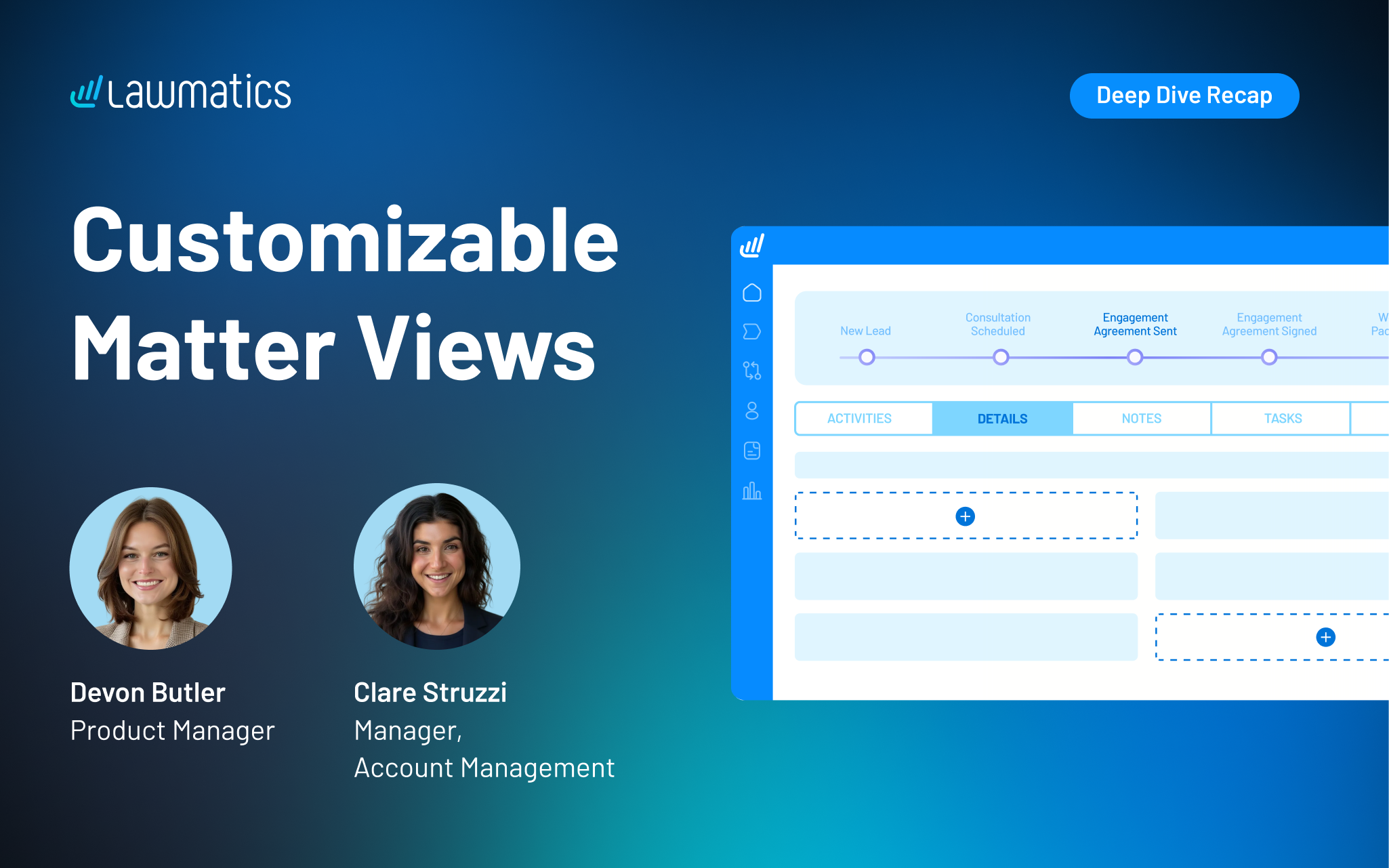
Matter profile pages can quickly fill with details, especially for firms managing multiple practice areas or using a lot of custom fields. Our recent platform update gave users the power to customize the layout of their Matter pages, making it easier to surface the right information, reuse fields without duplication, and create a more organized experience for every user at their firm.
In this Deep Dive webinar, Devon Butler, product manager at Lawmatics, and Clare Struzzi, who leads the account management team, walk through how these new customizable matter views work and how firms can tailor them to better match their workflows.
Time stamps of key takeaways
8:00 – A tour of the updated Matter page design
Devon kicked off the session with a walkthrough of the redesigned Matter page. Some of the key updates she highlights include a customizable side bar, reorganized sections within Matter details, and the ability to control the placement of fields on the page.
18:42 – How to tailor your Matter Details tab
The new Matter Details page gives you the flexibility to choose which fields appear on this page and how they’re organized. In this section, Clare and Devon showed how this flexibility allows teams to structure information in a way that aligns with their workflows, making day-to-day tasks easier to navigate.
27:15 – Setting up role- or practice-specific configurations
Devon demonstrated how firms can configure different matter views based on user role or practice area, ensuring each team member sees only what’s relevant to their work. This helps reduce noise, improve usability, and keeps confidential information on a need-to-know basis.
35:50 – Managing and maintaining your configurations
The team covered how to update, refine, and manage these configurations over time, including how changes apply across matters. This ensures firms can continuously optimize their setup as workflows evolve without needing to rebuild from scratch.
42:10 – Creating a more streamlined matter management experience
The webinar wrapped with a look at how these updates work together to create a more focused and efficient matter management experience. By organizing information more intentionally, firms can reduce friction, save time, and keep teams aligned around the details that matter most.
Webinar slide deck

Lawmatics, the leading CRM and client acquisition platform for law firms, today announced a new integration with SmartAdvocate, a leading case management provider trusted by litigation firms. The integration gives law firms a direct connection between lead intake and case management, removing the manual work that typically slows down the transition from signing a new client to beginning active case work.
Through this integration, firms using both platforms can sync matter details from Lawmatics to SmartAdvocate automatically or with a few clicks. Contacts, notes, documents, and custom fields transfer together, so teams can pick up new cases in SmartAdvocate with the full picture already in place.
For many firms, the gap between lead intake and case management is where small but costly problems take root. Details have to be re-entered manually, documents get uploaded twice, and information that was carefully collected during intake has to be tracked down again.
“When firms are growing and handling more leads, the last thing they need is a bottleneck between signing a client and starting the work. This integration with SmartAdvocate means that as volume increases, the process of getting a new case up and running stays fast and reliable, not slower and more error-prone,” said Matt Spiegel, founder and CEO of Lawmatics.
“This partnership reflects SmartAdvocate’s ongoing commitment to integrating with leading legal technology providers. By connecting Lawmatics’ feature set with SmartAdvocate’s comprehensive case management platform, we’re helping deliver a more complete solution that supports firms at every stage of the client journey,” said Allison Rampolla, senior vice president of sales & marketing at SmartAdvocate.
The integration is available now for customers of both Lawmatics and SmartAdvocate.
This launch continues Lawmatics' investment in building native integrations with the platforms law firms already depend on, so teams can connect their core tools without adding operational complexity. Lawmatics also continues to expand its platform capabilities, including breaking new ground in legal tech with QualifyAI, an AI agent that evaluates the quality of a firm’s lead as soon as it enters the system. From first touch to active case work, Lawmatics is building toward a future where every stage of the client acquisition process is built for efficiency and scale, without adding administrative burden.

Lawmatics, the leading CRM for law firms, today announced it has been named to G2’s 2026 Best Software Awards, placing #11 on the Best Legal Software list. G2, the world’s largest and most trusted software marketplace, reaches over 100 million buyers annually. Its annual Best Software Awards celebrate the world’s best software companies and products based on verified user reviews and market presence.
This ranking reflects a year of Lawmatics accelerating the shift to automated, AI-driven law firm operations, most recently with the full launch of QualifyAI, an AI agent that instantly identifies a firm’s best-fit leads based on firm-defined criteria and historical analysis. Lawmatics has also expanded its ecosystem with deeper practice management connections, including a new partnership with Filevine and a recently released integration with LEAP. Together, connections like these form a full suite of integrations that support firms within the systems they already rely on, from reception to practice management, helping reduce manual handoffs and streamline workflows.
“Law firms are being asked to move faster and deliver a better client experience with lean teams,” said Matt Spiegel, co-founder and CEO of Lawmatics. “Our mission is to unleash law firms’ full potential by putting trustworthy AI agents to work across intake and marketing. That means the right inquiries are identified early, the next step happens automatically, and teams spend less time on manual follow-up and more time doing high-value work. Implementing automation and AI as core infrastructure removes so much of the chaos and inconsistency that holds law firms back. Being recognized by G2 reinforces that our customers are gaining a competitive advantage from our approach.”
“As buyers increasingly shift to AI-driven research to discover software solutions, being recommended in the ‘answer moment’ must be earned with credible proof,” said Godard Abel, co-founder and CEO at G2. “Our Best Software Awards are grounded in trusted data from authentic customer reviews. They not only give buyers an objective, reliable guide to the products that help teams do their best work, but they’re also the proof AI search platforms rely on when sourcing answers. Congratulations to this year’s winners, including Lawmatics. Earning a spot on these lists signals real customer impact.”
Lawmatics was also recently awarded a Bronze Stevie© Award for Customer Service Department of the Year in the Computer Software - Up to 100 Employees category.

New lead intake breaks down when staff spend too much time on manual review. Some of those leads were never a fit for the firm in the first place, and in the time it takes to identify strong opportunities through manual review, those prospects might have already contacted another firm. When speed to lead is everything, firms can’t afford slow, inconsistent processes for qualifying and routing inquiries.
In this Deep Dive webinar, Devon Butler, product manager at Lawmatics, and Clare Struzzi, manager of the account management team, walk through how QualifyAI solves these problems in intake. They show how firms can design AI-driven qualification systems that surface the right leads earlier, automate next steps, and create a faster, more focused path from inquiry to conversion.
Time stamps of key takeaways
8:31 – Tailoring QualifyAI agents to your practice area
Devon shared how QualifyAI allows firms to design intake systems that reflect how they actually evaluate opportunities. Instead of treating every lead the same, firms can define what a strong case looks like in each practice area. QualifyAI compares leads to these criteria, as well as historical analysis of the firm’s cases, so the right matters rise to the top, weak fits are filtered out earlier, and intake teams spend their time where it counts.
34:52 – Using CoPilot to implement best practices
CoPilot is a chat interface that helps firms get started quickly with QualifyAI. Just type a prompt in CoPilot, and AI will automatically generate best-practice qualification criteria to match your practice area and jurisdiction. From there, you can refine the logic as needed, ensuring that your criteria are always up to date and consistent.
38:06 – How to trigger QualifyAI lead evaluations
Devon walked through how firms can automatically evaluate leads the moment key information is captured, typically through intake forms or matter creation. By connecting QualifyAI to workflows, intake teams can spring into action while a good lead is still fresh and ready to convert.
45:10 – Your lead has been qualified…now what?
Once a lead is categorized, firms can automatically take the right next step: prioritizing high-value opportunities, requesting consultations or agreements, referring out cases that aren’t a fit, or closing the loop on rejected inquiries. The result is a more focused intake process that follows up faster on strong leads and reduces time spent on the rest.
Webinar slide deck

Legal software is meant to reduce administrative work, not create more of it. But for many firms, disconnected systems still lead to duplicate data entry, manual handoffs, and wasted time between intake and case management. In this webinar, we walked through the new Lawmatics + LEAP integration and how it connects client intake, CRM, and marketing automation in Lawmatics with case management, documents, and billing in LEAP — so matters move forward without friction once a client is hired.
The session was led by Devon Butler, product manager at Lawmatics, and David Morgan, head of product for LEAP US.Together, they shared how the integration works, how firms can use it to create a more connected workflow from first contact through active case management.
Time stamps of key takeaways
4:13 – Defining CRM and practice management
Devon and David opened the session with a quick summary of the differences between a CRM like Lawmatics and practice management software like LEAP. Lawmatics handles intake, CRM, and marketing automation up front, while LEAP takes over once a client is engaged to manage cases, documents, billing, and accounting through the life of the matter.
9:25 – Live demo of the Lawmatics side
Devon walked through connecting LEAP inside Lawmatics, enabling the conversion sync, and configuring practice area and field mappings. She then demoed a full intake flow using a custom form, showed how matters are created in Lawmatics, and explained the different ways a matter can be converted or synced to LEAP.
22:37 – Live demo of the LEAP side
David opened the synced matter in LEAP to show how client details, matter type, related contacts, notes, and documents transfer from Lawmatics. He highlighted how attorneys can immediately begin work in LEAP using document automation, AI tools, workflows, accounting, and billing once the matter arrives.
26:50 – Q&A
The Q&A covered pricing and subscription structure, syncing existing matters, one-way sync behavior, multi-state limitations, and how custom forms and third-party tools like DecisionVault fit into the workflow.
Webinar slide deck

Lawmatics, the leading CRM for law firms, today announced a new official partnership with Filevine, an AI-native legal operating intelligence system designed for modern legal teams. The partnership deepens collaboration between the two companies and allows for direct API access, enabling faster integration performance, stronger capabilities, and a more reliable path from client intake to active case management.
The Lawmatics–Filevine partnership eliminates the need for repetitive manual data transfers and creates more dependable hand-offs throughout the client lifecycle. Law firms increasingly rely on multiple systems to run their practices, but when those systems don’t stay in sync, teams pay the price in duplicate work, inconsistent information, and avoidable operational risk. As firms grow, operational drag compounds quickly: small data gaps become delays, delays become bottlenecks, and bottlenecks reduce responsiveness.
“Our job as a platform is to make day-to-day work easier for the people running a firm,” said Matt Spiegel, co-founder and CEO of Lawmatics. “Partnerships like this at the product and engineering levels help teams within law firms stay aligned, and they help legal clients have a consistent and responsive experience from the word go.”
"We are excited that Lawmatics has become a Filevine Certified Integration Partner," said Erik Bermudez, VP strategic partnerships at Filevine. "This underscores Lawmatics' and Filevine's commitment to bring integrations to the client experience that deliver true value."
The integration is already live and available for customers of both Lawmatics and Filevine.
This partnership reflects Lawmatics’ continued investment in supporting firms through high-volume intake and day-to-day operations, including the release of QualifyAI to support faster, more consistent lead evaluation; event management and round robin lead assignment to coordinate schedules and reduce bottlenecks; and a new mobile app to keep work moving while legal professionals are away from their desks. Lawmatics also maintains SOC 2 Type II and HIPAA compliance to support firms that handle sensitive client information at scale, and it continues to grow a robust network of native integrations so firms can connect the core tools they already depend on without adding operational complexity.

Lawmatics, the leading CRM for law firms, today announced the full launch of QualifyAI, an AI agent designed to help law firms convert more inquiries into signed clients. Following a successful beta with active Lawmatics customers, QualifyAI is now available to all customers as an add-on feature.
For growing firms, lead intake is one of the highest-leverage points in the business — and one of the easiest places for potential revenue to leak. When responses are delayed or qualification standards vary from one team member to another, good-fit prospects slip away while poor-fit inquiries consume valuable time. As a result, marketing dollars are spent generating volume that doesn’t turn into cases that fit a firm’s preferred client profile. QualifyAI brings structure and consistency to this first critical decision, enabling firms to evaluate lead quality immediately and act with greater speed and precision.
“Lead intake can make or break a law firm’s growth,” said Lawmatics co-founder and CEO Matt Spiegel.
“If you’re slow to respond, don’t have that much information about a prospect, or don’t realize a lead isn’t a fit until you already have a contract ready, you’re simply not going to convert as many leads into paying clients.”
With QualifyAI, firms define their own qualification criteria — including accepted practice areas, disqualifiers, and key intake signals — and an AI agent applies that logic consistently across every evaluated inquiry. Each recommendation includes clear, explainable reasoning, giving intake teams visibility into why a lead was scored a certain way and allowing firms to refine their criteria over time. This feedback-driven approach helps firms continuously improve how leads are evaluated as the firm evolves, and instills confidence that the first decision made during intake is the right one.
“Our team used to spend hours reviewing leads one by one. Now, QualifyAI in Lawmatics does the first pass for us,” said Jay Stefani, managing partner of Levinson & Stefani and a Lawmatics customer who participated in the beta. “I don’t have to review every lead myself, and I know the system is qualifying cases the way our firm would. It saves time and helps us respond to good leads faster.”
QualifyAI works natively inside the Lawmatics platform, integrating directly with existing workflows and automations. Firms can use QualifyAI’s recommendations to automatically trigger routing, follow-ups, and next steps — ensuring high-quality leads are prioritized immediately.
The full launch of QualifyAI builds on a series of recent Lawmatics releases focused on helping law firms convert more qualified clients through automation and AI-powered speed to lead. To assist the transition from qualified lead to signed client, Lawmatics has also expanded its ecosystem with deeper integrations into legal practice management platforms such as Filevine, MyCase, and LEAP, with a SmartAdvocate integration coming soon.
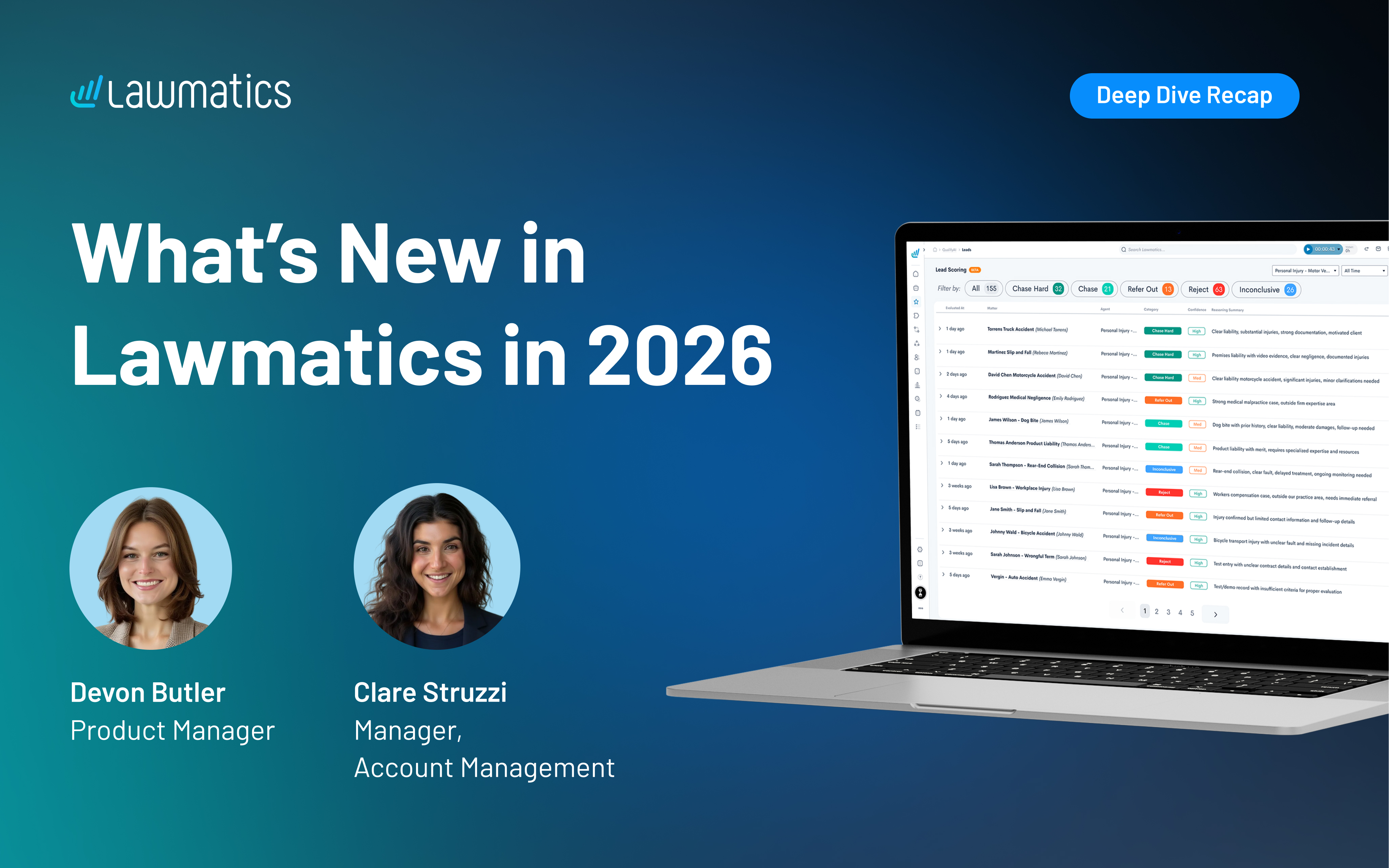
Law firms spend a lot of time on the same three problems: getting the right information from new leads, quickly signing prospects after they’ve been qualified, and knowing which marketing dollars are actually paying off. In this session, Product Manager Devon Butler and Account Management Lead Clare Struzzi walk through new and upcoming Lawmatics features that address each of those challenges, from QualifyAI lead evaluation to e-signature packets and upcoming Meta Ads tracking.
Time stamps of key takeaways
7:15 – Send one link for forms, signatures, and payment
16:13 – Add automation around packet completion
24:03 – Set up QualifyAI agents by practice area
31:25 – See the “why” behind each QualifyAI recommendation
45:11 – Track Meta Ads spend and leads automatically
Webinar slide deck

As we head toward the end of the year, our team revisited the most meaningful product updates of 2025 and how they’re reshaping the way firms work. All year long, our product work has centered on the same core goal: removing the obstacles that slow firms down. That’s meant bringing key information to the surface when teams need it, cutting out friction in the client journey, and giving staff clearer ways to build and maintain their processes across the platform.
Time stamps of key takeaways
8:15 – New, intuitive navigation
Devon walks through the redesigned navigation, which brings the most-used areas — like Matters, Pipeline, Calendar, Tasks, and Automations — into a cleaner, left-hand layout for quicker access. Reminders, emails, and other tools that had previously been scattered across the app now live in central, easy-to-find locations. The goal is simple: fewer clicks, clearer groupings, and a workspace that reflects how firms actually move through intake.
26:20 – Get key info faster with MMS
The team shows how firms can now receive MMS messages directly into Lawmatics, allowing clients to text photos or documents straight into their matter. It’s especially useful for practices like personal injury, where images of an accident or ID documents are often needed quickly.
31:18 – Manage your emails in one place
Email tools have been fully centralized, replacing the old model where templates lived in different corners of the app. Everything — from document send templates to automation emails — can now be created, edited, and organized in one place. Folders help firms manage growing libraries of emails, and each template can be applied across multiple documents without duplicate versions.
36:55 – Build and maintain automations with less effort
Devon and Clare highlight the refreshed automation experience, which makes appointment-based and date-based workflows easier to find, build, and understand. Relative timing is now built directly into each automation, and shared entry rules help firms avoid recreating the same logic dozens of times. Automation builds can also now be grouped in folders, similar to how you organize your email library.
45:18 – Additional highlights
The session closes with a handful of smaller but long-requested additions, including improvements to round-robin scheduling, password-protected forms, Message Center filters, auto-pay for billing, and color-coded appointment types to make dense calendars easier to read.
Webinar slide deck
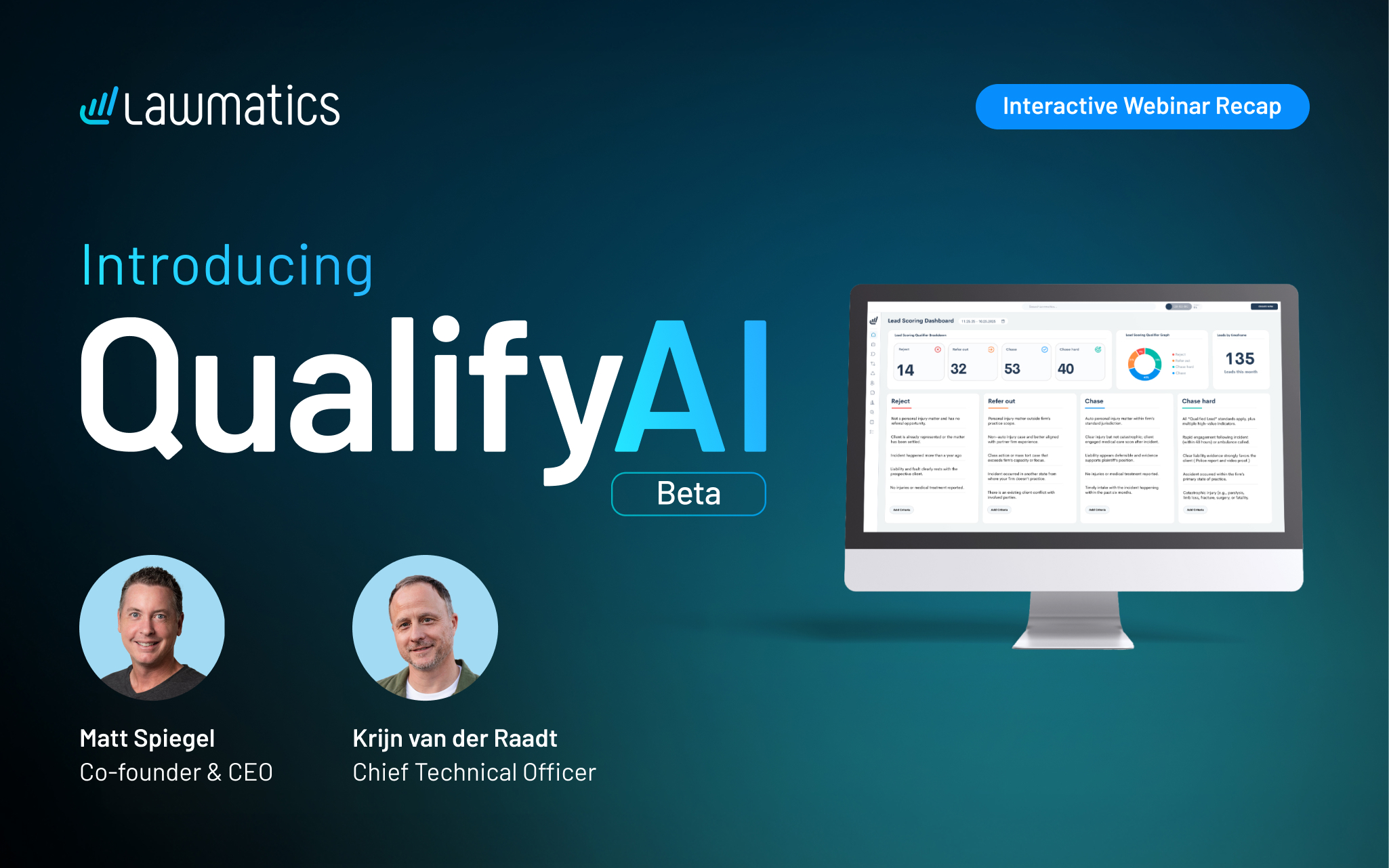
Sorting leads takes time, and too often that time goes to incomplete info, inconsistent review, and opportunities that stall. Deciding which cases to pursue, refer, or reject can slow intake and leave firms guessing about where to focus their efforts.
QualifyAI is Lawmatics’ newest beta feature, bringing artificial intelligence into the intake process in a way that’s practical, transparent, and built for law firms. Using your firm’s own data, it evaluates new leads and recommends next steps with clear reasoning, helping teams move faster and focus on the cases that matter most.
This session, hosted by Lawmatics co-founder and CEO Matt Spiegel and CTO Krijn van der Raadt, pulls back the curtain on the new beta feature and how it fits into the Lawmatics platform. Matt shares Lawmatics’ vision for building AI that supports real firm workflows, while Krijn demonstrates how to create a scoring model, review recommendations, and fine-tune results with feedback.
Time stamps of key takeaways
3:50 — Lawmatics’ approach to AI
Matt opens with Lawmatics’ broader vision for AI and why it’s critical to build automation that’s targeted and relevant. Rather than bolt-on tools, he explains, AI should live within the platform itself: aligned to real law firm workflows and transparent about how decisions are made.
14:48 — Setting up your lead scoring model
To kick off the demo, Krijn walks through how to create a qualification profile using the data already in your account. At setup, the system reviews past leads, pipelines, and forms to suggest criteria for what defines a qualified lead in each practice area. From there, QualifyAI references those firm-defined standards to recommend next steps — whether to pursue, reject, or refer a matter.
21:40 — How QualifyAI makes its recommendations
Next, Krijn shows how the tool evaluates incoming leads in real time. Each recommendation includes a confidence level and a short explanation of why — factors like case type, location, or claim details — so firms can see the reasoning before deciding how to proceed.
28:00 — Giving feedback to your AI model
Users can review QualifyAI’s recommendations, mark them as accurate or off-base, and add notes for context. That feedback feeds directly back into the system, refining future results. Krijn demonstrates how updating a single “Chase” call to “Refer Out” instantly adjusts how similar leads will be handled going forward.
40:00 — Q&A
The session wraps with questions on multi-practice support, privacy safeguards, and how QualifyAI fits into the client experience. Matt and Krijn also share a glimpse of what’s next for AI in Lawmatics, including tools designed to further enhance intake and lead management.
Webinar slide deck
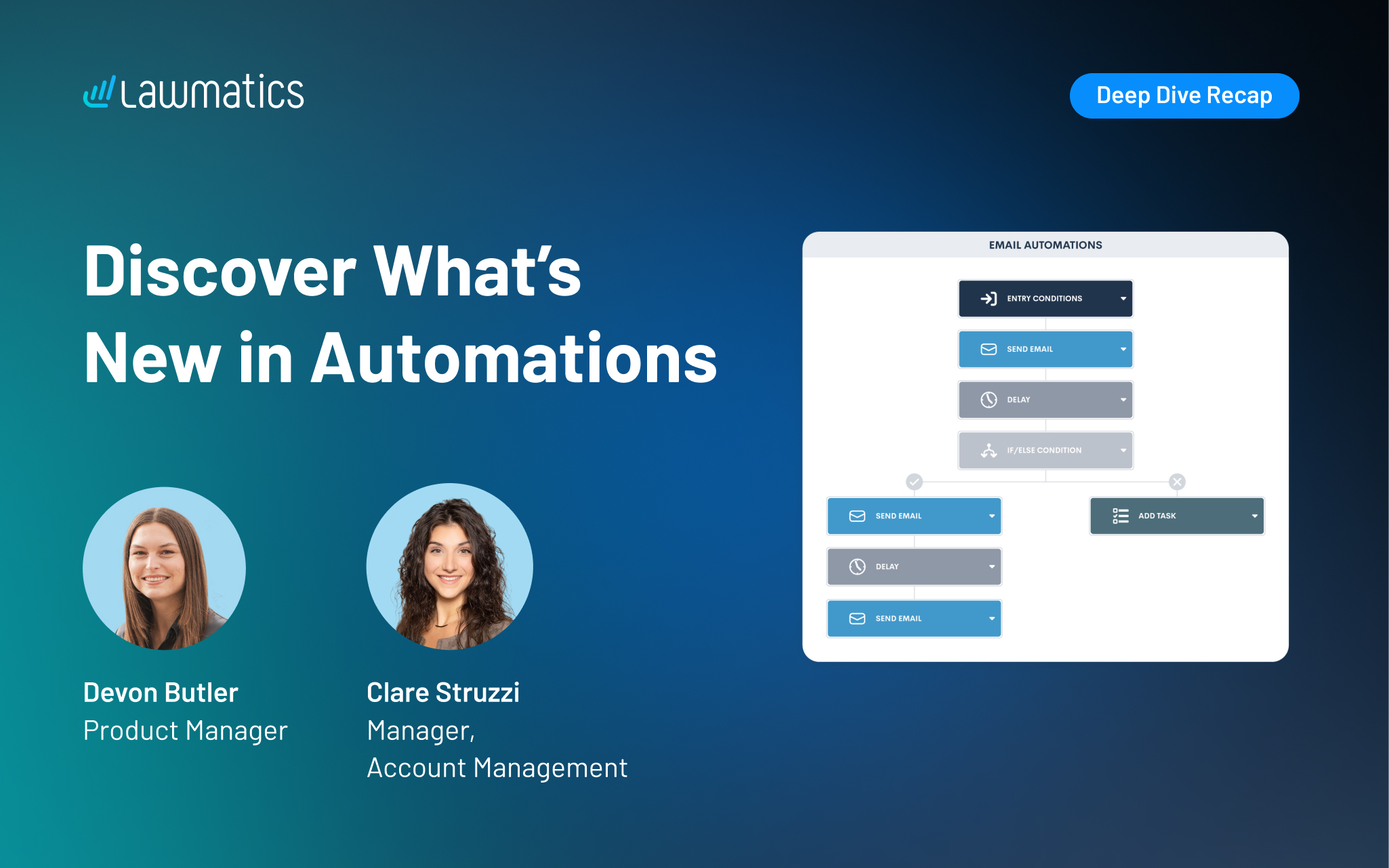
About the session
Behind every great client experience is a system quietly keeping things on track. The newest automation updates in Lawmatics build on that foundation, making it even easier to build and manage their automated workflows.
In this session, Devon Butler and Clare Struzzi walk step-by-step through what’s new. They cover trigger-based automations, appointment workflows, shared entry rules, and a simple way to organize everything in folders. Together, these improvements give firms even more control, flexibility, and time back in their day.
Webinar slide deck
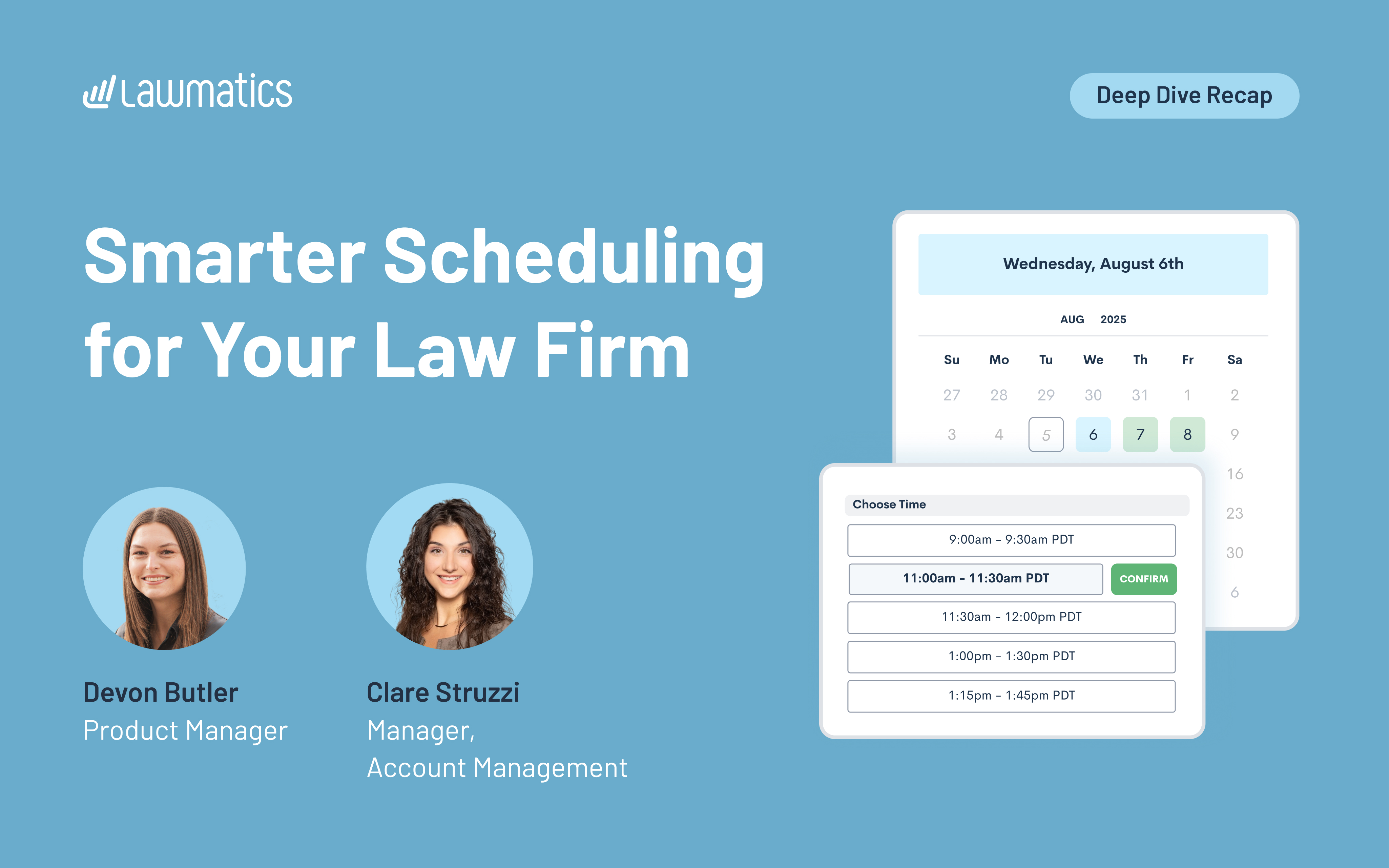
Booking a consultation might seem like a small step in the client journey, but it’s often where momentum is either gained or lost. When scheduling feels smooth, clear, and personalized, it sets the tone for everything that follows.
This month’s Deep Dive webinar focused on how to use Lawmatics to streamline scheduling, reminders, payments, and event registrations. Hosted by Product Manager Devon Butler and Clare Struzzi, manager of the account management team at Lawmatics, the session covers everything from customizing availability to collecting payments through booking forms.
Time stamps of key takeaways
8:19 – Appointment scheduling options
Devon walks through how to set up your calendar, including working hours, buffer times, and rolling booking windows. She also explains the difference between general availability and appointment-specific settings. Clare clarifies how two-way sync works and when to use appointment-type-specific rules to better control your calendar.
21:51– Using appointments with forms
This section focuses on how clients book appointments through forms. Devon shows how to embed booking blocks in custom forms, with options like selecting hosts, adding additional attendees, and applying conditional logic. Clare shares examples of firms using location- or attorney-based fields to dynamically display the right booking options.
33:20 – Setting up confirmations and reminders
Next, Devon and Clare show how to create personalized confirmations and reminders using appointment-specific emails or texts. They walk through how to assign emails based on appointment type, location, or practice area, and explain when to use general messages vs. detailed ones with merged info like Zoom links or physical addresses. They also break down the differences between confirmation and reminder timing.
40:25 – Collecting payments for appointments
Devon demonstrates how to add payment fields to forms using LMPay, including setting fixed fees and applying conditional logic based on form answers. Clare explains common use cases, like toggling payment fields based on consultation type or practice area. This lets firms collect fees at the time of booking and avoid chasing payments later.
46:23 – Building and managing events from within Lawmatics
Webinar slide deck
Devon explains how to create and manage group events, like webinars or workshops, directly in Lawmatics. She walks through setting up event types, adding registrants manually or through forms, applying registration caps, and using automations and tags to track registrants or trigger follow-ups.