



News & Updates


Will AI replace lawyers? Artificial intelligence (AI) will not replace lawyers, but it is fundamentally changing how they get legal work done. As AI becomes more embedded in research, document review, and client intake, firms are increasingly automating many traditional legal tasks. This article examines whether AI can truly replace lawyers, which legal functions are most affected, how law firms are using AI today, and what these trends mean for associate attorneys navigating an AI-driven legal industry.
AI is already reshaping how your firm gets work done. It’s changing how you handle research, drafting, intake, billing pressure, and the future of associate work.
For many firms, the real question is how to use AI without disrupting the way they already work. Firms are figuring out where AI adds value and where attorneys still need to stay hands-on, while navigating how these tools change the work without changing who’s ultimately responsible.
In this guide, we’ll examine where AI affects legal tasks, why associate attorneys feel the most pressure, how firms are using AI today, and what the next 12-24 months are likely to bring.
Will AI Replace Lawyers or Just Change the Job?
The short answer is no: AI will not replace lawyers. What it can do is automate or accelerate certain tasks lawyers have traditionally handled manually, and that distinction matters.
When people ask, "Will lawyers be replaced by AI?" or "Can AI replace lawyers?" they are usually reacting to how quickly these tools have improved at summarizing information, reviewing documents, and generating draft language.
But those capabilities are not the same as practicing law. Lawyers are still responsible for legal judgment, ethical obligations, advocacy, and client outcomes. And courts, clients, and regulators continue to hold licensed attorneys accountable.
A better question is: “Which parts of your work is AI already automating, and what does that mean for you?”
Why Associate Attorneys Feel Most at Risk
If any group in the profession feels exposed by AI, it is associate attorneys. Associates often spend a large share of their time on high-volume, repeatable work:
- Document review
- Contract comparison
- Drafting from templates
- Follow-up tied to matters in progress
Those are also the kinds of tasks AI is taking on.
It’s no surprise that many associates feel pressure as these tasks shift. Many associates are already under pressure to be faster, more accurate, and easier to justify to cost-conscious clients.
But "most exposed" does not mean associates are the most likely to be replaced. It means the tasks that make up their role are among the first to be reshaped by AI, while expectations for more substantive work rise earlier.
Legal Tasks AI Can Replace or Automate
AI is most effective at handling structured, repetitive, text-heavy, and rules-based work that slows your team down.
Legal research and case summarization
AI is already changing the first layer of legal research. Attorneys can use it for a faster first pass to:
- Scan cases, statutes, and regulations quickly
- Summarize large volumes of text
- Highlight recurring themes
- Spot potential issues faster
That means less time gathering information and more time testing whether the output is accurate, relevant, and persuasive. These are the kinds of outputs that actually move cases forward.
Contract review and document analysis
Contract review is another area where AI can help. AI can be useful in due diligence, compliance review, procurement workflows, and any matter involving large volumes of contracts or standard language, including:
- Identifying clauses
- Comparing language across document sets
- Flagging deviations from standard terms
- Surfacing inconsistencies that manual review might otherwise miss
Many firms are also exploring legal document automation software to streamline repetitive drafting and review tasks while keeping attorneys in control of the final output.
Intake, qualification, and administrative work
Some of the fastest wins come from automating intake and follow-up with predefined criteria, so no potential client gets lost. These are areas where automation and AI can reduce a major administrative burden:
- Client intake
- Lead qualification and routing
- Follow-up
- Automated scheduling and reminders
Legal Tasks AI Cannot Replace
For all the attention on automation, there are still core parts of legal practice that AI cannot replace.
AI cannot replace certain legal tasks
Legal work often involves high-stakes decisions where the details matter, and the right call isn’t always obvious. Many matters require attorneys to navigate uncertainty, emotional dynamics, and practical risk in ways that go beyond pattern recognition.
Lawyers do more than surface information. They interpret ambiguity, weigh tradeoffs, and make recommendations when the answer is not obvious. AI can help organize information and support analysis, but legal judgment still depends on attorneys.
Advocacy and negotiation
Legal advocacy is deeply human. Whether in court, at a mediation table, or in a negotiation, persuasion depends on judgment, timing, credibility, listening, and adaptation.
Strong advocates read tone, pressure, resistance, leverage, and opportunity. AI can assist with preparation, but it cannot respond to the human dynamics that shape negotiation and advocacy in the moment.
Ethical responsibility and accountability
The biggest boundary in legal practice around AI use is accountability. Lawyers have ethical duties to clients, courts, and the profession, including competence, confidentiality, candor, supervision, and professional judgment.
Those duties still rest with attorneys. They must verify the work, protect client information, exercise judgment, and stand behind the advice they give.
How Law Firms Are Using AI Today
Law firms are using AI in several practical ways today. It supports legal work by improving intake and connecting workflows inside a legal client relationship management (CRM) system.
AI as an assistant, not a replacement
In many firms, AI is being used to accelerate research, support drafting, improve consistency, and reduce time spent on routine tasks. It helps attorneys work more efficiently, but they still have to review outputs, make decisions, and stand behind the final work product.
AI in client intake, lead qualification, and routing
One of the clearest applications of AI for law firms is in client intake. AI can help firms improve the quality of information they collect, apply qualification criteria more consistently, and move leads through the right next steps with less manual effort.
For example, AI can:
- Evaluate urgency: Identify inquiries that may need faster attention based on timing, case type, or stated circumstances.
- Screen for practice fit: Help determine whether a matter aligns with the firm’s services before teams spend time reviewing it.
- Assess lead quality: Apply defined qualification standards consistently to help teams focus on stronger opportunities. Tools like QualifyAI support this process by helping firms automate intake screening and matter qualification without crossing into the realm of legal advice.
- Collect intake information: Use custom forms and structured workflows to gather client details and create more complete records from the start.
- Route inquiries intelligently: Sort leads by priority, stage, or next step and direct them to the right person or process.
- Automate follow-up: Trigger responses, reminders, and outreach to ensure promising leads do not stall due to delayed communication.
- Support scheduling: Move qualified leads into consultations with less back-and-forth and fewer manual touchpoints.
- Reduce administrative drag: Improve upstream intake so attorneys spend less time on triage and more time on billable work.
AI paired with legal CRM workflows
AI becomes more useful when it works inside a broader system. That works best when legal CRM software and legal software integrations connect intake, follow-up, and client information into a single centralized system.
When intake data flows directly into a centralized CRM, follow-up can happen automatically, and attorneys can work from more complete, organized information.
What Will Actually Change for Associate Attorneys in the Next 12-24 Months
The table below illustrates which legal tasks firms are already automating, which are likely to change in the next 12-24 months, and which still depend on human judgment.
| Legal task category | Examples of tasks | Level of AI impact | Timeline |
|---|---|---|---|
| Intake and administrative work | Intake data collection, lead qualification, follow-up, and scheduling | High | Already happening |
| Legal research and summarization | First-pass case law research, statute summaries, issue spotting | High | Already happening |
| Contract review and analysis | Clause identification, risk flagging, document comparison | High | Already happening |
| Drafting standard legal documents | Routine motions, template-based agreements with attorney review | Medium | 12-24 months |
| Litigation prep and discovery support | Document organization, evidence tagging, timeline creation | Medium | 12-24 months |
| Intake decision support | Applying firm-defined qualification rules without legal advice | Medium | Already happening |
| Legal judgment and strategy | Case strategy, risk assessment, application of law to facts | Low | Unlikely to be replaced |
| Client counseling and advocacy | Client advice, negotiation, courtroom advocacy | Low | Unlikely to be replaced |
| Ethical and professional accountability | Malpractice liability, ethical judgment, licensing responsibility | None | Not replaceable |
Fewer low-value tasks, higher expectations
Associates will likely spend less time on intake administration, document work, and other repetitive tasks that can be standardized. As a result, firms may expect associates to handle more substantive work earlier.
As routine work takes up less of the role, firms may place greater value on analytical skills, precision, and the ability to take on client-facing responsibility.
Faster feedback loops
AI-assisted systems can make performance more visible. When workflows are digitized and standardized, firms can see turnaround times, follow-up completion, response rates, matter progression, and other indicators sooner.
Faster feedback loops help strong associates stand out while also making expectations around consistency and execution clearer across the board.
Increased leverage for AI-literate associates
The associates who benefit most from AI will be the ones who adopt it quickly and use it responsibly. That starts with understanding how to prompt, review, verify, and refine outputs. It also involves knowing where automation adds value and where it introduces risk.
The real advantage comes from turning saved time into stronger work, not just faster work.
The real risks of AI in legal practice
AI can create leverage, but only if you understand the risks that come with it. Key concerns include:
- Hallucinations and inaccurate outputs: AI can produce confident-sounding errors, including fabricated citations, misread authority, or oversimplified legal distinctions. In legal work, every output requires attorney verification.
- Confidentiality and data privacy: Firms must handle client information carefully, and not every AI tool is appropriate for legal workflows. Tools can create risk when firms do not understand how data is processed, stored, or reused. That is why firms need clear policies, controlled workflows, and tools built for legal use cases.
- Unauthorized practice of law: AI cannot independently provide legal advice. Firms can use AI to support intake, qualification, and internal workflows, but if implementation crosses into unsupervised legal advice, the risk becomes regulatory exposure.
- Over-reliance and skill atrophy: Attorneys still need to build judgment, pattern recognition, and analytical strength. If AI is responsible for too much thinking, it can result in weaker legal reasoning over time.
How Associate Attorneys Can Future-Proof Their Careers
The strongest position is knowing where AI supports your legal work and where your judgment still matters most.
Focus on high-judgment legal work
The more your value depends on strategy, counseling, nuanced analysis, negotiation, and client communication, the harder you are to replace. Look for opportunities to build skills in asking better questions, improving communication, and taking ownership of recommendations.
Become AI-literate, not AI-dependent
Lawyers do not need to become AI experts. They need to understand how AI fits into their day-to-day workflows.
Learning how to evaluate outputs, identify weak reasoning, spot missing context, and supervise automated processes will better equip you to leverage AI without becoming dependent on it.
Use AI to protect billable work
AI should protect time for more meaningful work. When firms automate low-value administrative steps, intake bottlenecks, or repetitive drafting processes, you can focus your time where it adds the most value: analysis, advocacy, and client service.
The Future of Law in an AI-Driven Legal Profession
AI isn’t changing who’s responsible for legal work. It’s changing how efficiently you can get that work done.
For attorneys, AI is most useful when it automates administrative tasks and streamlines intake, follow-up, and qualification, allowing them to spend more time on substantive legal work.
As a legal CRM, Lawmatics helps firms automate intake, follow-up, and qualification through custom automations. You receive better information and fewer administrative bottlenecks, so you can spend more time practicing law.
To see how AI-supported intake fits into a modern Legal CRM, request a demo.
FAQ
Will AI replace lawyers entirely?
No. AI can automate parts of legal work, but it cannot replace legal judgment, ethical accountability, or advocacy. Lawyers are still responsible for advising clients, applying the law to specific facts, and standing behind the decisions and filings.
Are associate attorneys more vulnerable to AI?
Associate attorneys are more affected by AI-driven task automation because early-career roles often include more routine, document-heavy, and process-driven work. With AI, the structure of their work is changing, with more emphasis on analysis, judgment, and client-facing readiness.
Can AI practice law on its own?
No. AI cannot practice law independently or provide legal advice without attorney oversight. It can support research, intake, and administrative workflows, but licensed attorneys are still responsible for verifying outputs, protecting client information, and exercising professional judgment.
What legal work is safest from AI?
Legal work that depends on strategy, advocacy, negotiation, and client counseling is the least likely to be automated. These responsibilities require judgment, persuasion, relationship management, and the ability to respond to nuanced facts and human dynamics.
Should lawyers be worried about AI?
Lawyers should prepare for change, but not assume AI is replacing the profession. Firms and attorneys who learn how to use AI responsibly will be in a stronger position than those who ignore it.
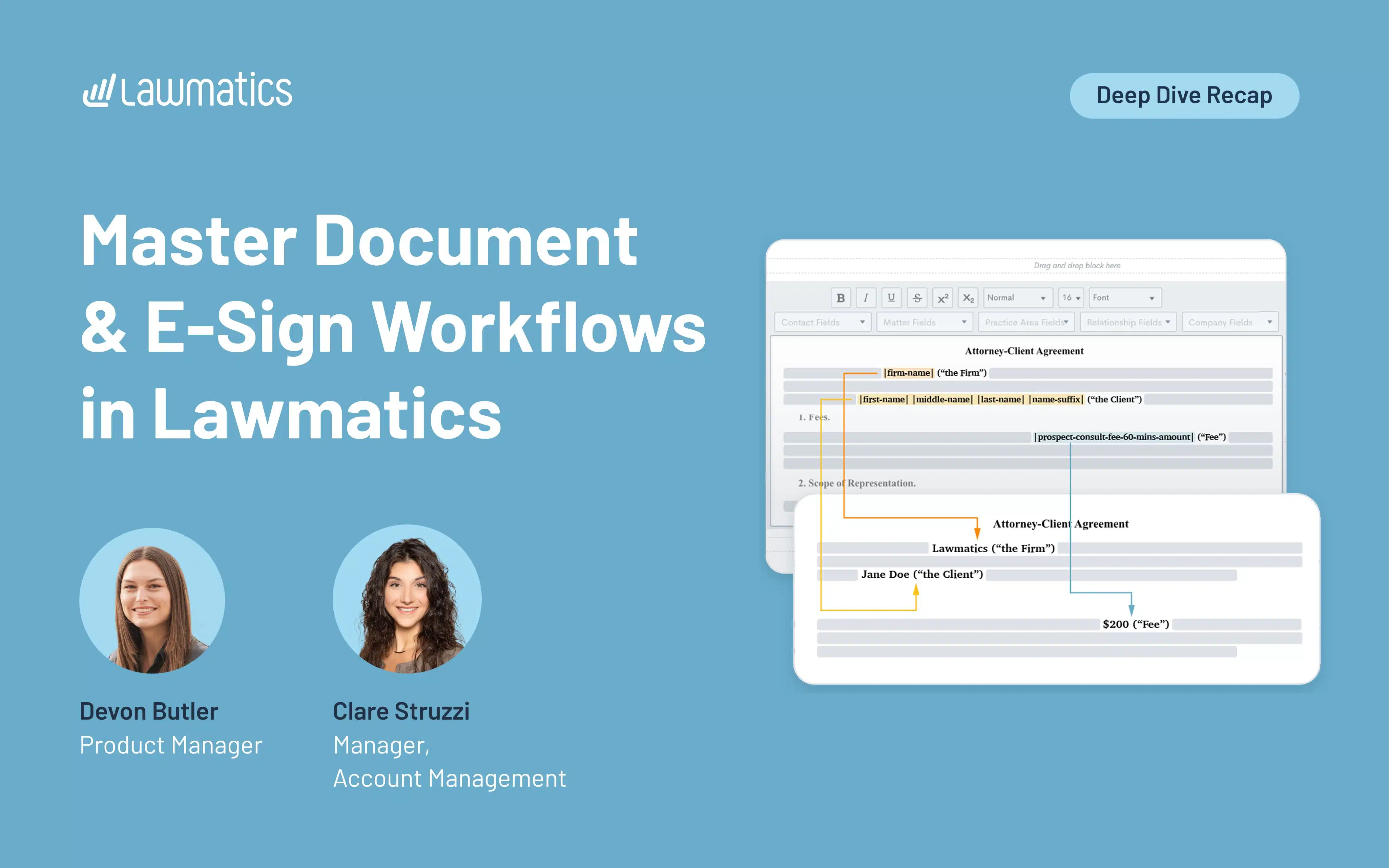
Documents are a critical part of any legal intake, but they’re also one of the easiest places for things to get messy. Whether it’s missing information, outdated templates, or slow turnaround times, small issues can add up fast. That’s why it’s so important to have a document workflow that’s tightly connected to the rest of your process, especially when it comes to forms, automations, and e-signatures.
Hosted by Product Manager Devon Butler and Clare Struzzi, manager of the account management team at Lawmatics, the session walks through how to use Lawmatics to build dynamic documents, pull in the right data, and automate the intake process all the way through to a signed agreement.
Time stamps of key takeaways
7:15 – Creating a new document
Devon walks through how to build a document using the Start Fresh option in Lawmatics, which is the recommended editor. She covers everything from adding headers and footers to inserting merge fields and signature blocks. Clare also shares tips on how to handle formatting, like where to place page breaks and how to use conditional logic blocks effectively based on practice area, without needing separate documents for each.
21:00 – Customizing content with merge fields
In this section, Devon explains how merge fields pull in data from both the contact and matter to personalize each document. She shows examples like merging in retainer amounts, scope of representation, and current dates. Clare also highlights how firms often use consultation notes forms to pre-fill these fields, so everything’s ready to go by the time a document is sent.
29:32 – Sending forms / merging data from forms
Devon and Clare walk through how forms and documents work together. Using a form lets you collect the exact information needed to populate an e-signature doc, things like fees, payment plans, or incident details. They also cover when to set fields as required and explain when to trigger sends in an automation, as opposed to manually reviewing before sending.
36:18 – Internal vs external forms
Not all forms are built the same. Devon explains that internal forms can’t be sent via automation — even to internal users — so marking a form as external is key when it's part of a workflow. They also share how to pre-fill fields like lead attorney using hidden defaults, and how to time form delivery (e.g., sending to a lead attorney 10 minutes before a consultation) using appointment-based automations.
Webinar slide deck

At first glance, law firm profitability looks healthy: average U.S. firm revenue jumped 12.5 percent in 2024 on the back of aggressive rate increases. Yet under the hood, lawyers were actually less productive — worked‐hour productivity fell 2.4 percent in early 2025.That gap between rising top-line numbers and slipping efficiency signals a deeper problem. Profits are climbing largely because rates keep rising, not because firms have solved the time drain of manual intake, back-office work, and slow client follow-up. Left unchecked, those hidden leaks hinder growth and invite price pressure when markets cool. Legal workflow automation is how forward-thinking firms plug the holes, and it no longer requires enterprise-size budgets or year-long IT projects.
Workflow bottlenecks drain revenue in legal practices
When billing rates expand faster than demand, every unbilled hour hurts twice: it’s lost revenue and a weaker justification for premium pricing. The latest Thomson Reuters Law Firm Financial Index shows firms increasing rates by more than 7 percent while utilization slipped — evidence that “work smarter” must complement “bill higher.” Automation addresses the root cause by reclaiming hours now sunk into tasks software can finish in seconds.Automation isn’t just an internal timesaver; it’s a competitive weapon at the very first touchpoint. In 2024, 28 percent of firms replied to new web leads within five minutes — and they’re winning business from the rest, because 78 percent of consumers hire the first company that responds. Even more startling: 27 percent of firms never answer at all. Every silent inbox or voicemail is a profit leak that no hourly rate can patch — meaning relying on manual processes for these tasks puts profit at risk.
Legal workflow automation strategies for growing law firms
Think of automation as a relay race that starts the instant a prospect raises their hand and doesn’t stop until the invoice is paid. Once you’ve captured a lead, the clock is ticking. Every manual handoff, delayed reply, or missed follow-up costs time and potential revenue.Automation helps you capture value at every step without creating more work for you or your team. Below are five points along that track where software can shave hours, rescue opportunities, and convert those savings into profit.
Client intake automation
When a prospect submits an inquiry, automation can immediately send a personalized response, offer a consultation link, and trigger internal tasks. You’re responding faster and more consistently, without anyone lifting a finger.
Lead nurturing that runs in the background
Even interested leads often need multiple touches. With automation, you can queue up reminders, educational emails, and check-ins that are paced and personalized based on each lead’s behavior. It keeps the relationship warm while you focus on your caseload.
Workflow triggers
Once a lead converts, automation can route tasks to the right team members, assign deadlines, and even launch templated documents. No more reminders slipping through the cracks.
Proactive client updates without playing phone tag
Automation can schedule regular status emails, appointment reminders, and even post-engagement review requests. You keep clients informed and reduce time spent fielding “just checking in” calls.
Billing & collections
Batch invoices, scheduled reminders, and embedded payment links shorten “days-to-cash” while freeing staff for higher-value work.
AI tools that integrate into real workflows
Targeted generative-AI tools now save lawyers about four hours a week, worth roughly $100,000 in additional billables per attorney each year. That gain is only realized when AI outputs feed directly into automated workflows rather than sitting in a download folder.
Quick action plan to implement legal automation
You don’t need to automate everything at once to see results. In fact, the best place to start is often the part of your workflow that frustrates you the most. Maybe it's leads going cold before anyone follows up. Maybe it's the back-and-forth of scheduling. Whatever it is, that pain point is a signal.Here’s a straightforward way to get started without overhauling your entire system:
- Map one process. Choose a workflow you use often, like intake or consultation scheduling. List out each step from start to finish.
- Spot the friction. Look for repeat tasks, delays, or steps that often get missed. Tasks like follow-ups are the best candidates for automation.
- Set a clear trigger. Decide what should kick things off. A form submission, a status update, or a calendar booking are all good starting points. An automation with a “If form received → send retainer packet” trigger beats a calendar reminder every time.
- Link your steps. Make sure each trigger leads to a meaningful action, like sending an email, assigning a task, or updating a record.
- Check your results. After a few weeks, look at what changed. Are you saving time? Are clients moving through faster? Use what you learn to refine the process.
Start small, start simple, and focus on progress over perfection. The results will speak for themselves.
Key metrics to measure legal automation ROI
If you can’t track it, you can’t improve it. Make sure your platform surfaces these metrics on one dashboard so you can course-correct fast:
- Response-to-consult time: Minutes from lead submission to first meaningful reply. Cutting this below five minutes correlates with a double-digit jump in sign-up rates.
- Lead-to-client conversion rate: The percentage of inquiries that become paying matters. Automation lets you test messages and pinpoint which sequences close best.
- Utilization rate: Billable hours divided by total hours worked. When routine tasks are automated, more of each day turns into revenue-generating work.
- Collection cycle: Automated reminders trim weeks off receivables, turning “profit on paper” into cash in the bank.
Track these KPIs monthly; the compounding effect makes even small gains hard to ignore at partner meetings.
See what automations could make your firm more profitable
Profit growth shouldn’t rely solely on ever-higher rates. Real, sustainable margin comes from reclaiming time and capturing clients you already paid to attract. Book a Lawmatics demo to watch an automated intake and follow up flow live. Because one thing more expensive than automation is the profit you miss without it.
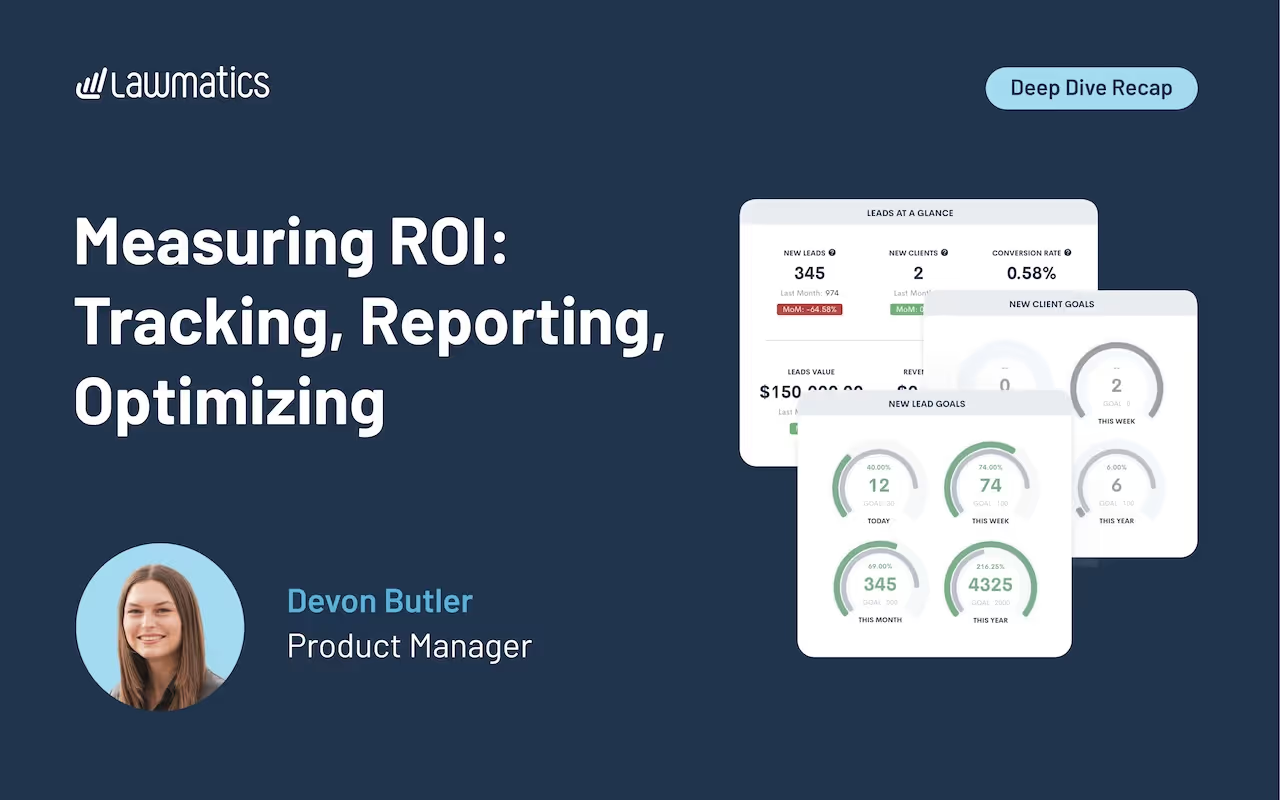
Firms spend serious time and money bringing in new leads, but when it comes to knowing which efforts actually drive revenue, the picture is often fuzzy. Without reliable source tracking and clear reporting, it’s hard to tell where your marketing budget is paying off and where it’s getting wasted.In this month’s Deep Dive, Product Manager Devon Butler walks through how to set up and optimize marketing attribution in Lawmatics, from source creation to custom ROI reports and dashboards that help you make smarter, faster decisions.
Time stamps of key takeaways
8:13 – Set up marketing sources to start tracking
Devon begins in the settings page, where she demonstrates how to create a clean hierarchy of sources and campaigns. She highlights the importance of tracking costs for each source, from digital ads to referrals. This setup lays the foundation for accurate attribution and reporting later in the client lifecycle.
14:49 – How sources are assigned and tracked
Once sources are configured, Lawmatics automatically assigns them to new leads using form UTMs, CallRail tracking, or embedded snippets on your site. Devon breaks down how attribution is preserved throughout the client journey, from first click to hire. She also outlines common missteps, like missing UTMs or unlinked forms, that can cause breakdowns in source tracking.
24:17 – Monitoring ROI
The ROI Tracker gives a side-by-side view of each source’s leads, hires, revenue, spend, and return. Devon explains how the data flows directly from the marketing source setup and shows examples of real performance breakdowns. This report helps firms understand which channels are producing value and which ones aren’t.
36:18 – Creating a custom report and dashboard
To better understand what’s driving ROI, Devon builds a custom report that breaks down lead conversion by salesperson. She uses that as one example, noting that you can report on anything from practice area performance to time-to-hire. Once created, reports can be added to a dashboard so your most important metrics are always front and center, making it easy to track trends, spot issues, and share insights with your team.
Webinar slide deck

As law firms pour ever-larger sums into digital marketing and client acquisitioßn, growth hinges on more than a bigger budget — it hinges on knowing exactly which efforts drive revenue. Simply having data isn't enough; what matters is connecting data points so you see the story behind every lead and every dollar.In our latest webinar, Reporting Essentials: The Key to Unlocking Your Firm’s Growth, we were joined by Martin Kravchenko, co-founder and CTO of Swans, who showed exactly how to build that visibility. We walked through the foundations of airtight marketing attribution, intake analytics, and firm-wide dashboards that help achieve sustainable profitability.
Time stamps of key takeaways
09:11 — Why reporting matters now
Johnny explains how rising digital ad spend and AI search tools have raised the bar for lead response. Firms that know exactly which campaigns convert — and how fast staff follow up — re‑allocate budget faster and win the race to “first meaningful contact.”
10:52 — Marketing attribution fundamentals
Martin breaks down first‑touch vs. last‑touch attribution, common pitfalls (mixing “lead source” with “contact method”) and the must‑have data points: lead source, campaign, and cost. Automated capture with UTM parameters and call‑tracking numbers beats relying on what callers say every time.
15:25 — Metrics that move the needle
From cost‑per‑qualified‑lead to speed‑to‑lead, conversion rate, pipeline value and ROI, Martin maps the formulas and target benchmarks that let owners forecast revenue and spot bottlenecks weeks, not months, before they hit the books.
22:34 — Building a reporting‑ready foundation
Johnny walks through the mechanics: mirror ad campaign names in your CRM, require drop‑down fields (never free‑text) on intake forms, and sync case‑value updates back from case management so lifetime‑value and ROI reports stay accurate.
32:59 — Implementation checklist & real‑world wins
Two client case studies show the pay‑off: a 25‑person PI firm that replaced weekly spreadsheet gymnastics with an hourly data pipeline and live dashboard, and a 15‑person PI/Crim‑defense shop that cut reporting time by 75 % and hired two new attorneys by doubling down on the channels the data said were working.
Webinar slide deck

SAN DIEGO, July 15 — Lawmatics announced today that it has been named a winner in the 2025 Sammy – Sales and Marketing Awards, presented by the Business Intelligence Group. The company was listed in the Growth Catalyst category for its impact in transforming how law firms attract, retain, and serve clients.“Sales and marketing are now operating as one, which means success demands not just great ideas or great tools, but a team that brings both together,” said Russ Fordyce, CEO of the Business Intelligence Group. “The 2025 Sammy – Sales and Marketing Awards honor those making that vision real. We’re excited to recognize Lawmatics for its leadership and results.”Lawmatics is the legal industry’s leading growth platform, combining client intake, CRM, marketing automation, and data reporting into one intuitive system. Designed specifically for law firms, the platform empowers practices to streamline operations, deliver better client experiences, and drive more profitable growth. With a steadfast commitment to continuous innovation, the platform recently expanded its offerings with tools to help firms handle high lead volumes and sensitive case details, from MMS messaging to SOC 2 Type 2 and HIPAA attestations.“Lawmatics shows what’s possible when a platform is designed for growth: thousands of firms leveraging millions of automations to eliminate countless hours of admin work,” said Matt Spiegel, co-founder and CEO of Lawmatics. “We’re excited to keep building on that foundation, and the AI enhancements on our roadmap have a tremendous potential to free up even more time for legal professionals to reinvest in their clients.”Lawmatics previously won the Sammy for Product of the Year in the CRM category in 2023 and 2024. Earlier this year, Business Intelligence Group also recognized Lawmatics for excellence in customer service with the Bronze Stevie Award. Most recently, Lawmatics earned a spot on G2’s Best Legal Software list in their 2025 Best Software Awards.

Intake is often the first real interaction a prospective client has with your firm — and the experience matters. The right form doesn’t just collect information; it sets the tone, guides the conversation, and lays the groundwork for everything that follows. That’s why building a single, thoughtful intake form can have an outsized impact on your workflow, your team’s efficiency, and how clients experience your brand from day one.To dig into what that looks like in practice, Lawmatics Product Manager Devon Butler teamed up with Clare Struzzi from our account management team for this month’s Deep Dive webinar. They covered everything from the fundamentals of form building to more advanced features like conditional logic and automation triggers.
Time stamps of key takeaways
7:00 – Custom form builder
Devon kicks things off with a walkthrough of the custom form builder, starting with the basics like naming conventions and form types. She also explains the different field types you can use (standard, contact, matter, company) and how to think about them when building a form that fits your intake process. The focus here is on creating something that’s both flexible and easy for your team to use consistently.
15:41 – Adding advanced elements
Devon and Clare go over enhancements like booking blocks, file uploads, and general form-only fields. General form-only fields live only on the form and don’t clutter up your matter pages — great for questions you don’t need to track long-term, like a detailed list of client assets. This portion also covers relationship blocks, perfect for collecting info for a client’s spouses or kids.
29:51 – Using conditional logic for smarter forms
Here, Devon introduces a key strategy: using conditional logic to tailor the form experience. Instead of overwhelming people with a wall of questions, you can have fields appear only when they’re relevant, like only showing spouse info when "married" is selected. Conditional logic is also a handy way to trigger follow-ups or route leads to the right next step, depending on how they answer.
37:02 – Trigger automations with form responses
Devon shows how you can connect your forms directly to automations. For example, if a consultation gets booked, an email or text confirmation goes out automatically. The key is using custom and standard fields to kick off the right workflow, so your team doesn’t have to remember to do it manually.
Webinar slide deck

As law firms grow, so do the complexities of managing both new leads and active cases. That’s why firms turn to purpose-built software to support each phase of the client journey, from intake to active cases and beyond. But having the right tools isn’t enough. Growth doesn’t come from stacking tools; it comes from connecting them in ways that simplify work and strengthen the client experience.In our latest webinar, we were joined by Amanda Connolly, senior account manager for partnerships at MyCase, to break down the differences between CRM and case management platforms, and how the two software complement each other over the course of the full client journey.
Time stamps of key takeaways
6:59 — Defining CRM and case management
Blake and Amanda opened the session with a clear breakdown of CRM versus case management platforms. CRMs are designed to manage leads and long term relationships, while case management systems take over once a client signs on. Think of the CRM as your engine for intake, marketing, and referrals, and case management as your legal operations hub.
11:21 — How the platforms work together
It’s important to view the client experience as a full journey, from first touch to final invoice. CRMs help with both prospects and former clients, while case management handles everything for active matters. Integrated properly, the two systems ensure a seamless, end-to-end experience for both clients and staff.
23:22 — Tracking & reporting across systems
Tracking data across both platforms provides valuable visibility into what’s working and where things fall off. By combining CRM and case management insights, firms can uncover trends, identify bottlenecks, and make better-informed business decisions all from a single source of truth.
27:29 — Keys to success for scaling systems
Rather than piling on more tools, growth-minded firms focus on making their existing systems work smarter. Blake and Amanda shared practical tips for aligning tech with firm goals, building simple and effective processes, and setting teams up for success through thoughtful implementation and training.
41:03 — Highlights from the Q&A
The Q&A touched on common pain points and practical solutions. Attendees asked about syncing data across platforms, training teams effectively, and where automation adds the most value. One clear takeaway: Firms want technology that feels like an extension of their team, not another tool to manage.
Webinar slide deck

In a crowded legal market, it’s not enough to simply generate leads. You need a clear plan for what happens next. That’s why we recently teamed up with CallRail’s Chris Nelson — to walk through how law firms can keep prospects engaged from first contact all the way through completed intake.This session covered what today’s legal consumers expect, how to tailor your communication, and how to build a workflow that drives more conversions with less manual effort. Below, we’ve rounded up the key takeaways and timestamps so you can jump right in.
Time stamps of key takeaways
6:55 — Why slow follow-up costs firms clients
Blake and Chris open the session by emphasizing how the legal buyer’s journey has changed — and why firms need to rethink their follow-up process. Most prospective clients reach out to law firms by phone, and 78% of clients hire the first firm to respond. These trends in client behavior mean law firms need a clear strategy to keep prospects engaged and moving forward at every step.
22:50 — Understanding who you’re targeting & how to reach them
Blake walks through how to define client personas based on practice areas, goals, and psychographics — and how those insights shape your communication. When you understand what your ideal clients care about and how they prefer to interact, it becomes easier to send the right messages at the right time. As Chris puts it, nurturing leads is like preparing a case for trial: Know your audience, tailor your message, and connect in a way that resonates.
40:44 — Map your process and prioritize the right leads
Chris stresses that there’s no one-size-fits-all approach to follow-up. Your workflow should reflect your firm’s goals, client expectations, and available resources. Together, he and Blake walk through how to break down your intake and follow-up process into specific stages, track what’s working, and continuously refine from real client behavior. They also introduce lead scoring as a way to gauge readiness and ensure you're spending time on the right prospects.
48:56 — Let technology do the heavy lifting
Blake and Chris close by showing how tools like Lawmatics and CallRail reduce the burden of manual follow-up. Automation handles things like scheduling emails and prompting reminders, while reporting tools give visibility into open rates, drop-offs, and what messages actually convert. Together, these tools help firms avoid missed opportunities, without adding more work to the day.
Webinar slide deck

Chasing down payments? Not exactly the dream when you started your law firm. Whether it’s prospects who never paid their consultation fee or leads dragging their feet on a retainer, the early stages of client onboarding can get bogged down fast. And when payment isn’t built into your intake process, it usually falls on someone’s shoulders to follow up, again and again.In this month’s Deep Dive, Lawmatics Product Manager Devon Butler walked through how to make payments a seamless part of your intake process. Joined by Sr. Director of Customer Success Johnny Bissell, she demoed how to add fees to forms, automate retainer collection, send receipts without lifting a finger, and keep tabs on every transaction along the way.
Time stamps of key takeaways
8:45 — Add consultation fees directly to your intake forms
Devon shows how easy it is to drag and drop a payment block onto your intake form using LMPay. You can set a flat fee, pick the bank account, and even use conditional logic to adjust pricing based on client responses. Johnny points out that this flexibility makes it simple to create one form that works for multiple appointment types.
15:41 — Collect retainers as part of your intake process
Need to collect a retainer before officially taking on a client? Devon walks through how to build that right into your automations — so once someone signs an agreement, the invoice goes out automatically. Johnny jumps in with ideas for customizing this based on package types or service tiers, making the process feel personal and polished.
32:43 — Automatically generate and send payment receipts
As soon as a payment is processed, Lawmatics can immediately send out a receipt. Devon shows how to tailor what’s included, like attaching the original invoice or just the receipt. It’s all handled behind the scenes, and yes, it waits until ACH payments actually clear.
35:07 — Monitor payments received from prospective matters
Keeping tabs on payments is simple with the invoices and activity views. Devon demos how to track what’s been paid, what’s still processing, and what might’ve failed. You can even issue refunds, if needed. Johnny notes that with the Time & Billing add-on, you can go even deeper, slicing your data by team member, payment method, or client type.
Webinar slide deck

It’s not just about landing the client — it’s about what happens next. For most law firms, the biggest growth opportunities aren’t in getting more leads, but in doing more with the ones they already have. From intake to invoicing to ongoing engagement, there are countless touchpoints where firms either build long-term value — or lose it.In this Lawmatics webinar, Brent Harkins, chief marketing officer at US Legal Marketing Group, laid out seven high-impact ways to strengthen the client journey and increase the lifetime value of every relationship. Whether you’re looking to improve your intake process, tighten up billing, or boost referrals, these key takeaways are a blueprint for getting more out of the work you’re already doing.
Time stamps of key takeaways
6:38 — Improving intake & consultation processes
Intake is your first impression — make it count. Brent recommends treating it like a concierge experience: align messaging, set expectations, and automate where you can. The most overlooked step? Simply tell them you want to represent them.
16:18 — Providing exceptional client experience
Clients remember how you made them feel. Consistent updates, clear communication, and a personal touch go a long way. Brent shared how standardized systems and team-wide trainings help his firm deliver that “white glove” experience at scale.
22:09 — Optimizing billing & accounts receivable
Clear, predictable billing builds trust. Brent’s firm uses bi-weekly invoicing and replenishing retainers to keep cash flow steady and clients informed. He also shared creative A/R strategies like third-party payers and managed receivables.
34:24 — Cross-selling & upselling legal services
Clients don’t know what they don’t know — so educate them early. Brent’s team uses newsletters and trained staff to surface relevant services, like estate planning post-divorce. As Brent put it: It’s about adding value, not squeezing dollars.
45:40 — Strengthening client retention & repeat business
Strong client relationships don’t end when the case does. Brent emphasized personal connection and follow-up — even something as small as using a client’s child’s name. Ongoing communication via email or social helps keep your firm top of mind.
49:48 — Referral marketing & reputation management
Your reputation is your silent salesperson. Brent walked through how to turn clients into advocates by sharing success stories (with permission), strategically timing review requests, and staying active with referral partners.
55:25 — Maximizing value with data & CRM automation
Law firm growth runs on data. Brent stressed the importance of clean data, smart automation, and a CRM that keeps everything connected. Just don’t lose the human touch — automation should support relationships, not replace them.
Webinar slide deck

Running a law firm means managing a lot of moving parts — from new inquiries and consultations to signed agreements and onboarding, let alone billable work. The more your pipeline grows, the more important it becomes to have systems that keep everything moving smoothly and nothing falling through the cracks. That’s where automation steps in — not just to save time, but to help you build a more scalable, conversion-ready intake process.In this month’s Deep Dive, Lawmatics Product Manager Devon Roth is joined by Clare Struzzi, manager of the account management team, to walk through how to get even more out of your automations and pipeline setup, so your firm can continue to grow.
Time Stamps of Key Takeaways
4:50 — Build an intentional pipeline
The webinar kicks off with Devon and Clare outlining how to build a clean, intentional intake pipeline that works across all practice areas. Rather than juggling multiple pipelines, they recommend one universal structure with milestone-based stages. Clare also shares tips from onboarding calls about using filters and tags to keep it flexible without adding complexity.
9:22 — Automate key workflows
In this section, Devon demonstrates how automations can replace manual tasks — like sending emails, changing statuses, or converting leads — so your team can focus on high-touch client work. The takeaway: Automation isn’t just about speed — it’s about setting your firm up to scale responsibly.
27:00 — Using triggers and actions
This section covers the full automation lifecycle, from what sets a workflow in motion to what happens next. Devon breaks down key trigger types like form submissions, document completions, and field updates, then transitions into a demo of how to stack actions such as emails, tasks, delays, and conditionals. Clare adds strategic context around using advanced logic, testing automations with dummy matters, and avoiding common missteps.
43:59 — Exit conditions and next steps
In the final segment, Devon and Clare demonstrate how exit conditions ensure automations stop when a lead hires, is lost, or moves forward, preventing redundant follow-ups. A key example is the engagement agreement: Once it’s signed, Lawmatics can automatically convert the lead to a hired matter, trigger a welcome packet, and end any drip campaigns still running. Your hosts wrap by emphasizing the importance of sub-statuses for tracking lost leads and using conversion actions to maintain clean data and syncs across systems.
Webinar slide deck

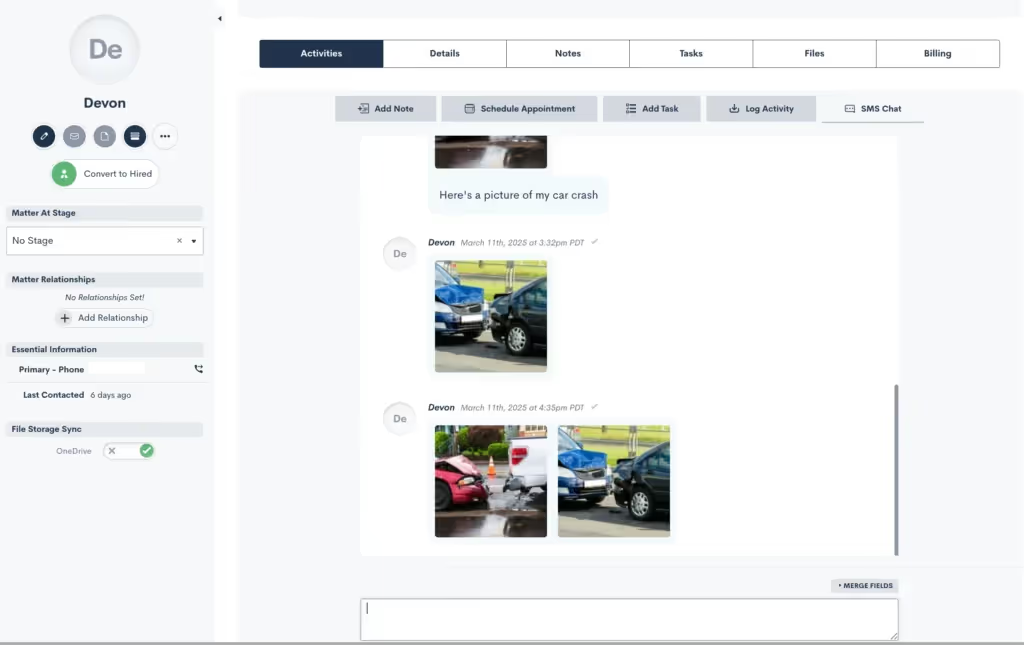
When a client needs to send over a copy of their ID or an accident photo, they’re not looking for a complicated process. They don’t want to log into a portal, track down your email address, or dust off the household scanner. They want to do what they already do dozens of times a day: take a picture on their phone and hit “send.”Now, they can — directly to your firm’s text thread.We’re excited to introduce MMS messaging in Lawmatics, a new add-on feature that makes it easier than ever for clients to share what you need. With MMS enabled, your clients can send photos and other media files straight to your firm via text message, no extra steps required. It’s fast, convenient, and designed for the way people actually communicate today.And because it all flows into Lawmatics, your team gets complete visibility — without ever chasing an email or wondering where that document went.
Why law firms need MMS
Law firms have long used SMS in Lawmatics to confirm appointments, send reminders, and streamline the intake process. It’s a fast, reliable way to keep communication moving — especially during those early client interactions where speed and clarity matter most.Now, with the addition of MMS, there’s an even more convenient option when a client wants to share something visual. Whether it’s a photo of a document or an ID, clients can send it directly by replying to a text message — no need to switch to email or upload through another system.For clients who are on the go or not especially tech-savvy, it’s a natural extension of how they already use their phones. And for firms, it’s a simple way to keep all communication in one place. A quick handoff of information is especially useful in early-stage conversations, where momentum can mean the difference between a retained client and a lost opportunity. It also helps prevent small delays from snowballing; when an item isn’t in-hand, you can’t move forward.
How MMS messaging works
MMS is an add-on feature that builds on your existing SMS capabilities in Lawmatics. Once enabled, clients can simply reply to your text with a file.Supported file types include standard formats like .jpeg and .png. You’ll see incoming media directly in the conversation thread within Lawmatics. From there, your team can take whatever next step is needed — whether that’s moving the intake forward, assessing the file in the client’s record, or triggering an automation based on the update.
Where MMS makes the biggest impact
While MMS is helpful across the board, in some practice types, the convenience can be a game-changer.Take personal injury, where documentation often includes real-time photos of injuries, accident scenes, or vehicle damage. Now, they can just text it, and you’ll receive it within seconds. And because Lawmatics is SOC 2 Type 2 and HIPAA compliant, your firm can safely receive even sensitive medical or personal records through MMS without worrying about where or how those files are stored.Alternatively, in immigration law, there’s often a long list of required documents: passports, visas, birth certificates, proof of residency, and more. Clients may not have ready access to email or may be coordinating with family members across borders. MMS lets them send what they have on hand right away, without needing a laptop or scanner.Even in estate planning, family law, or criminal defense, there are plenty of moments where a client needs to share a physical document, handwritten note, or piece of mail. With MMS, they can take a photo and send it through the text thread they’re already using to communicate with your firm. It’s easy, intuitive, and completely in line with how they already use their phones.
Built for a client-centered experience
For your firm, MMS means fewer delays, fewer follow-ups, and fewer dropped balls. For your clients, it means a legal process that feels more responsive and modern. Instead of “please send that via email when you get a chance,” they hear: “you can just text it.”And that shift matters. When clients feel like it’s easy to work with you, they’re more likely to follow through, stay engaged, and trust the process. And when your team has the files they need, exactly when they need them, they can serve clients more efficiently and effectively.
Getting started with MMS
At the end of the day, adding MMS support is about reducing friction in one of the most common parts of the legal journey: sharing photos and documents. Your clients expect to communicate with you as easily as they do with friends or family — and now, they can.If you're already using Lawmatics, enabling MMS is a simple upgrade. Once the feature is activated on your account, all incoming client messages will support media attachments, with no extra setup required on your end. To enable MMS for your firm, just reach out to your account manager or use this form to sign up.Not using Lawmatics yet? Get a demo to see how our platform helps law firms streamline communication, automate intake, and deliver a better client experience from day one.

In today’s competitive legal market, it’s not enough to simply have a digital presence — your online footprint needs to be fast, credible, and built to convert. In our latest webinar, we teamed up with the experts at Civille to break down exactly how law firms can strengthen their online presence and turn digital interest into real-world results. From the latest changes in search behavior to practical steps you can implement right away, here’s a recap of the insights.
Panelists

Blake Roberts
Director of Business Development,Lawmatics

Jess Stricklin
VP of Sales,Lawmatics

Eric Giroux
COO,Civille

Wes Lungwitz
Co-founder & Managing Partner,Civille
Time stamps of key takeaways
8:53 — The evolving digital landscape
Eric opened with a look at how the digital game is changing in 2025. The “mobile-first” mindset is more important than ever — but now it’s about fast-loading, lightweight content that works well even on weak mobile connections. He showed how Google’s AI-generated overviews are shifting how search results appear and explained why law firms should aim to be the source of the answers Google displays.
17:00 — Key components of a high-converting digital presence
The panel discussed what makes a website not just visible, but effective. Eric broke down how multi-step forms reinforce that a firm understands a visitor’s specific needs. Wes emphasized the value of regularly publishing useful, localized content and pointed to “E-E-A-T” (experience, expertise, authority, trust) as the standard Google uses to determine credibility. Reviews, case studies, and an optimized Google Business Profile also play a major role in turning visits into leads.
38:41 — Turning digital traffic into clients
This section focused on bridging the gap between traffic and conversion. Eric gave a live demo of an example using Lawmatics, showing how an appointment booked on a website instantly populates in the software. Jess then explained how automated workflows pick up from there, sending intake forms, confirming appointments, and triggering next steps. For firms struggling to keep up with growing lead volume, automation was framed as not just helpful, but essential.
53:11 — Actionable steps for law firms
To wrap things up, the team shared practical takeaways for firms at any stage. Blake and Jess emphasized that while these strategies take effort, they’re designed to scale — and the payoff is worth it. From tightening your Google Business Profile to embedding smarter forms and building automated intake flows, every step helps create a more seamless, client-ready digital presence.
Webinar slide deck
SAN DIEGO, March 25 — Lawmatics, the leading growth platform for law firms, proudly announces its achievement of Service Organization Controls (SOC) 2 Type 2 and Health Insurance Portability and Accountability Act (HIPAA) compliance, verified by an independent auditor. This assessment affirms that Lawmatics adheres to the highest standards of data security, availability, and confidentiality.“For firms handling sensitive data, like personal injury practices managing medical records, strong security is mission-critical,” said Matt Spiegel, co-founder and chief executive officer of Lawmatics. “Law firms don’t have to choose between using powerful cloud technology and protecting their clients’ data. Lawmatics makes sure they get both.”Established by the American Institute of Certified Public Accountants (AICPA), SOC 2 verification requires companies to implement rigorous controls around security, availability, processing integrity, confidentiality, and privacy. A Type 2 assessment evaluates the effectiveness of these policies over an extended period, ensuring continuous adherence to best practices.Separately, HIPAA sets strict guidelines for how organizations handle protected health information. HIPAA compliance ensures that any law firm handling medical or health-related legal matters can confidently use the platform while knowing their data is safeguarded to the highest industry standards.“We’ve built our platform with security at its core,” said Krijn van der Raadt, chief technology officer for Lawmatics. “Achieving SOC 2 and HIPAA compliance isn’t just about meeting industry standards — it’s about giving our customers peace of mind that their data is secure, no matter what.”Lawmatics’ SOC 2 report is available upon request for law firms requiring additional security verification.

Running a law firm means juggling a million moving pieces — marketing, client communication, team workflows, and of course, getting paid. Wouldn’t it be nice if more of that just... took care of itself? In our latest Deep Dive webinar, we shared some exciting new features designed to do just that.Your hosts, Lawmatics Product Manager Devon Roth and Sr. Director of Customer Success Johnny Bissell, walked through the newest and upcoming features designed to help law firms work more efficiently and drive growth. From enhanced marketing integrations to improved communication tools and smarter financial workflows, these updates are built to make a real impact on your firm’s success.
Time Stamps of Key Takeaways
9:00 — Google ads integration improvements
Google Ads integration has been enhanced to automatically import UTM values from your ad campaigns. This means that instead of manually tracking and entering UTM data, Lawmatics will now capture it automatically and sync it to your marketing sources. Additionally, Google Click IDs (GCLIDs) are now supported, allowing for more precise conversion tracking.For firms investing in Google Ads, this update eliminates the hassle of manually tracking ad performance. With automatic UTM imports and GCLID tracking, firms can send offline conversion data back to Google via Zapier, providing a clearer ROI picture for paid campaigns.
16:18 — MMS messaging
One of the most highly requested features, MMS messaging, is coming soon to Lawmatics! While firms have long been able to send and receive standard text messages, this new functionality allows clients to send images directly via text. This is particularly valuable for personal injury and family law firms, where clients frequently need to share accident photos, medical documents, or other case-related images.
23:25 — User activity reports
To enhance firm oversight and productivity tracking, Lawmatics is introducing User Activity Reports. These reports will log every action taken by every user, including emails sent, SMS activity, document shares, appointments scheduled, and more. With filtering options by user, action type, and date range, firms can quickly analyze performance, identify trends, and optimize workflows.
33:14 — Surcharging
For firms using LMPay Version 2, a new surcharging option allows firms to automatically add a 3% processing fee to credit card transactions. This helps firms offset processing costs without increasing service fees for all clients.