Guide to AI Lead Scoring | How to Automate Intake & Improve Lead Quality
Learn how AI lead scoring helps law firms automate intake, qualify leads faster, and convert more clients with Merlin Qualify and other intelligence legal CRM tools in Lawmatics


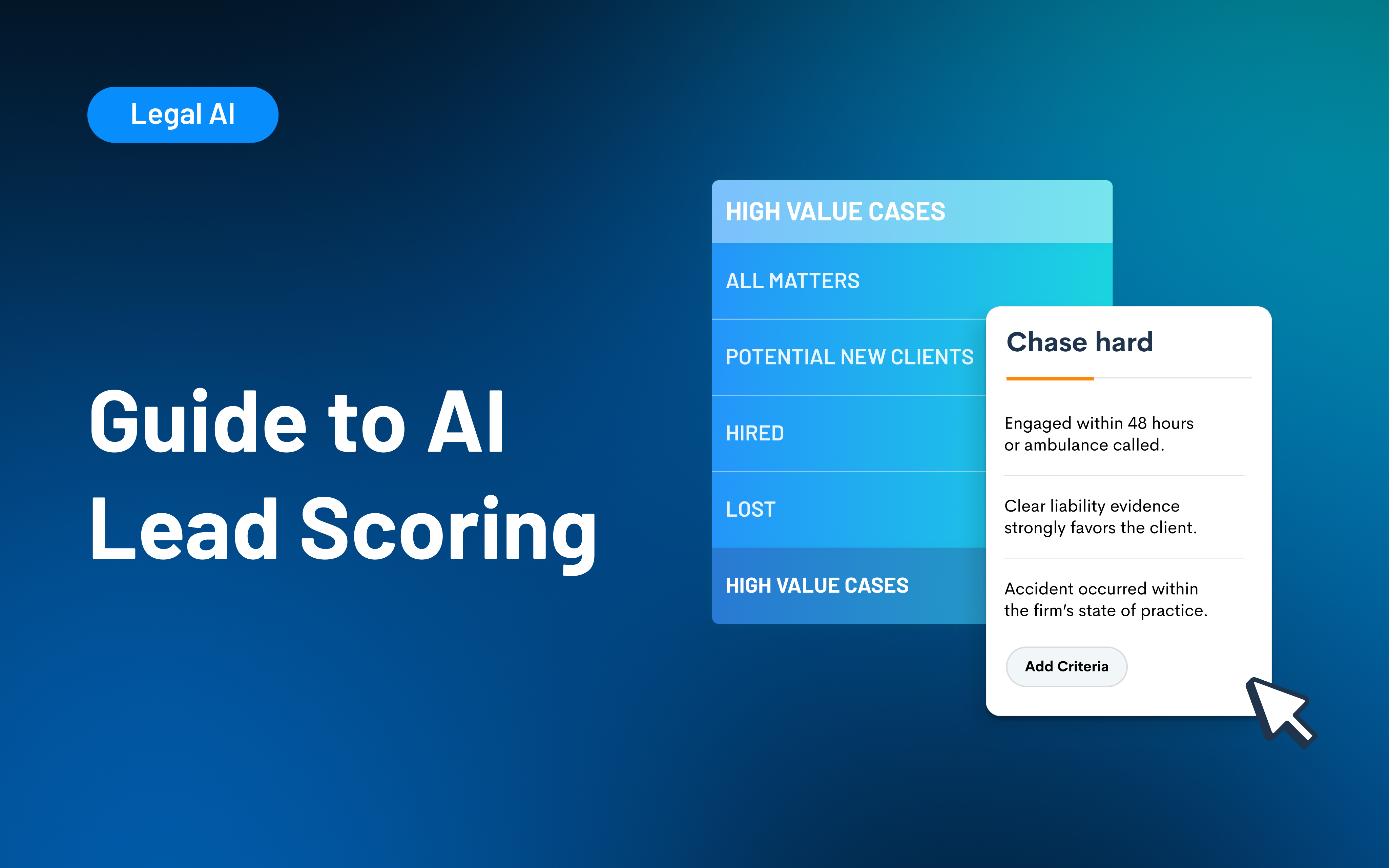
Table of contents
Believe it or not, many small and midsize firms still qualify leads the hard way: manual review, gut instinct, and whoever calls back first.
That makes it easy to burn time on the wrong matters while strong opportunities slip through the cracks. AI lead scoring changes that narrative for you and your teams.
In this guide, we’ll break down how it works, what it means for your intake process, and how tools like Lawmatics’ Merlin Qualify help your team focus on the right clients, faster — without adding headcount.
What Is AI Lead Scoring?
AI lead scoring is an essential part of legal software. AI scoring (or artificial intelligence scoring) uses predictive analytics to prioritize leads, helping busy teams strategically orient themselves.
It differs from manual scoring, which uses adaptive-learning-based models. AI lead scoring can analyze information across intake forms, practice areas, case types, location, and any other details identified as necessary by the law firm.
Merlin Qualify from Lawmatics is a next-generation solution that uses a lead-scoring machine based on criteria defined by the firm. This allows firms to adjust the requirements based on new experiences.
The result for legal teams is smarter follow-ups, fewer missed opportunities, and a better bottom line.
Why Law Firms Should Care About AI Lead Scoring
There are many variables in the world of law firms. It's no surprise that managing partners value predictable growth and strong return on investment (ROI) of sales initiatives.
This is made even more vital when you consider that 40% of law firm lead conversations go unanswered. Plus, up to 50% of legal consumers will hire the first attorney who returns their call or email. Teams that can’t keep up with leads are leaving money on the table.
With automated lead scoring, every inquiry gets evaluated and instantly prioritized. This saves teams money and ensures team capacity is well spent.
Unlike other lead-scoring tools that further silo data, Merlin Qualify integrates seamlessly with Lawmatics CRM and client intake. It provides a frictionless way to route and prioritize high-quality teams. This helps ensure team uptake.
How AI Lead Scoring Works
- Capture data: First, the AI will capture as much data as possible across client intake forms and the legal CRM.
- Analyze intake information: Using machine learning, the AI will then analyze each entry against criteria tailored to each law firm.
- Recommend an action: Once the information is analyzed, the AI lead-scoring tool will recommend a specific action based on the defined criteria. This could include Reject, Refer, Chase, or Chase Hard.
- Automated workflows: The AI will then trigger an automated workflow based on the overall score. This could include an email, a reminder, or even a demo prompt.
For example, Merlin Qualify uses a dynamic learning model that evaluates leads based on every firm’s different intake criteria.
Via "continuous learning,” the system will refine the recommendations over time based on each firm’s intake criteria. This way, the scoring always reflects what qualifies as a “good case” for that particular practice, not a hypothetical law firm.
Merlin Qualify can integrate directly with a law firm’s tech stack, including CRM, to ensure messaging is followed across the teams — no data warehouse or API setup required.
Lead Scoring Implementation — Best Practices for Law Firms
AI lead-scoring tools are very easy to use and, for the most part, self-explanatory. However, there are best practices for law firms to consider to make the most of their lead-scoring marketing automation efforts.
Audit existing data
Before adopting a new automation, teams should first take inventory of their existing legal CRM platform and its overall data hygiene. For best results, teams should perform a data cleanup before investing in an automation tool.
Define what a “qualified lead” is
The clearer the parameters, the better a legal workflow automation platform can assist legal teams. Teams should collaboratively define what “good” means to them. Ideally, this should be based on the attributes that lead someone to book a consultation or sign a retainer.
Consider your ecosystem
To prevent the growing pains that come with adopting new software, teams should look for solutions that integrate with their existing tools. For example, Lawmatics Merlin Qualify works smoothly with both Clio and MyCase.
Set up automations
Teams don’t need to set up all their automations overnight, but many find it easiest to start with follow-up and nurture campaigns. Client intake automation is also useful. It helps team your lead scoring system on what good looks like.
Train staff
Most AI lead-scoring systems are easy to use. However, it’s best to set aside time for staff to learn how to interpret lead categories and prioritize accordingly. As your staff learns, your AI will learn too, and you’ll find performance improves across the board over time.
Track performance
Track your performance metrics to monitor overall software ROI and firm performance. Many platforms, Lawmatics included, come with legal reporting and analytics tools that show you conversion rate and intake response time at a glance.
Common Lead Scoring Challenges (and How to Avoid Them)
Predictive lead scoring, by its very nature, is easy to use and almost always a net positive for any time. However, it’s better to be aware of potential issues in advance. This could include things like:
- Data quality issues: If the automated lead scoring is working on inaccurate data, its output will be inaccurate, too.
- Human oversight: AI workflows help make teams more efficient, but they don’t replace human expertise. Staff should monitor every AI suggestion for anomalies.
- Bias and compliance: Custom automations for law firms, like for lead qualification, should always be transparent and auditable. This way, teams know they’re getting suggestions that are true to them, not just the algorithm.
- Change management: Change can be hard, but teams can secure attorney buy-in early by showing results through a visual medium, such as a demo dashboard.
Choosing the Right Client Intake Tools
The software a team uses can have a real impact on their overall revenue and operations. Teams looking to invest in AI lead scoring tools should consider the following before making a decision:
- Integrations: AI lead scoring tools should complement the systems you already have in place, including legal CRM systems and client intake automation workflows. Lawmatics integration with Clio, MyCase, and PracticePanther means teams can rely on all their everyday tools to work together.
- Accuracy: Your scoring tool is only as powerful as the data beneath it. Once your internal data is cleaned and standardized, an AI model should be able to evaluate leads based on your firm’s actual intake patterns.
- Transparency: Look for tools that clearly explain why a lead received a specific score. Your team should be able to see the inputs, logic, and recommended next steps.
- Usability: Choose software with intuitive dashboards, minimal setup, and clear scoring outputs so that teams can act quickly without a steep learning curve.
See how Merlin Qualify compares to generic scoring tools
Merlin Qualify, launched by Lawmatics in 2025, combines advanced machine learning and natural language processing to evaluate leads using the information captured during intake.
The system analyzes responses, identifies intent signals, and predicts case quality with an accuracy that generic scoring tools can’t match.
Merlin Qualify works seamlessly within the tools firms already use. Instead of forcing teams to replace their tech stack, Lawmatics enhances existing CRM and client intake workflows by integrating cleanly across systems. This means that all pathways lead to a single, unified, automated workflow.
See how Merlin Qualify transforms intake automation and lead scoring. Request a demo.
The Future of AI Lead Scoring for Law Firms
AI lead scoring is the next frontier in intake efficiency, giving firms a more innovative, faster way to qualify leads and improve response times.
Lawmatics Merlin Qualify helps law firms focus on the right opportunities by using artificial intelligence to analyze, score, and qualify every inquiry using firm-defined criteria. It saves time, reduces guesswork, and helps firms respond more quickly.
Explore Lawmatics pricing and plans, or request a demo to experience how Merlin Qualify in Lawmatics helps your firm convert more leads into clients.
FAQ Section
What is AI lead scoring?
AI lead scoring uses machine learning to evaluate incoming leads and rank them based on their likelihood to fit a firm’s ideal client profile. This helps teams prioritize the highest-value opportunities.
What makes Merlin Qualify different?
Merlin Qualify is built specifically for law firms. It analyzes intake responses, engagement patterns, and firm-defined criteria to generate predictive scores that lead to more demos, more consultations, and faster conversions.
How does AI improve intake?
AI removes manual triage by evaluating leads automatically and alerting staff the moment a high-quality prospect enters the pipeline.
Can AI lead scoring integrate with my existing systems?
Yes. Lawmatics integrates seamlessly with the tools firms already rely on. It enhances CRM and client intake workflows without requiring teams to rebuild their tech stack.
Does AI lead scoring replace human decision-making?
No. AI enhances human judgment with data-driven insights. Your team still decides how to follow up. AI simply ensures you’re acting on the right opportunities at the right time.
.avif)
Ready to grow your law firm with Lawmatics?
Schedule a demo of legal’s most trusted growth platform.