The Lawmatics Blog
Insights on legal marketing, automating the law practice, and legal tech in general
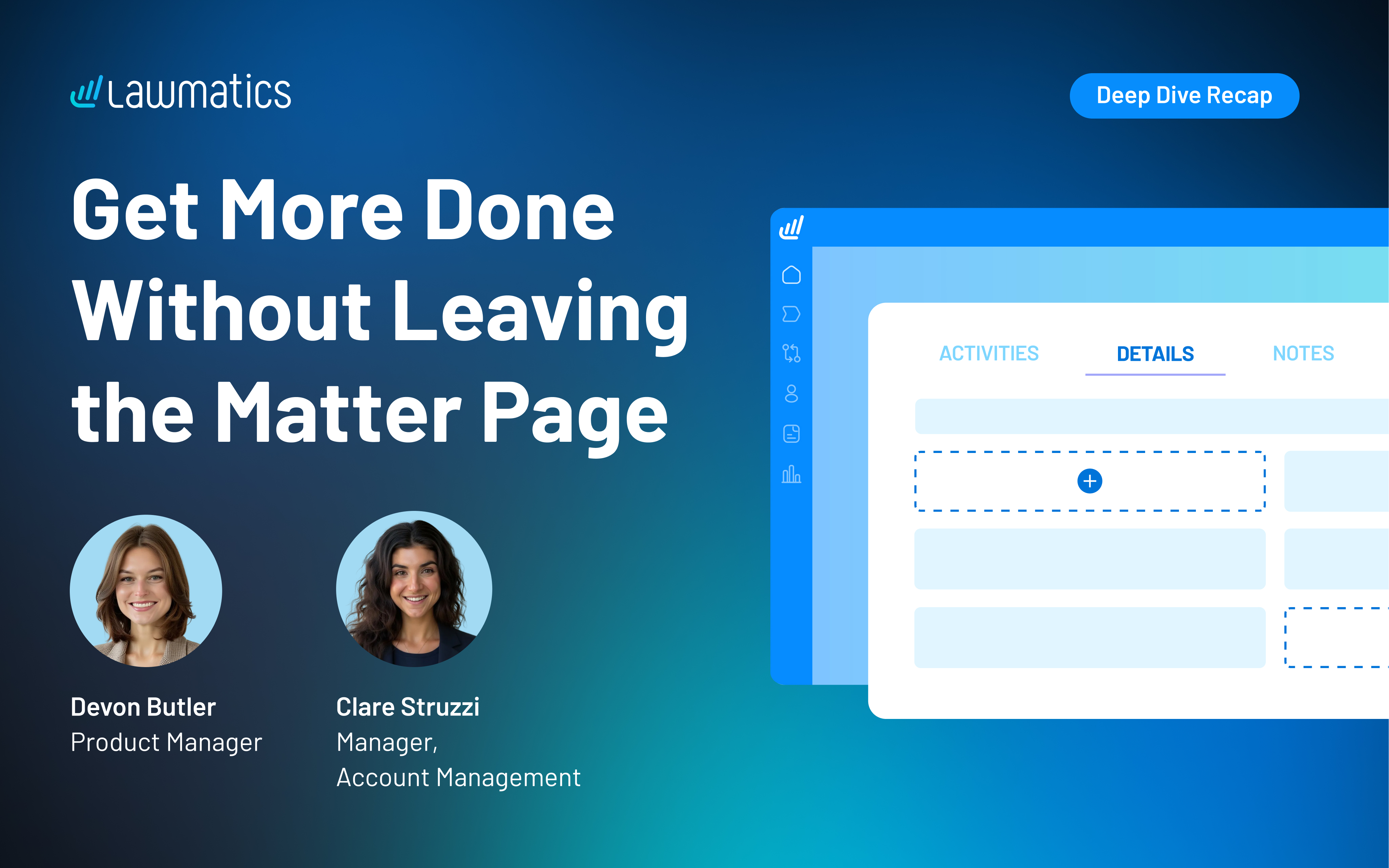


Last month, we walked through how to set up custom matter views. But building views is only half the equation — the real value comes from putting them to work. When intake staff, attorneys, and admins are all looking at the same long list of fields, it's easy to miss what matters, waste time hunting for the right information, or forget to fill out a field before firing off a contract.
In this Deep Dive webinar, Devon Butler, product manager at Lawmatics, and Clare Struzzi, who leads the account management team, showed how firms can use custom matter views to trigger automations, surface reporting fields, and tailor layouts by role and practice area.
Time stamps of key takeaways
5:53 – Why customize your Matter pages
Devon kicked off with four reasons to invest in custom matter views: cutting through the noise so each role only sees what they need, supporting cleaner reporting, strengthening team handoffs between intake and attorneys, and working faster directly from the Matter page without having to search for fields.
9:48 – Building practice-area-specific views
Clare walked through an estate planning intake view built specifically for intake specialists, showing how organized sections replace the old starred-fields approach. She highlighted how a field like "Next Steps Pre-Consult" can live right at the top of the view so the intake team can trigger automations directly from the details page — no need to reopen a form.
14:58 – Creating role-specific views
Devon and Clare showed how the attorney view for the same estate planning practice area includes different fields at the top — like "Next Steps Post-Consult" and a dedicated contract fields section where merge fields for engagement agreements can be reviewed and completed before sending. Clare also pointed out that sensitive information like Social Security numbers can be placed in sections that default to a collapsed view.
25:00 – Triggering automations and managing contract workflows
Devon walked through a live example of building an automation that fires when the "Next Steps Post-Consult" field is updated — automatically moving the matter to the correct pipeline stage and sending the engagement agreement. She also showed how duplicating automations makes it simple to handle variations, like sending a single-signer versus a joint estate plan document.
35:09 – Surfacing fields for cleaner reporting
The session wrapped with a look at how the reporting fields on custom views — source, campaign, estimated value, actual value — feed directly into the analytics page and custom reports. Devon demonstrated grouping a report by source to quickly see which referral sources are converting and where data gaps need attention.
Webinar slide deck

The only way to keep your law firm running is by bringing in new business consistently. That's why at the core of every successful law firm is a solid marketing strategy that has all the right components in place. In order to scale your law firm, you have to successfully target your ideal client, engage current clients, re-engage former clients, and stand out against the competition.Yet, not every type of marketing flies when it comes to promoting your law firm. There are certain rules that need to be followed in order to avoid ethical concerns and any disciplinary consequences that come along with them. Failing to comply with advertising rules could lead to serious repercussions that you’re better off without.For this reason, many law firms work with marketing agencies that have experience working with law firms, or who have had legal experience. Since they’re familiar with the ins and outs of advertising legal services, law firms don’t have to worry about their marketing methods violating rules.
Knowing what not to do when advertising your law firm
In order to successfully advertise and scale your law firm, it's a good idea to stay familiar with the rules that apply to you. That way you can successfully reach your target audience, and bring in more business, all while respecting advertising laws. Regardless of what kind of advertising channels you're planning on using, the same rules apply. Here are the most important advertising rules that you should know when marketing your law firm.
! Don’t make false claims
It goes without saying that making any false claims is dishonest. Lying isn’t an admirable quality in any business, and law is certainly no exception. Under no circumstances should you make a claim that is misleading, could be considered dishonest or stretching the truth.That means avoiding making any bold statements that could be deceiving, like guaranteeing you’ll win your client's cases. The same goes for making superlative claims like you’re “the best lawyer.” Simply put, don’t make any promises that you can’t keep.Instead, stick to the facts that no one can dispute. Claiming you’re the best lawyer in the world could be considered unsubstantiated and unverifiable. However, no one can deny that you have won a certain number of cases if you can back the claim up. When in doubt, always double-check any statements and make sure you can prove them.
! Don’t set unrealistic expectations
On your testimonials page, you may likely have bold statements from prior clients making claims like “My lawyer won my case and made me richer than I ever dreamed of!” which is entirely possible, however, it doesn’t guarantee that every client will have the same outcome working with you.Be careful of creating expectations that would lead a client to believe that their situation will turn out identical. Although you may have gotten one client a considerable amount of money for their claim, it’s dishonest to claim you can do the same for every client.There’s a reason that at the end of many commercials a voice can be heard saying “results may vary.” Keep your promises in check!
! Don’t say you’re a specialist or expert
Certain states have rules about presenting yourself as an expert or specialist. As such, you should avoid either one of these terms. The ABA clearly states that “a lawyer shall not state or imply that a lawyer is certified as a specialist in a particular field of law” unless they are officially certified and deemed specialist by an approved organization that is approved by the state or is accredited by the American Bar Association.Substantiating your expertise in law with the number of years you’ve been an attorney isn’t enough either. You must be able to demonstrate that you are officially an expert with certification and proof. Otherwise, you’re better off steering clear of calling yourself an expert or specialist.
! Don’t solicit your legal services directly
The American Board Association approves of traditional advertisements like billboards, search engine optimization, pay per click, and social media advertising. However, soliciting your services by targeting an individual directly is prohibited.In other words, targeting someone one-on-one may be viewed as soliciting your services for your own financial gain and not for the client’s best interest.[oxygen-template id="6133"]
Tips for successfully advertising your law firm
1 Do build the right website for your law firm
One of the most straightforward and effective ways to advertise your law firm is to build the right website for it. Having an online presence is a must for a lawyer, so the first place to start building your digital presence is by creating a strong website.Not only should you have a website, but you should make sure that it ticks all the right boxes. A great law firm website does the following:
Establishes credibility
Having a website serves as proof that you're a legitimate business. In today's digital age, Googling a lawyer's name and finding they don't have a website could be considered suspicious. Your web page is your digital business card. It’s a way to showcase your skills and offer testimonials that serve as social proof for your services. First impressions are everything when it comes to a website, so if you can present a professional and well constructed page, people will be that much more likely to hire you.
Generates leads
You likely have many different marketing methods in your marketing strategy. However, the cornerstone of it all should be your website. If you manage to optimize your website, then Google will start to favor it. As a result, your law firm will come up first in search results, generating more traffic, and in turn leads.
Increases your online visibility
The more visible you can make your website, the more leads you'll attract. Ultimately, Google is one of the biggest determining factors in your law firm's success. The more visible you are, the more you can target your ideal clients.
Offers valuable information
You can have the most professional-looking website in the world, but, if it doesn't have the information that people are there for, then you might as well not have a website at all. Your website should clearly display what kind of law you practice, and where you're located.You can also offer valuable information by adding a blog to your website. One of the best ways to bring people to your page is by offering relevant and free legal advice.
Saves you time
A fully functional website can save you a considerable amount of time. Offering your clients the ability to self-schedule using automated appointment scheduling software means that you no longer have to waste time on lengthy email back-and-forths. Clients can simply fill out a legal client intake form that goes directly into your law firm CRM, eliminating the need to manually input information. Above all, it's much more efficient. The minute a lead fills out their information, your CRM and legal client intake software like Lawmatics will meticulously track them. That way, you don't have to worry about who's been followed up with or what actions need to be taken next. Your software follows up for you, ensuring that no opportunity gets missed.
2 Do set up a Google Business Page
Online reviews are a critical part of building a digital presence for your law firm. It's critical that you set up a Google business profile where leads can read former client reviews, find out where you're located, and get your contact information. While there are many different review sites available to lawyers, Google is considered the most important, since it's what shows up first on search results.Don't be afraid to ask your former clients to leave you a review on Google. The more reviews you start generating, and the more you respond to, the more you’ll improve your ranking since Google favors active profiles.
3 Do create a social media profile
Nowadays, clients want to connect with their favorite brands, and their lawyers are no exception. Creating a social media profile for your law firm is a great way to build a connection with your clients, and increase brand awareness. If you can manage to create useful and shareable content, you'll build a following for yourself on social media, which will generate more leads. The best part is, social media is entirely free to start a profile on, which can be especially appealing for smaller firms with tighter advertising budgets.
4 Do create a blog
Starting a blog is a great way to establish yourself as an expert in your area of practice without outright calling yourself an expert. Starting a blog is a great way to add more content to your website, which will, in turn, boost your rankings on Google. Something as simple as a weekly blog post that offers a legal tidbit is a great way to get more visitors to your website. It's a good idea to familiarize yourself with the right SEO keywords and make sure they are there throughout, improving your organic search results.
5 Do use calls to action
Advertising is much more powerful and effective if you always include a call to action. Everything from your website to your marketing emails should encourage the reader to take further steps towards becoming a client. A call to action usually comes in the form of a phrase with a hyperlink.
Some ideas of CTA's for your law firm could be:
- Download an ebook
- Sign up for a Free Consultation
- Subscribe to Our Newsletter
The idea is to encourage a lead to take action before letting them click away.
6Do measure your results
In order to ensure you get the maximum return on your marketing investments, you have to measure your results. Using legal reporting software will help you identify what marketing channels are working and what aren't. Custom reporting allows you to assess your marketing campaigns, and identify room for improvement by keeping a close eye on your most important marketing metrics.Although data and analytics may seem out of context in the legal world, it can be one of your most valuable tools for standing out against the competition. Your law firm should be tracking important metrics such as:
- Bounce Rate
- Visit to Lead Ratio
- SEO Keyword Ranking
- Conversions by Source
- Email Click Rate
- Backlinks
- Newsletter Growth
Knowing how well your marketing is performing will help you determine whether you should continue in the direction you're going, or make changes.
7Do keep your leads engaged
The most successful law firms rely on marketing automation for law firms to keep their leads engaged. Attorney intake software streamlines your marketing emails, targeting specific audiences based on characteristics of your choosing. Tools like audience segmentation software allow you to customize what emails go out to who, based on certain triggers. For example, if someone signs up for your newsletter, they'll receive a specific follow-up, while someone who downloads an ebook will receive a different message. Automated personalized messaging makes your law firm memorable, and keeps your leads engaged which ultimately breeds brand loyalty.
Attract new clients and engage your former ones with Lawmatics
Advertising your law firm is a critical part of expanding your law firm and acquiring new clients. However, In addition to the legal market being competitive, it can also be risky if you don't know the advertising fundamentals. Understanding the most important advertising rules will help you maximize your marketing efforts and build a solid long-term marketing strategy for your law firm without problems.Having a clear understanding of the most relevant issues that may come up will help you build brand awareness without any ethical issues.Advertising your law firm starts with embracing legal technology. Trying to manually advertise your firm can be time-consuming, and full of potential errors. By automating your law firm marketing efforts, you can stay focused on what matters most at your law firm, while automation handles the rest.Are you ready to see how an all-in-one legal intake solution, marketing automation and law firm CRM software like Lawmatics can help increase your outreach and win more clients? Sign up for a free demo today!

As a personal injury lawyer, your job is to provide advice, explain your client's rights, and ultimately represent them in court, getting them the best possible compensation for their pain and suffering. It sounds simple enough, right? But as you know, it can be so much more. A day in the life of a personal injury lawyer is full of tight deadlines, extensive researching, and no shortage of stressed-out clients eager to get results on their case.On top of all that, you still have to carry out all of the administrative duties that it takes to run a practice and find new clients. At the end of the day running a practice is exactly like running a business, and yet law school didn’t teach you how to do that! It’s easy for personal injury lawyers to find themselves in over their heads with tasks they don’t have enough hands for. One of the most time-consuming aspects of running your personal injury law firm is the client intake process.The client intake process may seem so straightforward, yet it can be one of the most error-ridden, tedious, and laborious parts of your job. Trying to find the time between juggling your retained clients with trying to win your potential clients can feel downright impossible when you're manually running your law firm.That’s why more and more personal injury lawyers are turning towards automation that does all the busy work for them. Chances are you got into personal injury because you had a passion for zealously representing your clients and getting them the best possible compensation for their suffering — not because you wanted to do administrative work 60% of your day. Relying on automation can transform the way that you run your practice, boost your clients' overall experience, and make you a happier lawyer!
7 things automation can do for personal injury lawyers
1Greet new leads
Whether an interested lead fills out a legal client intake form or leaves a voicemail asking for more information, automation makes a great first impression by replying instantly. You can personalize your email responses with any helpful information specifically regarding their personal injury case type, any success stories your firm has on their type of cases like theirs, and why you’re the best person for the job.Believe it or not, 42% of the time law firms fail to get back to potential new clients within the first 72 hours. The more time you take to reply, the more time you’re giving your potential clients to find a different lawyer who gets back to them sooner.If you can manage to make a potential client feel valued from day one with a speedy and personalized response, you'll deliver an elevated client experience that delights and encourages referrals. By responding right away with a tailored response with the help of automation, you're already surpassing the majority of your competitors.
2Capture client data
It's no secret that the client intake process is one of the most time-consuming parts of running a law firm. It's easy to find yourself in a chaotic pile of to-do's, and manual processes that are eating up the majority of your day. Manual processes are time consuming, and downright boring. Automation can capture client contact information for you so you can focus your energy on more important matters.Automation captures lead information for you so you don't have to stop what you're doing to take someone's name and number ever again. Not to mention manually typing contact information is one of the biggest causes of errors. Automation means you can deliver error-free work, without having to worry about mistakes and dissatisfied clients as a result. Once you capture a lead's contact information it goes directly into your law firm CRM database where it can be accessed from any time anywhere.No more scrambling to find a contact phone number or risking mixed messages amongst multiple staff members working on the same case, thanks to automation keeping your team organized.
3Track leads
Attorney intake software tracks every single step of the client journey from the minute a lead first reaches out to your firm. Software like Lawmatics shows you a bird's eye view of who's been followed up with when, and what else needs to be done in the client intake process. No more wondering whether someone got called back— client intake software keeps you on the ball so you never have to worry about losing clients because they didn't get the attention that they deserved.
4Automate scheduling
One of the most frustrating parts of scheduling consultations with clients is trying to find a time that works for everyone. It's not long before trying to find the best time ends in a long string of lengthy emails. Automated appointment scheduling takes the headache out of setting a date for consultations by allowing your clients to book their own appointments. It's as simple as sending them a link to your schedule where they can choose the best time that works for them based on your availability. This modern and convenient approach to scheduling will thrill your clients and make your life easier too.
5Market on autopilot
Although you learn plenty of things in law school, one of the things they don't teach you is how to market yourself as a business. Yet, marketing is a necessary part of continuing to bring in revenue. Drip email marketing streamlines your marketing efforts so you can grow your law firm hands-free.By automating your marketing you can continue to produce high-quality leads without having to step away from a paying client again. The right software makes it easy to build newsletters by choosing custom triggers to send personalized emails at the right time to the right leads.For example, as a personal injury lawyer, sending out marketing materials with helpful personal injury case tips is a great way to drive client engagement and stay top of mind. You can easily configure your marketing to link to your blog or schedule a free consultation, guiding your leads seamlessly to the next stage of the client intake process.
6Create documents in seconds
From attorney retainer agreements to affidavits, there's no shortage of lengthy paperwork that personal injury lawyers have to assemble. Legal document automation makes it easy to generate lengthy documents in a matter of seconds that would have otherwise taken hours up to days.It's as simple as using custom fields to merge whatever data you need from your matters and contacts directly into your PDF and word documents. Not only do you gain precious time that you can use to focus on what matters most at your practice, but you ensure greater accuracy, giving you and your clients peace of mind.
7Analyze what’s working— and what's not
The right software can automatically report your law firms your most important metrics, helping you stay on top of the areas of your practice where you have to grow. From where your best clients are finding you, to how productive each of your employees is, powerful legal reporting software will continuously analyze in the background, helping you make smarter business decisions.[oxygen-template id="6129"]
Benefits of automating
Better reviews
We live in a review-fueled society, where people trust a five-star review as much as they would a recommendation from a personal friend. The more efficient and personalized an experience you can deliver to your clients on their personal injury cases, the better reviews you're going to get.The more positive reviews you acquire, the more that Google favors your website and the more leads you’ll produce. Automation is proven to have a huge impact on client satisfaction by speeding up and streamlining your clients' cases, keeping them informed every step of the way without you having to do a thing.
Decreased costs
Not every law firm has the luxury of including a front desk staff in their budget. Downsizing your staff and relying on automation can significantly reduce your operating costs. Although automation software requires an initial investment, the amount of money you’ll save in the long run far outweighs the price of law firm client intake software.
Increased efficiency
Automating your law firm means reducing delays, and in turn, delighting your clients with a modern and thorough approach to their personal injury cases. Accident victims have a lot on their plates, and in many cases, their lives may be on the line. Your clients don’t just need a thorough and organized pursuit of their case — they want to be informed every step of the way. Automated emails make your clients feel connected to you at every step, reassuring them that they chose the right lawyer for their case.
Greater visibility
Personalized and targeted automated emails keep you consistently in touch with your leads. Whether you're welcoming new clients or wishing a happy birthday to a former client, automated emails nurture and engage, increasing your law firm's visibility, and streamlining your follow-ups without you having to lift a finger.
Saved time
Recent reports show that lawyers spend over half of their week on administrative tasks. When you start relying on automation to take care of the lengthy and tedious administrative work that it takes to run in practice, you save so much time that you will wonder why you didn't switch to automation sooner. For lawyers, time equals money, so the more time you have to dedicate to what matters most in practice, the more money you put in your pocket— it's really that simple.
Reduced errors
When it comes to a personal injury claim, even the slightest error can lead to a judge dismissing a case. When your clients are paying you to protect their interests after being a victim of an injury, it's your job to ensure that your work is error-free. Automation reduces the risk of important details being forgotten or entered incorrectly, ensuring that everything is handled the way it should. Personal injury accidents can be downright catastrophic. Your clients don't need any more stress than they already have.
Reduced no-shows
One of the most frustrating parts of a lawyer's job is carving out time in your schedule for a consultation, only for it to result in a dreaded no-show. Statistics show that 25% of first consultations don't show up at all. These no-shows aren’t just a waste of time — but they’re lost money too.Automated appointment scheduling keeps everyone on track and reduces the chance of a client not showing up. The minute that a client's consultation is scheduled, they receive confirmation as well as you. In addition to the initial confirmation, both you and the client are each sent a reminder several days leading up to the appointment time, reducing your chance of no-shows by nearly 90%.
Streamlined processes
A day in the life of a personal injury lawyer is no piece of cake. From juggling phone calls with distressed clients wanting to get the best possible compensation for their case, to attending fervid court hearings, to sending out time-sensitive emails, to juggling phone calls — it's easy to find yourself in the midst of chaos. Automation replaces chaos with order, helping you run your practice with greater ease. Instead of running around in circles spending hours on time-draining manual tasks, you can rely on software to do it for you.
Set your personal injury clients up for success with Lawmatics
Keeping your documents organized, replying immediately, and staying on top of important deadlines is the only way to get the best possible results for your clients. Lawmatics law firm CRM and legal client intake software can help you stay on top of your most important tasks and automate the busy work so you can focus your attention where it matters most — getting your clients the best possible results on their personal injury case.If you're ready to start increasing your productivity and expanding your practice, then it's time to start relying on automation to automate your law firm's repetitive tasks.Are you ready to see how Lawmatics can help your personal injury firm and save countless hours thanks to powerful automations? Sign up for a free product demo today!

No matter how passionate you are about advocating for your clients as a criminal defense attorney, there never seems to be enough time in a day to do as much as you’d like to do. Despite your best intentions, you’re often fighting the clock and grappling with a lack of resources as you struggle to keep up with the volume of work that a criminal defense lawyer has on their plate.Because of the substantial workload, it can prove difficult to spend as much time on each individual matter as you’d like. The photocopies, the data entry, and all of the administrative tasks that it takes to run a criminal law practice can eat up your day in no time.
Biggest challenges that criminal defense lawyers face
Balancing potential clients with retained clients
One of the most common reasons why legal clients grumble about their lawyers is because they feel that they don't communicate enough. And the complaints are hardly unmerited. Statistics show that the average law firm has an impressively low response rate. A recent study showed that as few as 30% of all of the law firms contacted answered the phone. If you put yourself in the shoes of a potential client, it's incredibly frustrating if you can't even get someone on the phone when you're looking for a lawyer. Yet, from a lawyer’s perspective, it's not always simple to stop everything and pick up the phone. With so much going on in a legal practice, finding the time to balance your pain clients with your potential ones can be a downright headache. Yet, the new clients are the backbone of your legal practice. Without them, you would cease to continue to generate revenue. So, since you can't clone yourself to have enough manpower to get it all done, the next best thing is to rely on technology to take care of your potential clients for you. In turn, you can focus your energy on your retained clients.A CRM comes with built-in automations that ensure your clients get responded to right away in a personalized way that doesn't make them feel packed into a one size fits all messaging approach. Lawmatics is a client intake software and CRM built into one. It allows you to tailor and personalize your automatic replies, triggering certain responses based on your personal preferences, ensuring no potential client gets forgotten. Whether someone signs up for your newsletter or schedules a free consultation, you get to fine-tune and customize what automatic email will go out as a response.
Competing law firms
When it comes to dominating the legal market, having a presence on Google is king. Statistics show that over half of Google users use it specifically for searching for businesses. So, people looking for a criminal defense lawyer go to the first place they know to go— the internet. The most successful criminal defense lawyers are the ones that show up on the first page. It doesn't matter if you're the best criminal defense lawyer in the world— if Google doesn't show you on the first page of results when people search for a lawyer in your area, then the competition is going to eat you alive. It pays to execute a marketing plan that targets your ideal customer and puts you on the grid. A CRM like Lawmatics comes with law firm marketing tools that will skyrocket your leads, and smash the competition, getting you the attention on Google that it takes to make it to the first page.
Running a law firm like a business
Law school teaches you all kinds of information about how to be a criminal defense lawyer. From conduct research to how to present your findings in court, to negotiating plea bargains. However, what law school doesn't teach you is how to run a business. When you first start your career in law, you may not see yourself as a business person. However, you are. Running your law practice is exactly like running a business—because it is one.Once you start seeing your law firm as a business and put on a CEO hat, you will start realizing how valuable your time is. Turning to a law firm CRM is the most effective way to ensure that your clients receive the best possible experience, and you stay organized and on top of all the most important details.
Stress
Regardless of your legal practice area, a day in the life of a lawyer is incredibly demanding and nerve-wracking. Your cases are extraordinarily complex and require a taxing amount of effort to defend your clients and research the law. Statistics show that 19% of lawyers suffer from severe anxiety, and 10% have experienced suicidal thoughts at least once within the last year.Needless to say, criminal defense lawyers have a lot going on, on top of the administrative tasks that it takes to keep their practice running. That's why it's more important than ever that you take advantage of the benefits that legal technology has to offer to reduce your workload and use the pressure.
Long hours
If you're running your practice on a manual system, then chances are you're putting in extremely long hours. Some criminal lawyers work upwards of 60 hours a week, and a lot of those hours are dedicated to tasks they can't even invoice for. Client intake is one of the most time-consuming parts of being a lawyer. Turning to legal client intake software can shave hours off of your workweek that you can devote to the other areas of your life that are important too, like family and friends. A legal crm system like Lawmatics comes with law firm client intake software built-in, so you don't have to juggle multiple platforms trying to run your firm.Manual processes aren't just standing in the way of your mental well-being— they're standing in the way of your growth as a business. Using a CRM and client intake software like Lawmatics will cut down the number of tedious tasks you have to complete, and make your practice much more efficient. Ultimately, you'll achieve a greater quality of life and more revenue.
Signs your law firm needs a CRM
!You don’t know where your time is going
Do you find yourself at the end of your week wondering where the time went? If you're not sure where your time is going, then it's an indication that you could definitely benefit from putting a more efficient system in place. Once you start seeing a bigger picture of how much time you're losing each week on menial tasks that could be delegated to automation, a whole world of possibilities starts to open up for your law firm.A CRM like Lawmatics comes with law firm performance management software that tells you how your law firm is performing. From how productive you are, to where your best leads are coming from, data allows you to take control of your law practice and put more efficient methods in place.As a lawyer, time is money. You wouldn't frivolously spend all of the money in your bank account without knowing where it's going, would you? So why would you do the same thing with your time? A CRM with built-in reporting software allows you to take control of your productivity, organize your client activity, and identify the holes in your practice where you can improve your efficiency. Lawmatics CRM and pipeline management tells you what steps you need to take next to grow your practice resulting in repeat business and increased client referrals.
!Losing track of leads
One of the biggest mistakes you can make as a criminal defense lawyer is to throw away opportunities. The minute that a lead first contacts your law firm, you must start tracking them immediately. Whether they contact you through a legal client intake form or they call in, you need an efficient system in place that relies on more than post-it notes or a haphazardly thrown-together spreadsheet.A CRM tracks each stage of the client journey and tells you what action needs to be taken next. You can easily see all client communication in one place, and access contact details from anywhere anytime making sure that no opportunity gets lost.Lawmatics pipeline management tool manages, analyzes, and nurtures your leads from each step of the client journey, ensuring that you'll never lose track of a potential client. A fully customizable dashboard allows you to optimize your client intake pipeline, organizing and tracking your leads in a way that's easiest for you to understand. Customizable templates and workflows make it easy to see what you need to take action on next. From emails to phone calls, take control of each stage of the client journey step by step.You can even organize contacts with customizable tags so that you can find whoever you need in a few clicks without having to dig through your email inbox. Audience segmentation software makes it easy to organize your clients into groups based on their individual journeys, ensuring that all of your interactions are personalized and relevant, keeping them engaged every step of the way.
!You’re taking too long to get back to potential clients
If you're taking too long to get back to your leads, then you're failing to make consistency a priority. A CRM ensures that you never have to worry about forgetting to get back to someone again. Easily move each of your potential clients along with custom law firm intake forms that get all the information you need with minimal effort on your part. Position yourself as a reliable and prompt lawyer with features like SMS for law firms, that give your clients direct access to you, communicating in their preferred method.Usually, clients simply want to know the status of their case. While you may not have time to make individual calls to each of your clients updating on their case details, you can provide them with access to the client portal. A client portal allows them to see the status of their case whenever they need to. No more making your clients wait when they have questions. A client communication portal means you can give them an immediate answer without having to stop what you're doing to give it to them.
!You’re getting poor reviews
If your law firm is receiving poor online reviews, then this is a huge indication of a problem. We live in a society where the amount of stars you have on Google is equal to the opinion of a close friend or family member. People trust online reviews, so poor reviews are an indication that you need a better system in place. Prospective clients want to be reassured that you're going to do a great job representing them on their case.Start reading the poor reviews, and try to look for patterns. Chances are most of the complaints will come down to a poor client journey rather than the results you got in their case. It all comes down to how consistent and communicative they were during every step of the client journey.Regardless of whether you are a small firm or medium to large-sized one, keeping track of all of your clients and leads can become chaotic without a system in place. A CRM streamlines your processes and organizes your client communication so you can focus on what matters most at your law firm, ultimately resulting in plenty of five-star reviews.
!No idea where leads are coming from
If you're not tracking your leads, then how can you be sure what law firm marketing efforts are working? A CRM like Lawmatics comes with a lead tracking law firm client intake software that organizes your leads into categories of where they found your law firm. Not only does this help keep you better organized, but it helps you gain better insight into where you're getting your best leads from. Why pour your marketing dollars into lead sources that aren't producing any results? Law firm reporting software can reveal who your most valuable clients are, and how they found you, helping you get maximum return on your investment, and grow your law firm.
!No goals
Again, if you're thinking like a business person, then you must have goals in mind. How can you expect a business to grow if you have no clear objective set in place? Lawmatics legal reporting software, helps you pinpoint where you have room to grow, and how you're progressing. Stay accountable, and blast your goals out of the water by running regular reports through your legal CRM.[oxygen-template id="6130"]
How criminal defense attorneys can benefit from adopting a law firm CRM
Improved communication
As a criminal defense lawyer, you need to give each client the attention they deserve. A criminal legal case can be one of the most tumultuous experiences of a person's life. A CRM allows you to deliver first-class communications to your clients, and deliver high-quality legal services. Clients no longer have to play a waiting game when requesting details on the status of their case. They can easily access the client portal and see whatever information they need without having to endure lengthy response times.One single program allows you to see where all of your cases stand in a single place. That means no more missed opportunities or forgotten follow-ups. A CRM like Lawmatics tells you exactly who you need to contact next answer, so you can ensure your clients never feel forgotten.
Better case management
Criminal law cases are complex and require a lot of research. Chances are you have several different people working on each case. When you have various people looking at a case, it's critical that everyone stays on the same page. A CRM makes it easy to manage all client communications in one centralized database so that you can easily track clients' information without having to ask clients to repeat the same details.
Increased client retention
If you can deliver an outstanding client experience, then you build stronger relationships with your clients and increase your chances of them coming to you again if they have another legal issue. Not to mention, they are also more likely to recommend you to friends and family who are looking for a lawyer. 75% of law business comes from referrals, so the better of a client experience you can deliver with the help of a CRM, the more business you'll have.Many criminal law attorneys are no strangers to high turnover rates. If you're looking to build a strong legal client retention strategy, then the first thing on your list should be a CRM. Prioritize communication with your clients and you will flourish.
Streamlined workflow
Automated workflow automation for law firms reduces the amount of time that you spend on manually completing tedious administrative tasks. It's as simple as adding tasks to your automated email workflows for law firms, fully controlling each stage of the client journey with personalized and strategically timed messages.Lawmatics allows you to set up powerful email automation for law firms using a simple interface that delights your current clients and attracts new ones. You can easily take any data directly from your CRM database, to trigger what marketing steps you want to take next. Whether a lead first visits your site, or they sign up for your newsletter, you can decide what follow-up campaign to send out to them.
Examples of CRM tools
Email marketing
You should consistently market your business if you hope to bring in a steady stream of clients. There are a wide variety of email marketing tools out there, however, the nice thing about a CRM like Lawmatics is that you don't have to work on separate platforms. Your email marketing is built directly into your CRM, seamlessly inserting your contact information directly into personalized emails. Drip email marketing streamlines your client follow-ups and ensures that the right person gets contacted at the right time. Repeatable processes make it easy to send a new email anytime a client moves to the next stage of the client journey, ensuring that you never miss an opportunity to delight.
Marketing source tracking
Part of any effective marketing strategy includes knowing where your best leads are coming from. The right CRM tracks where your most profitable clients are coming from, and how well each campaign is performing. That way, you don't have to worry about wasting your resources marketing in places that are producing any results.
Contact management
The right CRM is so much more than just a glorified index of your contacts. It's one of your greatest tools for nurturing your relationships with leads and clients. As you know, the client intake process is one of the most critical parts of the client lifecycle column so you want to ensure that you don't miss a beat. Automations make it easy to assess what needs to be done next, and best of all does it for you so that you can turn your attention to the most important parts of your law firm.Unlike other CRM's, Lawmatics was created by an attorney, so thanks to the industry-specific features, you can see the most important criteria that you need to see from client stage to case title, easily managing every single step of the client journey.
Reporting
A legal CRM like Lawmatics comes with built-in reporting and analytics that makes it easy to report on the most important data in your law firm. Custom reporting eliminates the guesswork and shows you exactly where you have room to grow. A data-driven law firm is one that stays accountable by keeping an eye on what's working and what's not, boosting client engagement, converting more leads, and ultimately increasing your firm's revenue.
Client communication tools
CRM's allow your customer to communicate with you in the way that works best for them. Whether they want to send you an email, send a text message, or even log into the client portal to access their case details, a CRM offers state-of-the-art modern communication with your clients and less work for you. You can automate your replies and make your clients feel connected to your firm every step of the way.
Calendar syncing
You can easily connect your CRM to your outlook or Gmail calendar, ensuring that everyone stays up to date. No more wondering whether you'll miss an important date. No more having to toggle between applications. Your calendar is easily synced making sure that you never risk missing an important deadline or appointment.
Automated appointment scheduling
Trying to find the right time that works for you and your client can be a nightmare. Often it ends in a long string of drawn-out emails going in circles. Automated appointment scheduling takes the hassle out of appointment setting, allowing your clients to self-schedule. It's as simple as syncing your calendar to your CRM for lawyers and sending a link to your clients with only the dates that you want them to see. They can choose the appointment time that works best for them, and receive an automatic confirmation ensuring they don't forget the date. In addition to the initial confirmation, you and your client will also receive a reminder several days leading up to the appointment keeping everyone on track. That means less risk of no-shows for you, and more time saved.
Document storage
With a legal CRM, you no longer have to dig through multiple emails or scramble through papers on your desk. You can easily pull up documents from your central database from wherever you are. Your clients can easily send and receive by following a simple link or accessing the client communication portal. No more having to store bulky paper documents in your office. Store everything digitally and make your life more manageable. Clients can even use the client e-signature tool to sign important documents without the hassle of printing and scanning.
Smart criminal defense attorneys run their practice on Lawmatics
With Lawmatics CRM for attorneys and attorney intake software, you can delegate the tedious work to software, and devote your energy to why you became a lawyer in the first place— criminal advocacy. You got into the business to help people in potentially the worst moment of their life. With a CRM you can be the lawyer you’re committed to being by streamlining your processes and delivering error-free and efficient legal services.Are you ready to see how Lawmatics can help you be the best criminal defense lawyer you can be? Sign up for a free demo today!

What is your role at Lawmatics, and what does your job entail?
At Lawmatics, I am a Customer Success Specialist. My job is to help, investigate, and solve certain matters law firms encounter while using our software. Whether it is jumping on Zoom, making short videos, or emailing law firms, I’m always happy to help and make sure everything is running smoothly in their account!
How did you end up working for Lawmatics?
I just moved back to San Diego and was casually looking for new job opportunities on LinkedIn and I stumbled upon Lawmatics. I submitted my resume and applied for the position and once I had my interviews with everyone I knew this was gonna be a great place to work and that I would learn so many valuable skills!
What’s the best part of your job?
One of the best parts of my job at Lawmatics is when a customer reaches out and lets you know how much you have helped solve a huge problem. It makes me happy to know that I did something to ease the stress of their hectic schedule!
What challenges have you faced or opportunities you’ve uncovered working remotely during COVID-19?
Working remotely has both its benefits and downsides. One opportunity that came across from working remotely is the ability to work from anywhere. It is nice to have the option of choosing to work from my apartment in San Diego, or back in Redondo Beach with my family. One challenge of working remotely is the lack of face-to-face interactions with my co-workers. Working together in the office allows for clear communication and the ability to easily learn from one another.
Where are you originally from, and how did you end up in San Diego?
I am originally from Redondo Beach, California. I went to school at San Diego State University and fell in love with this city. I went back home for a year after graduation but missed it so much that I moved back!
What do you like to do when you aren’t working?
When I am not working at Lawmatics, I love spending time with my friends and family. Going to concerts, playing golf with my buddies, or going on morning runs are some of my favorite things to do to destress and have a good time!
What is a fun fact most people may not know about you?
I don’t know how or why but I’m insanely good at bowling. Every time I go with friends I beat everyone by a landslide. Watch out for me on the lanes!
What is the one thing you can’t live without and why?
The one thing I cannot live without is hot sauce. If you ask my friends and family I legit put hot sauce on everything. When I lived in Europe for a few months, I made my mom send over so much hot sauce because they didn’t sell the same ones in Europe.
Do you have a favorite saying, quote, or personal mantra and if so, what is it and why?
Growing up my family always told my brother and me that “There is no such word as can’t”. I still stick to this today and remind myself that you should never give up on something even though it is difficult. When things get tough or overwhelming, just take a step back and try to get through it!
Can you walk us through your "Aha" moment - the moment when you realized how powerful the Lawmatics platform is for lawyers and law firms?
I would say my “Aha” moment working at Lawmatics was probably one of the first couple weeks working here. I was shadowing one of the Implementation Specialist on one of their onboarding calls and the client was amazed and in awe about all the functionalities Lawmatics has to offer. Eliminating the workload by automating the intake process for busy lawyers made me realize how powerful the Lawmatics platform really is!
Based on your experience, what words of wisdom or advice do you have for legal professionals looking to help their law firms win more business, impress clients, and be more efficient?
Based off of my experience working at Lawmatics some advice I would give law firms to impress clients and win more business is to adapt to current marketing trends. There are so many different methods to broadcast your firm to reach many new potential clients. If your firm is still reaching clients the old fashion way, step out of your comfort zone and try new things! The easier and more efficient your intake process is on clients, the more likely they will choose you!

Our goal at Lawmatics is simple. We want to help lawyers work smarter, not harder, with the support of our robust legal technology platform. We built our client relationship management functionality specifically for lawyers and their unique needs. We know how important it is for lawyers to attract more clients, increase client engagement, and accelerate the growth of their firm.
That’s why we’re thrilled to be recognized by LegalTech Breakthrough as the Overall Client Relationship Management Company of the Year!
The LegalTech Breakthrough Awards program hosted by LegalTech Breakthrough, recognizes standout legal technology companies, products, and services around the globe. The mission of the annual LegalTech Breakthrough Awards program is to conduct the industry’s most comprehensive analysis and evaluation of the top technology companies, solutions, and products in the legal technology industry today. This year’s program attracted more than 1,300 nominations from over 12 different countries throughout the world.
Lawmatics’ was selected based on the intuitive nature of our platform, our ability to easily automate a law firm’s repetitive administrative tasks in one centralized location, and how our platform streamlines the administrative tasks that come with running a firm, helping lawyers focus on their client matters, and in turn, improving the bottom line.
“Law firms are in a constant struggle to cut down on time spent on tedious administrative tasks in order to spend more time on the needs of their clients. Law firms need solutions to help them automate their onboarding tasks and CRM, especially, in order to better meet their clients’ needs,” said Bryan Vaughn, Managing Director of LegalTech Breakthrough Awards. “With Lawmatics, attorneys are able to automate the business side of their firm so they can focus on what matters - representing those that need it most and delivering successful outcomes for their clients. Congratulations to Lawmatics for winning our 2021 ‘Overall Client Relationship Management Company of the Year’ award.”
We are honored to be recognized by the industry, and we look forward to continuing to build the end-to-end legal tech platform that helps lawyers be more efficient, and win more business. Take a look at the full list here to see all of the amazing 2021 LegalTech award winners.

As we head into the final weeks of 2021, it’s hard to believe we’re already here. While there have been considerable challenges throughout the last year, there has also been hope, joy, and unlocked inspiration. Thanksgiving is an opportunity to transform everyday things we may normally take for granted into blessings by practicing gratitude. Gratitude has the power to change what we see as “enough” into “abundance.” It can turn uncertainty into clarity and transform resistance into acceptance by simply reflecting on what we have rather than what we lack.
This Thanksgiving, we at Lawmatics want to share our genuine gratitude for you. Without you, we would not be where we are today, and we wholeheartedly thank you for your support throughout the year.
After working hard all year long to build what is known now as the leading all-in-one legal intake solution, marketing automation, and law firm CRM, our San Diego-based team gathered for a Thanksgiving celebration. The gathering was a wonderful occasion to come together to recognize and celebrate all of the amazing successes of 2021 and share our stories of gratitude with each other.

In between bites of turkey, stuffing, mac and cheese, and pies, the team exchanged what they felt grateful for this year. Here are some we’d like to share.
“This year, I'm thankful for my family and friends. This time of the year is my favorite because you get to spend time with some of your extended family that you don't get to see very much on a regular basis!”
- Ryan Brown, Customer Success
“Colorful sunsets, live music, scented candles, houseplants, cozy slippers, good beer :)”
- Anna Gasperlin, Customer Success
“I’m thankful that I get to travel home for the holidays this year to visit my family and play with my parents’ new puppy.”
- Kevin Looney, Marketing
“Being able to spend time with friends and family.”
- Connor Brown, Implementation
“This year, I’m thankful for Stitch (my Corgi puppy), that all my family and friends are healthy, joining Lawmatics, and the awesome people I’ve gotten to know because of it.”
- Devon Roth, Implementation
“I’m thankful to have been able to buy the lot where I’ll build my house ”
- Diogo Beda, Engineering
“I am thankful for every day I get to spend on this earth with so many amazing people, and especially my Lawmatics family! <3”
- Kaia Dobbs, Sales
“I’m thankful for live music being back in full swing!”
- Val Kirsh, Implementation
“My wife, for being a great support to me, so I can focus better! And that I have the great luck, to share healthy days working towards a common goal with such a bright and dedicated team of wonderful people!”
- Roey Chasman, Engineering
“This year, I’m thankful to have such a long list of things to be grateful for…my family, friends, coworkers, health, mind-blowing experiences, and dreams of what is yet to come.”
- Sarah Bottorff, Marketing
“I’m thankful for my family's health and for the love & support they provide me each day.”
- Bobby Orozco, Sales
“I am very grateful for the health of my family members and that we are vaccinated. We are grateful to be able to come together again and celebrate the little moments of life.”
- Fred Assuncao, Engineering
“I'm thankful for the opportunity to do meaningful work that I'm truly passionate about (helping firms across the country scale their practice); with a team of talented people I'm honored to work with—my fellow Lawmaticians.”
- Andy Campbell, Sales
“My wife, and her savvy. Our dog and her playfulness. The ability to enjoy our surroundings, to be able to play outside, to engage in and explore new creative endeavors, being able to help family and friends... To enjoy the little things. Oh yeah, and thankful for the kickass team I get to work with every day :)”
- Zsolt Mar, Product
“I'm thankful for this great job of mine and all the subsequent good quality life I have that come with it. I also am thankful for the great friendships I have, for whom I am and am becoming, and last but not least, I am thankful for the awesome girlfriend that I had the chance to meet this year.”
- Leandro Nascimento Camargo, Engineering
“I am thankful for the health and happiness of my family and friends. I am also extremely thankful for the fact that every day I get to spend time building a great company with great people. I am thankful I don’t consider what I do to be work.”
- Matt Spiegel, Executive
“I am thankful for the health and happiness of my family and friends, and for the amazing opportunity I have here at Lawmatics!”
- Clare Struzzi, Customer Success
On behalf of all of us at Lawmatics, may your upcoming celebration be one full of gratitude, joy, and an opportunity to embrace that which enriches our lives. Happy Thanksgiving!
Subscribe to get our best content in your inbox
Law firms love Lawmatics
Our customers give their clients the client-focused experience they deserve. Learn how they do it all with Lawmatics.
.avif)
.avif)

.avif)

Ready to grow your law firm with Lawmatics?
Schedule a demo of legal’s most trusted growth platform.