



CRM


Will AI replace lawyers? Artificial intelligence (AI) will not replace lawyers, but it is fundamentally changing how they get legal work done. As AI becomes more embedded in research, document review, and client intake, firms are increasingly automating many traditional legal tasks. This article examines whether AI can truly replace lawyers, which legal functions are most affected, how law firms are using AI today, and what these trends mean for associate attorneys navigating an AI-driven legal industry.
AI is already reshaping how your firm gets work done. It’s changing how you handle research, drafting, intake, billing pressure, and the future of associate work.
For many firms, the real question is how to use AI without disrupting the way they already work. Firms are figuring out where AI adds value and where attorneys still need to stay hands-on, while navigating how these tools change the work without changing who’s ultimately responsible.
In this guide, we’ll examine where AI affects legal tasks, why associate attorneys feel the most pressure, how firms are using AI today, and what the next 12-24 months are likely to bring.
Will AI Replace Lawyers or Just Change the Job?
The short answer is no: AI will not replace lawyers. What it can do is automate or accelerate certain tasks lawyers have traditionally handled manually, and that distinction matters.
When people ask, "Will lawyers be replaced by AI?" or "Can AI replace lawyers?" they are usually reacting to how quickly these tools have improved at summarizing information, reviewing documents, and generating draft language.
But those capabilities are not the same as practicing law. Lawyers are still responsible for legal judgment, ethical obligations, advocacy, and client outcomes. And courts, clients, and regulators continue to hold licensed attorneys accountable.
A better question is: “Which parts of your work is AI already automating, and what does that mean for you?”
Why Associate Attorneys Feel Most at Risk
If any group in the profession feels exposed by AI, it is associate attorneys. Associates often spend a large share of their time on high-volume, repeatable work:
- Document review
- Contract comparison
- Drafting from templates
- Follow-up tied to matters in progress
Those are also the kinds of tasks AI is taking on.
It’s no surprise that many associates feel pressure as these tasks shift. Many associates are already under pressure to be faster, more accurate, and easier to justify to cost-conscious clients.
But "most exposed" does not mean associates are the most likely to be replaced. It means the tasks that make up their role are among the first to be reshaped by AI, while expectations for more substantive work rise earlier.
Legal Tasks AI Can Replace or Automate
AI is most effective at handling structured, repetitive, text-heavy, and rules-based work that slows your team down.
Legal research and case summarization
AI is already changing the first layer of legal research. Attorneys can use it for a faster first pass to:
- Scan cases, statutes, and regulations quickly
- Summarize large volumes of text
- Highlight recurring themes
- Spot potential issues faster
That means less time gathering information and more time testing whether the output is accurate, relevant, and persuasive. These are the kinds of outputs that actually move cases forward.
Contract review and document analysis
Contract review is another area where AI can help. AI can be useful in due diligence, compliance review, procurement workflows, and any matter involving large volumes of contracts or standard language, including:
- Identifying clauses
- Comparing language across document sets
- Flagging deviations from standard terms
- Surfacing inconsistencies that manual review might otherwise miss
Many firms are also exploring legal document automation software to streamline repetitive drafting and review tasks while keeping attorneys in control of the final output.
Intake, qualification, and administrative work
Some of the fastest wins come from automating intake and follow-up with predefined criteria, so no potential client gets lost. These are areas where automation and AI can reduce a major administrative burden:
- Client intake
- Lead qualification and routing
- Follow-up
- Automated scheduling and reminders
Legal Tasks AI Cannot Replace
For all the attention on automation, there are still core parts of legal practice that AI cannot replace.
AI cannot replace certain legal tasks
Legal work often involves high-stakes decisions where the details matter, and the right call isn’t always obvious. Many matters require attorneys to navigate uncertainty, emotional dynamics, and practical risk in ways that go beyond pattern recognition.
Lawyers do more than surface information. They interpret ambiguity, weigh tradeoffs, and make recommendations when the answer is not obvious. AI can help organize information and support analysis, but legal judgment still depends on attorneys.
Advocacy and negotiation
Legal advocacy is deeply human. Whether in court, at a mediation table, or in a negotiation, persuasion depends on judgment, timing, credibility, listening, and adaptation.
Strong advocates read tone, pressure, resistance, leverage, and opportunity. AI can assist with preparation, but it cannot respond to the human dynamics that shape negotiation and advocacy in the moment.
Ethical responsibility and accountability
The biggest boundary in legal practice around AI use is accountability. Lawyers have ethical duties to clients, courts, and the profession, including competence, confidentiality, candor, supervision, and professional judgment.
Those duties still rest with attorneys. They must verify the work, protect client information, exercise judgment, and stand behind the advice they give.
How Law Firms Are Using AI Today
Law firms are using AI in several practical ways today. It supports legal work by improving intake and connecting workflows inside a legal client relationship management (CRM) system.
AI as an assistant, not a replacement
In many firms, AI is being used to accelerate research, support drafting, improve consistency, and reduce time spent on routine tasks. It helps attorneys work more efficiently, but they still have to review outputs, make decisions, and stand behind the final work product.
AI in client intake, lead qualification, and routing
One of the clearest applications of AI for law firms is in client intake. AI can help firms improve the quality of information they collect, apply qualification criteria more consistently, and move leads through the right next steps with less manual effort.
For example, AI can:
- Evaluate urgency: Identify inquiries that may need faster attention based on timing, case type, or stated circumstances.
- Screen for practice fit: Help determine whether a matter aligns with the firm’s services before teams spend time reviewing it.
- Assess lead quality: Apply defined qualification standards consistently to help teams focus on stronger opportunities. Tools like QualifyAI support this process by helping firms automate intake screening and matter qualification without crossing into the realm of legal advice.
- Collect intake information: Use custom forms and structured workflows to gather client details and create more complete records from the start.
- Route inquiries intelligently: Sort leads by priority, stage, or next step and direct them to the right person or process.
- Automate follow-up: Trigger responses, reminders, and outreach to ensure promising leads do not stall due to delayed communication.
- Support scheduling: Move qualified leads into consultations with less back-and-forth and fewer manual touchpoints.
- Reduce administrative drag: Improve upstream intake so attorneys spend less time on triage and more time on billable work.
AI paired with legal CRM workflows
AI becomes more useful when it works inside a broader system. That works best when legal CRM software and legal software integrations connect intake, follow-up, and client information into a single centralized system.
When intake data flows directly into a centralized CRM, follow-up can happen automatically, and attorneys can work from more complete, organized information.
What Will Actually Change for Associate Attorneys in the Next 12-24 Months
The table below illustrates which legal tasks firms are already automating, which are likely to change in the next 12-24 months, and which still depend on human judgment.
| Legal task category | Examples of tasks | Level of AI impact | Timeline |
|---|---|---|---|
| Intake and administrative work | Intake data collection, lead qualification, follow-up, and scheduling | High | Already happening |
| Legal research and summarization | First-pass case law research, statute summaries, issue spotting | High | Already happening |
| Contract review and analysis | Clause identification, risk flagging, document comparison | High | Already happening |
| Drafting standard legal documents | Routine motions, template-based agreements with attorney review | Medium | 12-24 months |
| Litigation prep and discovery support | Document organization, evidence tagging, timeline creation | Medium | 12-24 months |
| Intake decision support | Applying firm-defined qualification rules without legal advice | Medium | Already happening |
| Legal judgment and strategy | Case strategy, risk assessment, application of law to facts | Low | Unlikely to be replaced |
| Client counseling and advocacy | Client advice, negotiation, courtroom advocacy | Low | Unlikely to be replaced |
| Ethical and professional accountability | Malpractice liability, ethical judgment, licensing responsibility | None | Not replaceable |
Fewer low-value tasks, higher expectations
Associates will likely spend less time on intake administration, document work, and other repetitive tasks that can be standardized. As a result, firms may expect associates to handle more substantive work earlier.
As routine work takes up less of the role, firms may place greater value on analytical skills, precision, and the ability to take on client-facing responsibility.
Faster feedback loops
AI-assisted systems can make performance more visible. When workflows are digitized and standardized, firms can see turnaround times, follow-up completion, response rates, matter progression, and other indicators sooner.
Faster feedback loops help strong associates stand out while also making expectations around consistency and execution clearer across the board.
Increased leverage for AI-literate associates
The associates who benefit most from AI will be the ones who adopt it quickly and use it responsibly. That starts with understanding how to prompt, review, verify, and refine outputs. It also involves knowing where automation adds value and where it introduces risk.
The real advantage comes from turning saved time into stronger work, not just faster work.
The real risks of AI in legal practice
AI can create leverage, but only if you understand the risks that come with it. Key concerns include:
- Hallucinations and inaccurate outputs: AI can produce confident-sounding errors, including fabricated citations, misread authority, or oversimplified legal distinctions. In legal work, every output requires attorney verification.
- Confidentiality and data privacy: Firms must handle client information carefully, and not every AI tool is appropriate for legal workflows. Tools can create risk when firms do not understand how data is processed, stored, or reused. That is why firms need clear policies, controlled workflows, and tools built for legal use cases.
- Unauthorized practice of law: AI cannot independently provide legal advice. Firms can use AI to support intake, qualification, and internal workflows, but if implementation crosses into unsupervised legal advice, the risk becomes regulatory exposure.
- Over-reliance and skill atrophy: Attorneys still need to build judgment, pattern recognition, and analytical strength. If AI is responsible for too much thinking, it can result in weaker legal reasoning over time.
How Associate Attorneys Can Future-Proof Their Careers
The strongest position is knowing where AI supports your legal work and where your judgment still matters most.
Focus on high-judgment legal work
The more your value depends on strategy, counseling, nuanced analysis, negotiation, and client communication, the harder you are to replace. Look for opportunities to build skills in asking better questions, improving communication, and taking ownership of recommendations.
Become AI-literate, not AI-dependent
Lawyers do not need to become AI experts. They need to understand how AI fits into their day-to-day workflows.
Learning how to evaluate outputs, identify weak reasoning, spot missing context, and supervise automated processes will better equip you to leverage AI without becoming dependent on it.
Use AI to protect billable work
AI should protect time for more meaningful work. When firms automate low-value administrative steps, intake bottlenecks, or repetitive drafting processes, you can focus your time where it adds the most value: analysis, advocacy, and client service.
The Future of Law in an AI-Driven Legal Profession
AI isn’t changing who’s responsible for legal work. It’s changing how efficiently you can get that work done.
For attorneys, AI is most useful when it automates administrative tasks and streamlines intake, follow-up, and qualification, allowing them to spend more time on substantive legal work.
As a legal CRM, Lawmatics helps firms automate intake, follow-up, and qualification through custom automations. You receive better information and fewer administrative bottlenecks, so you can spend more time practicing law.
To see how AI-supported intake fits into a modern Legal CRM, request a demo.
FAQ
Will AI replace lawyers entirely?
No. AI can automate parts of legal work, but it cannot replace legal judgment, ethical accountability, or advocacy. Lawyers are still responsible for advising clients, applying the law to specific facts, and standing behind the decisions and filings.
Are associate attorneys more vulnerable to AI?
Associate attorneys are more affected by AI-driven task automation because early-career roles often include more routine, document-heavy, and process-driven work. With AI, the structure of their work is changing, with more emphasis on analysis, judgment, and client-facing readiness.
Can AI practice law on its own?
No. AI cannot practice law independently or provide legal advice without attorney oversight. It can support research, intake, and administrative workflows, but licensed attorneys are still responsible for verifying outputs, protecting client information, and exercising professional judgment.
What legal work is safest from AI?
Legal work that depends on strategy, advocacy, negotiation, and client counseling is the least likely to be automated. These responsibilities require judgment, persuasion, relationship management, and the ability to respond to nuanced facts and human dynamics.
Should lawyers be worried about AI?
Lawyers should prepare for change, but not assume AI is replacing the profession. Firms and attorneys who learn how to use AI responsibly will be in a stronger position than those who ignore it.

Lawmatics CEO Matt Spiegel recently joined the Love Thy Lawyer podcast, hosted by Louis Goodman. Their conversation ran the gamut from law firm marketing strategy to cultivating positive client relationships. Stay tuned for some inside baseball on creating a legal tech startup and the path that took Matt from practicing attorney to founder of MyCase and, eventually, Lawmatics. Here are some key points:
The client journey
Matt and Louis discuss the client journey and what it means to delight a client. They dive into the big ‘Why?’ of Lawmatics and the importance of optimizing the client intake process.
- What are the phases of the client journey?
- What steps can firms take to create a full client journey?
- How can attorneys create a client journey by empathizing with the client’s experience?
Legal CRM
More specifically, Matt and Louis talk about critical operational questions that a legal CRM can address:
- What mistakes do law firms make in building their business?
- How do you create a marketing strategy for a law firm?
- How can legal software improve client communication (and reduce bar complaints!)?
Listen to the audio player above, or read the transcript below.
Podcast transcript
Louis Goodman — 00:03 Welcome to Love Thy Lawyer, where we talk to practicing attorneys about their lives in and out of the practice of law. I'm Louis Goodman, the host of the show, and yes, I'm a lawyer. Nobody's perfect! Matt Spiegel is an attorney and entrepreneur in the legal tech space. He is the founder and CEO of Lawmatics, an automation platform for client intake, marketing and billing. Matt also founded and developed MyCase, a legal practice management software that is widely used and cloud-based, and it is a law practice management system. Matt worked as a criminal defense attorney for six years. He lives in two places, the world of building law firms and the golf course.Matt Spiegel, welcome to Love Thy Lawyer. Matt Spiegel — 00:59 Yeah. Thank you, Louis, and I appreciate that warm intro and thank you for having me. I will just point out one correction. I do not live on the golf course nearly as much as I used to or I want to these days, but separate conversation. Louis Goodman — 01:13 Well, we'll have to get you back out there more.Matt Spiegel — 01:16 Yeah, I think that's gonna be easier said than done with the way in which this company is growing, but yeah. Louis Goodman — 01:23 Where is your company growing? Where are you right now? Matt Spiegel — 01:27 So, we are in, we're based in San Diego. Louis Goodman — 01:29 Tell us a little bit about what type of business that you have now. Matt Spiegel — 01:34 My business that I have now is called Lawmatics. Lawmatics is what we call software as a service, right. It's just a web-based software platform like almost everybody is used to using in their daily lives now. And we really look to solve a very specific problem for law firms. It's a problem that I've experienced for a long time. It's pain that I experienced for, you know, prior to my career in tech, as you know, when I was a practicing lawyer.But we really, so we really look at the world and in terms of what's the journey that a client goes through with a law firm, right? So, we like to think of, we like to put ourselves, Louis, in the shoes of our customers' customer, right, the client of a law firm. And we look at it as three different phases to the journey. There is like phase one, which is the intake phase. You know, customers, potential client is determining whether they wanna hire the lawyer. The lawyer is determining whether they wanna take the case. And you know, it's a sales process. That's phase one. Phase two is you hired them, you hired the law firm. Now you have an active case, right? And then phase three is after the case is over, right. They're now a former client and there's a lot of aspects to that relationship which are important to a law firm. Along that, well, most of the traditional software out there, including my first business, MyCase, Clio, PracticePanther, Filevine, Smokeball, like all these products out there are focused on phase two, which is, you have an active case. What tools do I need to help me manage my cases, right? Lawmatics has really been focused on everything in phase one and everything in phase three. So everything you need before the person's hired you, help you do sales, help you do marketing, and then everything after the case is over, engaging with that, you know, nurturing that relationship, helping turn your old business into new business, things like that. So that's really where Lawmatics sits. Louis Goodman — 03:27 So Lawmatics really is more in terms of client development and marketing rather than running the case itself? Matt Spiegel — 03:39 You're absolutely right. Yeah, that's a great way to look at it. Louis Goodman — 03:42 Okay. Well, where are you from originally? Matt Spiegel — 03:46 Originally, I'm from New Jersey. Louis Goodman — 03:47 Really? Whereabouts? Matt Spiegel — 03:49 Yeah. Yeah. A place called Livingston. Louis Goodman — 03:51 Oh, well I grew up in Milburn. Matt Spiegel — 03:54 Oh, okay. Right next door! Louis Goodman — 03:57 Yeah. We used to play you all the time in football and wrestling and basketball. Matt Spiegel — 04:03 That's true. So I was there in some early formative years. And then like for middle school, high school, we moved out to Arizona, to Scottsdale. And so that was the second part of my childhood and then I went to school in Tucson and then migrated out to San Diego thereafter. Louis Goodman — 04:23 So, where'd you go to college? Matt Spiegel — 04:25 I went to college at U of A, University of Arizona. Louis Goodman — 04:29 And then from there you went to law school in San Diego? Matt Spiegel — 04:33 I came out here and went to the only law school that was still accepting applications. Given that I applied very late in the process. It's a school called Thomas Jefferson. Got a great education there, had a lot of fun. Passed the California bar in the first try and then went off and practiced criminal defense for about five years. Louis Goodman — 04:53 So, between the time you graduated from the University of Arizona and you went to Thomas Jefferson, did you take any time off or did you go directly through?Matt Spiegel — 05:02 I went directly through. And what's interesting about my story getting into becoming a lawyer, is I was sitting at home prior to going on my senior spring break trip, senior year of college. So pretty late in the game, right? You're talking March of my senior year of college. And my parents sat me down and they're like, what are you doing after you graduate? I'm like, oh. I'm like, dad, I'm gonna kind of follow in your original footsteps. What he had done back east, he didn't do it any, you know, at the time he wasn't in the business, but back east, he was in commercial real estate. And I'm like, what are you talking about? I'm going into commercial real estate, and they're just like, no. We do not think that that's gonna be a good move for you. Louis Goodman — 05:46 Why didn't they think that commercial real estate would be a good move for you? Matt Spiegel — 05:49 I don't know. Maybe they just thought I wasn't good at selling or something. I have no idea. Or I, maybe I, you know, or maybe my dad had a bad experience with it. All I know is that they said like, why don't, like, we think you need to go get a further degree. Why don't you become a lawyer? Maybe it was because we were like, I feel like, you know, I come from a good Jewish family, and most good Jewish families have a lawyer in there and we didn't, so maybe they felt like they needed a good lawyer in the family. Whatever the reason was, this is what they said. And so they said, why don't you go to law school? And I'm like, what are you talking about? It's March. And I've never even thought about law school. So I thought about it for like a little bit, maybe like an hour. And I'm like, yeah OK. I'll go to law school. And so, I went on spring break. I came back from spring break. I studied for like a month for the LSATs. I took the LSATs. I did pretty well, and that's where I ended up. Louis Goodman — 06:41 When you got out of law school, you ultimately had a job as a criminal defense attorney. Can you talk a little bit about that process? Getting out of law school and then getting into the criminal defense world?Matt Spiegel — 06:55 I'll be very forthcoming. The reason why I went into criminal defense, I don't know that I ever wanted to be, I don't know that I ever saw myself being a practicing lawyer for the rest of my life. And I've always been a bit more of an entrepreneur than anything else. And I think that that showed itself with my choice to go into criminal defense.I think, one, I enjoy the action, and so I just thought like, wait a second, I'm a lawyer. Doesn't that mean, shouldn't I be in court all the time? And then I realize that very few practice areas actually put you in court, all the time. But one that does was criminal defense. So that was one reason. But the more important reason to me was I thought that it could be a good business to run.I thought that having a criminal defense firm would lend itself really well to building like a repeatable business model. Louis Goodman — 07:48 How did that work out? Matt Spiegel — 07:50 Well, it worked out pretty well. You know, I was able to, I went and worked at a firm for like four years, and then I started my own firm. And when I started my own firm is when I really put into motion these ideas I had about building, you know, a repeatable process around criminal defense.And so that was like, okay, every person that comes in, this is the process they're gonna go through. This is how I'm gonna treat them. This is, it's like an assembly line, not as far as their case is concerned, but as far as their experience is concerned. And I like the fact that it was, I thought it's easier to run a business and it's easy to have a more predictable business if you're billing flat fee, whereas an hourly business is not as predictable.And so I went the route of criminal defense primarily because I thought it would be a good business model. Louis Goodman — 08:34 So can you talk a little bit about what sort of theories and procedures that you had in terms of the criminal defense practice and how you built that practice? Matt Spiegel — 08:47 Yeah, I mean, I had a pricing schedule really. I was like, okay, if you have a DUI that fits into this mold, like this is what the cost is going to be, right? There was no, doesn't matter the number of hours or it didn't matter the amount of work, the level of complexity was this was a flat fee. And so I could very say, okay, if I go get this many DUIs, this is how much money I'm gonna make. If I get this many felony cases, this is how much money I'm gonna make. And the reason why that was important is just kinda the way I looked at the world. And you know, ended up being very relevant to the type of businesses that I've built since, especially Lawmatics. But I look at it as like, okay, I'm trying to build a business. What's one of the first things you have to do if you wanna go get business? You gotta advertise, you gotta do marketing, right? The business isn't just gonna come to you without doing anything, even though most lawyers think that that's the case. So I was like, all right, well if I go spend money on marketing, how do I know if what I'm spending is worth it? Right? Like what's the value of going and spending a dollar on advertising? Well, if I go spend a hundred dollars on advertising and I get a case that I have no idea how much I'm gonna make from, might be a lot of billing, might be a little bit of billing, that's not really great from a, from a KPI standpoint. If I'm measuring, if I'm trying to measure data, if I'm trying to measure the value of a dollar spent on marketing, it's hard if I don't know how much is gonna come outta the back end.So by going into criminal offense, which was a very flat feet oriented practice area, I knew. So I knew if I go and spend $500 to acquire a DUI client, I make $2,500 off of it. That's $2,000 in profit when it comes to acquisition cost. Right? And it's very formulaic. And now I can go spend a ton of money on advertising and I will always be able to formulate whether my acquisition cost is worth it.And things like acquisition cost are things that lawyers just typically don't think about. It's one of the reasons why we built Lawmatics, but it really is critical to any business, and this is just how I looked at the world when I was getting started with my own practice, and it's just translated to now.Louis Goodman — 10:55 Yesterday I did a podcast interview with a very successful lawyer who has a family law practice, and she was telling me about how her firm uses MyCase. Matt Spiegel — 11:08 I've heard of it! Louis Goodman — 11:09 And yeah, and I said, well, that's interesting because tomorrow I'm gonna be talking to the guy who developed MyCase. Tell us a little bit about MyCase and how you developed that and what the point of MyCase is.Matt Spiegel — 11:23 MyCase is designed to be a product for a law firm. MyCase got started, it's an interesting story in the sense that it's not many people know it, but MyCase was only started because I had a problem at my law firm that I wanted to solve, right? So, the truth of the matter is, shortly after I started my law firm, I got a bar complaint from an existing client, right? And that bar complaint, if you have any knowledge at all about what the number one complaint at any state bar is, then you would know what my bar complaint was. Louis Goodman — 11:59 You didn't return their phone call. Matt Spiegel — 12:01 You are a hundred percent accurate. That is exactly what it was. It was attorney-client communication, and it wasn't like that I didn't call, it was simply that they were calling me, I was in court all day and I didn't return their phone call quick enough. Right? So I got a bar complaint because of that. And I thought to myself, this is insane. Like, how am I still dealing with this issue? First of all, that's ridiculous. I was in court all day. I called you back as soon as I got out of court, you know, and it was six hours, seven hours tops. What's the big deal there? But also I'm like, why am I still communicating this way? Like, there's all this great tech in the world. How in the world am I still not able, and you know, what they wanted from me was not earth-shattering. It wasn't like they needed to discuss something that was urgent. They just wanted to know what was going on. Louis Goodman — 12:52 How's my case? Matt Spiegel — 12:52 How's my case going? When's my next court date? Where's my discovery, right? So I'm like, man, I could, like I said to my cousin, my cousin was building my website for my law firm, just my basic website. It was like, you know, whatever, some basic HTML thing. And I said to him, I'm like, hey, look, listen Alex, can you just build like a backend to my website where I can put things up there so my clients can just see it without having to call me? And he is like, I don't know. I mean, maybe. He's like, but I don't know how to do that. I'm not that kind of developer. So, I'm like, maybe I could just find somebody to do it. So I found a friend who was an engineer or software engineer, and I'm like, can you do this? He's like, yeah, I guess whatever. So, he started to do it. I started telling my friends I was doing it, and they're like, oh, that's cool. Can they do it for me? And I'm like, no. And I said to them, hey, I'm getting some friends asking me about this. Do you think that maybe we should build a product that just does this for lawyers? Lets them communicate with their client? And so the first ever legal client portal was built, right? That's what we built. That's what MyCase was in the beginning. MyCase was not a practice management software. MyCase didn't even know what time and billing was, right? It was just simply a way to talk to your clients in a way that they were used to being talked to. And so we released that product, or we tried to release it and we went to a conference and we started talking to random lawyers and they're like, yeah, this is kind of cool. I'm not gonna pay extra for it. It should just be part of like these other, you know, practice management softwares that have been around. And so we said, huh, okay. And so then I'm like, Hey guys, I got another idea. How about we just turn this into a practice management software? Because I wasn't very happy with the other solutions that were out there. And I had been using a couple of them. At the time I was using Clio, I was using Rocket Matter. Both of those products have come a long way and they're actually, you know, obviously now they're very great, robust and mature products, but back then they were brand new. They didn't solve the problem I needed to solve.So, I convinced these two guys, my cousin and my friend Chris to build, basically build the company with me. And that's how MyCase got started. And you know, a year and a half later or two years later, we were acquired by a much larger company and then we went public in 2015 and the story is still being written for MyCase.Louis Goodman — 15:24 Yeah, I hear about people using it all the time. Matt Spiegel — 15:26 So now MyCase is owned by the parent company that owns LawPay, so it has become a very big, very big player in the legal tech space. Louis Goodman — 15:35 When did you decide to leave MyCase and then go and start Lawmatics? Matt Spiegel — 15:44 Yeah, that's a good question. So, I left MyCase. Time was up. The company was growing a lot pretty fast. I had like a deal with the company that acquired us, that required that I'd be there for a certain amount of time, and then when that ended, it was the right time for me to exit as well. And I actually went and did some non-legal related stuff. So for a couple years, Louis, I was just off, I was running a totally unrelated company as CEO, I was actually headquartered primarily in Sydney, Australia.And so, I was going back and forth to Sydney, Australia frequently. And as a husband and as the father of two young girls at the time, it wasn't great. And so after about two years, I'm like, a couple things started to percolate. One was all this travels a lot. Two was, I wanna be my own boss again. So I was the CEO, but I had a board, I had a chairman. It wasn't really the arrangement that made me the most happy. so I decided I wanted to build my own company again. And I also decided that the legal space, I thought I wanted to get away from it, but I really liked it and it was a space I knew really, really well. And thirdly, back at MyCase, we had identified a shift or, or the beginnings of a shift in the legal market as a whole. We started to see law firms begin to understand that they need to think about their law firm more as a business and less as a law firm, right? And now it was just a kernel of an idea. It hadn't really become a mainstream concept yet, but this was back in 2013, 2014. So now fast forward to 2017, and I'm wanting to build another company in the legal tech space.And I thought to myself, this little kernel of an idea that we saw years ago has now become a little, there's a lot more inertia behind it. And it's becoming more of a mainstream idea that like the law firm is not just a law firm, it's a business like any other. And it was that that allowed us to build Lawmatics. We needed that market shift. We needed that mindset shift in lawyers in order for Lawmatics to make sense. It wouldn't have made sense eight, nine years ago, but it made sense at the end of 2017, beginning of 2018, when I was coming back into the space. Louis Goodman — 18:12 And if I understand Lawmatics correctly, it has to do with funneling clients into your firm.And then while they're there as clients, perhaps a firm would want to use something like MyCase or Clio, but then once they are done, once the case is over, you still wanna keep client contact with them because they're the people who are gonna be referring you new business. Matt Spiegel — 18:44 You're a hundred percent right. Yeah. You think about it exactly the correct way. Lawmatics is sort of the bookend around the bookends of other products that exist in the market. And that final part of the journey, that part where the case is over and they're a former client, that's the part, Louis, that so many lawyers get wrong. They neglect it, right. We talk to lawyers all the time, obviously, and I go all around the country and I talk to bar associations and all these big groups of people. And I always say, like, I always tell people, how many of you have more than 500 past clients? Right? And almost everybody raises their hand.And then I say, how many of you send all of them an email on their birthday? And all of the hands go down. Like, what are we doing here? That's so easy. What you have to remember. What I think lawyers, what we tend to forget and like, what I always like lawyers to think about more than anything else is like for, for 95% of the practice areas out there, consumer driven law, personal injury, estate planning, bankruptcy, family law, criminal defense, to your client, this is the most important thing going on in their life, no matter what, right? It's the most important thing. To the lawyer, just another client, and you just can't think of it that way. You have to think about it in terms of like, this is the most important thing going on in their life. And if you think about it like that, you realize the relationship is a lot more important.And you realize that like when their case is over, you're just dropping them and not communicating with them anymore. That doesn't feel very good, right? You helped usher them through the most important thing in their life, and now you just want nothing to do with them like they don't exist to you anymore? No. You need to be, you should be sending 'em an email on their birthday. You should be reaching out every now and again. You should be sending them updates about your law firm. And at the end of the day, that is ultimately gonna result in a better experience, which will result in a better business for the law firm. Louis Goodman — 20:52 And people referring their friends, relatives, and that sort of thing.Matt Spiegel — 20:57 That's exactly right. Yeah. People forget about it. I don't know. Louis Goodman — 21:01 Well, what do you really like about working with lawyers? Matt Spiegel — 21:04 Lawyers are receptive to tech, right? So what I like about lawyers are they're not heavily invested in technology, typically. It's still an, it's still an industry that is behind the times, believe it or not, right?Louis Goodman — 21:16 Oh yeah. Absolutely. Absolutely. Matt Spiegel — 21:19 And I love that because that's such an opportunity to, the same way that as a lawyer, I want to delight my customers, I wanna delight my clients, I want them to have a great experience. I feel the same way now. I want the law firms that I work with to be delighted. I want them to have a great experience.And it's really cool when you talk to a lawyer who's not using tech, not leveraging it in a way that really benefits them or leveraging it at all. When you hit them with that value proposition and when they see what technology can do for them, it's a really cool moment, right? And you can't do that in all industries because other industries have been using technology to streamline their processes, to make them more efficient for a long time. But legal just hasn't quite been there. So it's probably the thing I like the most is just really being able to have a significant impact with not a lot of effort. Louis Goodman — 22:15 What sort of mistakes do you think lawyers make? Matt Spiegel — 22:17 That's a good question. I mean, I think I pointed out a big one already, which is that they don't treat their law firm like a business. I think you could be the best lawyer in the world, but you could suck at bedside manner. So you could be the best lawyer in the world and you could have a terrible business, right? Because you don't provide a good customer experience. The flip side is you could have a great business because you provide a great experience. It's not always about the outcome of the case. And lawyers, I think lose sight of that. All they think about is, I'm gonna deliver you a good outcome. I'm gonna get you more money, I'm gonna get you... And that's great. Obviously at the end of the day, you know, you wanna be a good lawyer, but there's a lot more to it than being a good lawyer, right? It's like the same reason why, you know, we go shop at Trader Joe's as opposed to, you know, Ralph's or Safeway or whatever grocery stores in your community. It's because we get a good experience when we go there. You can buy eggs from any grocery store, but you go to the one that you like because it provides a good experience for you. Lawyers are becoming more and more ubiquitous and the difference between lawyers I think is becoming less and less. You have so many lawyers who are out on their own, so many great lawyers who are providing really good outcomes, competitive services, advertising on Google. Like if I need a criminal defense lawyer now I go on Google and I type in San Diego DUI lawyer, I'm gonna get a hundred guys. And all of them are ultimately gonna be able to deliver me about the same outcome, but they're not gonna all deliver me the same experience. And that's where I think lawyers make mistakes, is they just don't think about those things.Louis Goodman — 24:08 How do you define success? You've had a lot of success from an objective point of view. How do you, Matt, define success in your own life? Matt Spiegel — 24:19 I'm a big believer in the cliche of, if you love what you do, you never work another day in your life. It couldn't be more accurate. And to me that, you know, when it comes to professional success, that's how I view it. I don't consider myself having a job, right? Like I'm just sort of always working, and I'm always not working because it's just like my life is intertwined with what I do professionally and it's just, it just is, right? It's not like, okay, I get up in the morning, I gotta go to the office and it's like a switch, and then I leave the office and it's switched off. It's not like that at all. It's just all intertwined. My whole life is intertwined with the business I build and my family and my friends and everything just works together. And to me that's success, to me. I don't care how much money I make, that doesn't really measure success to me. I think that's a byproduct of, of being successful. But, you know, building a business that supports you, you know, financially obviously is critical, but it's more. It's feeling like you don't work and it's just your life and everything kind of revolves around each other, to me is how I measure success and I have a feeling a lot of solo lawyers out there probably feel the same way.Louis Goodman — 25:48 How has being in this business affected and fit in with your family life? Matt Spiegel — 25:56 Building a startup is not for the faint of heart. I built MyCase, I had the idea for MyCase the very same week that I found out we were pregnant with our first daughter. And that's hard. It is hard to build a startup and have a kid have a baby. Yeah. That was tough. But again, I've been able to have it become just intertwined with my life. So, if I need to go do something for my family, I just go do something for my family. It doesn't mean I'm not working, right. It doesn't mean I am working, it just means I'm doing what I need to do.And then, you know, the business is a 24/7 thing. There's no hours for a business like mine, right, like a tech company, a software company. We're always working, we're always thinking, we're always, our head is always in the business. Even if we're, you know, if we're also participating as something else with our family.And so for me, I've really learned this work life balance almost being forced to. Because, you know, truth of the matter is I've seen like a lot of, you know, families and relationships devastated by building a startup, right? Because it is really, really hard work. It takes up more time than you can imagine.But I was really open with my wife when doing it. We were very upfront with what it was gonna take and what it was gonna look like. But then very quickly we learned how to morph and balance and turn the business into our life instead of kind of fitting everything around it. Louis Goodman — 27:30 Have you had any interesting travel experiences?Matt Spiegel — 27:32 I'm actually not very well traveled, Louis. I had this whole Australia thing for a while and I don't know, have you ever been to Sydney? Have you ever been to Australia? Louis Goodman — 27:42 Yeah, I have. Matt Spiegel — 27:44 Did you like it? Louis Goodman — 27:45 I loved it. I thought it was amazing. I thought it was a wonderful mix of Southern California and British culture.Matt Spiegel — 27:56 So that's a really good way to put it and I would totally agree with you. And I would actually go on a limb and say that Sydney might be one of my, might be my favorite city in the world. I did get to go play golf in Scotland, which is probably one of my highlight travel experiences. I also lived in Spain for a summer when I was 16 to train on clay courts. I was a tennis player and I went to train on clay courts for a summer. Louis Goodman — 28:20 What keeps you up at night? Matt Spiegel — 28:22 That's a really tough one. Well, it's not a tough one, but it is what it is. At a tech company, product is the most important thing. You know, in my opinion, you gotta have a good product. And what keeps me up at night is the fear of like Lawmatics going down, or, you know, waking up in the morning and, and seeing that, like, we broke something massive, which has happened before, and it'll happen again. But I think that keeps me up at night is like the fear that like, at any moment it could all, it could all fall apart. And it can. It's an, you know, we, we have an amazing team. We built an amazing product. We know what we're doing when it comes to building software. But there's always still this fear in the back of my head that like, you know, God, it's like we had to have screwed up somewhere along the way and at some point it's just gonna all explode. You know? And I think if anything keeps me up at night, it's that.Louis Goodman — 29:22 Let's say you came into some real money. You and your wife came into, let's say three or four billion dollars. What, if anything, would you change in your life? Matt Spiegel — 29:32 Well, if you asked my wife nothing would change. If you ask me, probably a lot, but really like other than stupid stuff, because if I came into that kind of money, I'd probably buy like a sweet car because I'm really into cars.I think the only thing that would change would be the way that, the amount of time that we experience life outside, like I think I would travel a lot more, like you mentioned travel earlier. I think that's where the biggest change would be, is I think we would just, you know, travel. You know, clearly we don't, I mean, we do travel a bunch, but it's just not the crazy places usually. I think that would change if, if we came into that kind of money. I don't think, I don't think I'm, you know, life is gonna change where I'm gonna move and buy new houses and do all this crazy stuff. I think I'm just gonna travel a lot more. And to be honest with you, Louis, maybe you're the type of guy that feels the same way, but I think I would still build the company I'm building. I don't think I would, I don't think I would be taken away from that. Louis Goodman — 30:28 Matt, if someone wants to get in touch with you and has some interest in Lawmatics or in speaking with you, is there a website or a place that they can go where they can open up that communication? Matt Spiegel — 30:45 Yeah, totally. So, If you wanna look at Lawmatics, which, you know, go, please do lawmatics.com super easy. Go there. Maybe more importantly, if you have any questions for me, if you have any thoughts. I love just talking to lawyers in general. As hopefully I've illustrated, I've been doing it for a long time now, and I love hearing stories from lawyers. I love lawyers who have problems and, and wanna try to figure out creative ways to solve them.You can email me anytime. My email is matt@lawmatics.com. I love hearing from people. Louis Goodman — 31:20 Matt, is there anything that you'd like to discuss or touch on that we haven't had a chance to talk about? Matt Spiegel — 31:26 No. We've talked about a lot and some cool stuff, to be honest with you, so I'm not sure that there's any like one thing or any parting wisdom or anything I have. I don't think I'm very wise. But I think the only thing if I could leave lawyers with any, you know, with any thought, and this is, you know, again, from my own experience as, you know, a lawyer, not just someone who's been helping lawyers, but also as a lawyer. It's like, just remember that this is the most important thing your clients are going through and remember, you know, just put yourself in their shoes and how you would want to be treated during that time.Forget about the outcome of the case and just think about how they want to be treated throughout that process. And if you can do that. I just think you're gonna have a better practice, a more successful practice, and you are just gonna be much happier, which is all what it translates to. So that would be all.Louis Goodman — 32:23 Matt Spiegel, thank you so much for joining me today on the Love Thy Lawyer podcast. It's been a pleasure talking to you. Matt Spiegel — 32:30 Yeah, Louis, it's been a pleasure to be here and I appreciate you having me on. Louis Goodman — 32:34 That's it for today's episode of Love Thy Lawyer. If you enjoyed listening, please share it with a friend and follow the podcast. If you have comments or suggestions, send me an email. Take a look at our website at lovethylawyer.com, where you can find all of our episodes, transcripts, photographs and information.Thanks to my guests and to Joel Katz from music, Bryan Matheson for technical support, Paul Robert for social media and Tracy Harvey. I'm Louis Goodman.
What does CRM stand for?
For any legal professionals asking themselves if CRM is a word, the answer is simple, really. CRM is a commonly used acronym in the business world that stands for "Customer Relationship Management." In the context of the legal industry, an attorney CRM software refers to software used by law firms to manage and analyze customer interactions and data throughout the customer lifecycle. This includes marketing automation, contact management, sales management, and client intake. The goal of using a CRM in the legal industry is to improve customer engagement, streamline processes, and increase sales and profitability. Let’s dive into the meaning and purpose of the three letters that have become a staple in the legal industry lexicon.
What is a CRM and how does it work in the legal field?
Law firms have to manage a large volume of client data, and keeping track of all this information manually can be a time-consuming and error-prone process. Enter legal CRM software. A CRM system helps law firms to manage this data in a centralized and organized manner, making it easy for them to access and use it to improve their customer engagement and business processes.Using this software, the customer relationship management process in the legal industry involves the following steps:
- Marketing Automation: CRMs help law firms to generate leads by automating their marketing campaigns, such as social media marketing, and tracking their effectiveness. This enables law firms to attract and reach out to potential clients in order to convert them into customers.
- Contact Management: CRMs help law firms to manage their contact information, including client information, leads, and customer interactions. This makes it easy for law firms to keep track of their customers and reach out to them when needed.
- Sales Management: CRMs help law firms to manage their sales pipeline, including the tracking of opportunities, quotes, and sales activities. This enables law firms to close deals faster and improve their sales performance.
- Client Intake: CRMs help law firms conduct efficient and effective client intake by automating intake forms, document requests, and organizing client information for future engagement.
What is the importance of a CRM in the legal industry?
The role of customer relationship management (CRM) in the legal industry is more than just about keeping track of clients and their cases. With the right CRM system in place, law firms can achieve a number of important business goals. The importance of customer relationship management lies in its ability to help firms become more efficient and ultimately grow their business. By using CRM, law firms can better understand their clients' needs, provide white glove customer service, increase sales and profitability, and even predict future business trends. The end result is increased customer satisfaction and a more successful and profitable law firm.But it’s not enough for law firms to procure a generic CRM. Legal specific CRM provides a centralized platform designed to meet the unique needs and requirements of the legal industry — one of which is client intake.
How does a CRM help law firms with client intake?
The client intake process is one of the most critical steps in the legal industry, as it sets the foundation for a successful client relationship. By automating and streamlining the client intake process, law firms can improve their customer engagement and increase their overall efficiency. Here's how CRM can help law firms handle the client intake process:
- Automating client intake forms: CRM software allows law firms to automate client intake forms, making the process faster and more efficient. With digital forms, clients can complete the intake process from anywhere and at any time, eliminating the need for manual processing and reducing the risk of errors.
- Organizing client information: CRM software helps law firms organize client information in a centralized database, making it easier to access and manage. This central repository of client data can be used to track client interactions, monitor progress, and make informed decisions about future engagement.
- Tracking client interactions: CRM software allows law firms to track client interactions, from initial contact to final resolution. This data helps law firms understand their clients' needs and preferences, allowing them to provide better customer service and increase customer satisfaction.
- Improving communication with clients: CRM software provides a platform for law firms to communicate with clients in a more organized and effective manner. With tools such as email and text messaging, law firms can keep clients informed and engaged, improving customer loyalty and retention.
What are the CRM software options for law firms?
There are limited CRM software options available for law firms, including free and paid options. Lawmatics is among the best CRM for law firms. Lawmatics is a CRM specifically designed for the legal industry and offers a range of features, including lead generation, contact management, sales management, customer service, and technical support. Lawmatics legal CRM elevates the client experience with automated processes, customizable digital intake forms, email workflows, advanced custom fields, document request templates, e-signature capability, and more. To learn more about how Lawmatics can help your firm’s process run smoothly, request a demo today.
More and more lawyers are using customer relationship management — or small law firm CRM — software to help them keep track of their clients, and no–we're not talking about the old Rolodex systems of yore.With today's streamlined CRM systems, it has never been easier for lawyers to manage client data efficiently. Using a CRM, you’re able to create marketing campaigns tailored to a specific audience to identify prospective clients. You can prioritize the most important relationships by sorting your contacts by goal type. CRM insights can help your team understand your potential customers better so you can nurture leads and convert them into clients.
Understanding the role of legal CRMs
A legal CRM is an indispensable tool for law firms to serve their clients best. A law firm's CRM helps identify and track leads and provides powerful insights into better understanding your client acquisition process. These insights can include demographic information, pain points, and communication preferences, among other things. With this information, you can craft content that specifically addresses your target audience's needs and interests, increasing the likelihood that the content will resonate with them and lead to an inquiry. CRM solutions typically integrate with virtual receptionists, online intake forms, email marketing tools, and practice management software to be a centralized database for your law firm. A law firm CRM solution should be employed to help you tighten up your law firm's marketing efforts and client intake.
If it ain't broke, why does my law firm need a CRM?
Even if your law firm is already running efficiently, there are still many benefits that a CRM can offer. Here are some reasons you should consider investing in one:
- Improved Customer Service: With easy access to contact information, documents, notes, and other data, lawyers can respond quickly to clients and build stronger relationships.
- Enhanced Data Security: Law firms store confidential client information that must be stored securely. A CRM helps ensure this data is safely contained in one secure system – both online and on-premises
- Better Marketing Automation: Identifying target markets and sending automated newsletters or emails through the CRM will enable you to engage potential clients more effectively.
- Gaining Insights: By accessing analytics from a single platform, law firms can comprehensively view their operations and make data-driven decisions based on facts and figures.
Must-have features of a legal CRM software
To be effective, a CRM should bring value to your law firm by having intuitive navigation, fast searching capabilities, and the ability to sync with your existing software. Here are the top five features every legal CRM should have:
- Track and create audience segmentation: A great legal CRM should provide the ability to track metrics such as acquisition, engagement, conversion rates, and other important user data. It should also have advanced segmentation capabilities so you can target specific subsets of clients.
- Engage potential clients: Many legal CRMs will offer email automation features that allow you to send targeted campaigns and emails to potential clients. Doing so helps increase brand awareness and drives conversions.
- Manage client activity and communications: A versatile CRM should facilitate communication between all stakeholders in the legal process, from attorneys to paralegals, assistants, and clerks. Advanced task management capabilities help keep everyone informed while keeping data organized.
- Keep your client data records organized and updated: The best legal CRMs allow you to store contact information, documents, notes, and more in one secure space – both online and on-premises. Keeping these centralized ensures that all data is easily accessible when needed.
- Sort your contacts with criteria tailored to your law firm: Advanced search filters enable lawyers to quickly find cases based on criteria such as area of practice, case type, or client status.
How to choose a CRM for law firms
Choosing the right CRM system for your law firm is a crucial decision. Consider your firm’s current infrastructure, team size, and budget when evaluating to ensure compatibility.Opt for a cloud-based CRM that is both easy to use and robust enough to track leads, acquire data, and nurture relationships effectively. Additionally, prioritize security features such as access rights on multiple levels to reduce the risks associated with data breaches. With the right choice of CRM system in place, you will have better control of your data while enjoying greater management efficiency.
What CRM do law firms use?
Lawyers use the following CRM software to help manage client relationships:
- Excel - Microsoft's popular spreadsheet application allows users to track, visualize, and analyze data easily. Excel data can easily be overwritten, become unwieldy, and may not serve a growing law firm.
- Lawmatics - Lawmatics was designed specifically for law firms to manage cases from intake to close in one unified platform.
- Hubspot - A leader in the customer relationship management space, Hubspot offers powerful analytics that allow users to understand how customers interact with their business. However, Hubspot is not specific to the legal industry and is often too robust for smaller law firms.
- Salesforce - This non-legal-specific CRM system provides robust features, including workflow automation, integration with other services like Outlook or Google mail, and detailed reporting capabilities designed for enterprise businesses. That said, Salesforce lacks the functionality that an attorney’s office requires for managing client relationships and case information.
Stay in touch with a legal CRM
Law firms increasingly turn to CRMs for their operational efficiency, improved customer service, and better marketing capabilities and results. A good CRM can also help law firms gain valuable insights into their business operations and make data-driven decisions. If you want to keep up with the competition and maximize your law firm's performance, consider investing in a legal CRM today. Book a demo with us now and find out how Lawmatics can help!
According to Gartner, customer relationship management (CRM) is the largest and fastest-growing enterprise application software category. Worldwide spending on CRM is expected to reach $114.4 billion by 2027. So what is CRM, and what does it have to do with marketing?
What is CRM in marketing?
Customer relationship management (CRM) is a technology used to manage a company’s relationships and interactions with customers and potential customers. The goal: to enhance business relationships and grow the business. An attorney CRM software, for instance, allows law firms to stay connected to clients and prospects, simplify processes, and boost profitability.The term CRM typically refers to a CRM system, a technology tool that supports contact management, sales, productivity, and more. CRM tools manage relationships across the entire customer lifecycle, including marketing, sales, digital commerce, and customer service interactions.A CRM solution helps an organization focus on its relationships with people – customers, colleagues, vendors, and suppliers — throughout their interactions with them, including finding and engaging new customers, winning their business, and providing support and additional services throughout the relationship.
What are the types of CRM?
There are several types of CRM, and organizations must understand the differences between them to determine the right option. The 4 types of CRM systems include:
- Operational CRM. The most common type of CRM is the operational CRM, which performs the broadest range of functions. Operational CRM streamlines the various processes utilized when building customer relationships and applies them to the central business process. These platforms help companies generate leads, convert them into contacts, and provide the infrastructure necessary to retain customers. In addition, operational CRM systems seize customer details and use them to provide superior service through marketing, sales, and service automation. Some common examples of operational CRMs include Mailchimp, HubSpot, and Salesforce.
- Analytical CRM. This CRM type leverages customer data into trends and insights that enable organizations to improve customer experience. They are good options for mid to large-size companies that collect vast amounts of data and want to condense it into actionable information. Two examples of analytical CRMs include:
- Salesforce CRM Analytics: a part of Salesforce CRM that provides data visualization
- Zendesk Explore: reporting and analytics software that imports data from support and service options to help organizations gauge and improve customer service
- Collaborative CRM. This focuses on customer service. Collaborative CRM systems bridge the gap between teams and departments, enabling various groups or areas within an organization to share customer data to make decisions and manage customer relationships. Some examples of collaborative CRMs include Microsoft Dynamics 365, a suite of tools for B2B organizations, and Copper, a collaborative CRM that integrates with Google Workspace to allow small businesses to use a central hub to access customer data.
- Strategic CRM. This type of CRM specializes in long-term or ongoing customer relationships. A number of common features of a strategic CRM intersect with those of collaborative CRMs, like data regarding prior interactions with a particular customer. If the success of your law firm is contingent on repeat clients, a strategic CRM can help you identify why a client keeps coming back. The benefits of a strategic CRM are in its ability to form the foundation of data-driven marketing and operations strategies, offering insights into areas like marketing, sales, and customer service over the course of a client’s relationship with you.
When choosing a CRM system, organizations should identify needs and priorities, determine essential features, assess the vendors’ vision, viability, and support, and compare deployment and purchasing options.
What are the benefits of CRM in marketing?
CRM platforms provide many benefits to marketers, including:
Personalized marketing
Organizations with practical customer experience frequently tailor their service and marketing efforts to individual customers and segments of customers. This personalized approach can increase customer satisfaction and sales; however, it can only be provided if organizations track necessary data. CRM platforms record vital customer information such as demographics, purchase history, and customer service interactions. Equipped with this information, these platforms can perform targeted advertising.
Increased productivity
Organizations can streamline workflows by integrating their CRM platforms with other tools, such as calendar and electronic signature applications. For example, suppose an organization integrates its CRM platform with its e-signature application. In that case, the system automatically populates forms containing customer information – name, phone number, address, email, and more – from the CRM's repository. CRM integrations can also increase productivity. For example, if a CRM platform is integrated with an organization’s email and calendar apps, agents can view sales pipelines, customer interactions, and upcoming appointments in one central location.
Artificial intelligence
Organizations can use CRM platforms to obtain critical business insights through artificial intelligence (AI). For example, CRM platforms with forecasting tools have the ability to detect trends in customer data and provide sales agents with recommendations regarding actions to take. In addition, some AI-powered CRM systems use sentiment analysis tools to discern customers' emotions during a given interaction.
What legal CRM should my law firm choose to automate marketing efforts?
Lawmatics is the logical choice for organizations that want to attract more prospects, win more clients, automate the leg work of their marketing efforts, and drive growth. Lawmatics law firm marketing automation enables growing law firms to seize every new client opportunity with targeted messaging and impeccable timing. It allows them to guide leads through a seamless journey from potential lead to happy client. For more information on how Lawmatics can turbocharge your marketing efforts, get a demo today.
In personal injury law, evidence is everything. Personal injury clients count on attorneys to help them recover losses from the harm they’ve suffered. There are numerous ways that personal injury attorneys gather evidence, and technology such as case management software or CRM for law firms helps them:
- Gather data. Mobile phones are helpful to those injured in a motor vehicle crash by allowing them to call 911 – the phone records the time of the call, which can be valuable evidence in a personal injury case.
- Record evidence. When a dashcam captures the scene of a motor vehicle accident, this video can be shown at trial to establish how the crash happened and who was at fault.
- Prove liability. When law enforcement takes a photograph of a license plate, the photo can be used as identifying information to prove liability.
- Manage cases. Personal injury case management software organizes client information, manages workflows, generates documents, handles billing, keeps files secure, and performs many other essential functions.
Case management software is a valuable tool for personal injury law firms of all sizes. It replaces paper files and client tracking in a spreadsheet on Excel, reduces human error, automates manual processes and repetitive tasks, establishes and maintains client engagement, and ensures that vital information is securely stored and easily accessible.
What is case management software for personal injury?
Personal injury case management software is technology customized to help personal injury attorneys manage their firms and build solid cases. Personal injury-specific platforms typically include custom forms and templates for various types of personal injury cases – medical malpractice, slip and falls, automobile accidents, workplace injuries, and more – as well as specific features like:
- Conflict checking
- Client intake automation
- Task management
- Appointments scheduling
- Automated appointment reminders
Because personal injury is a document-heavy area of practice, many of these platforms provide robust document management functionality and the ability to track deadlines and run reports that offer an overview of each case as it progresses. However, since most personal injury attorneys accept cases on a contingency basis, these systems may not include time-tracking functionality, instead focusing on tools to manage all stages of a case, including litigation.
What is the difference between CRM and case management software?
The main difference between case management software and legal CRM (customer relationship management) is that case management software is intended to streamline the internal operations of a law firm. At the same time, CRMs are professional marketing tools that focus on external communications, allowing attorneys to communicate with potential clients. However, some case management tools include lead management and customer relationship management features.Case management software helps firms automate and build systems around things like:
- Invoicing and bookkeeping
- Case records
- Client contact information
- Files and documents
- Critical deadlines
- Calendaring and appointments
CRMs are professional marketing tools that allow firms to:
- Build lists of prospects
- Categorize prospective clients
- Conduct drip email campaigns
- Track interactions with potential clients
- Use their website to collect contact information
- Visualize and manage their sales funnel
As law firms grow, they might eventually need both tools. However, case management software is typically a priority for growing firms.
Why do personal injury lawyers need case management software?
Case management software helps personal injury attorneys operate more efficiently. In general, these systems can help law firms:
- Reduce the risk of defending a legal malpractice claim
- Lower the firm’s malpractice insurance rate
- Streamline attorney-client communications
- Eliminate missed deadlines
- Reduce staff workload
Generally speaking, If a law firm isn’t using case management software, it might be wasting time and money compared to firms that have digitized their practice.
Features and benefits of personal injury case management software
Personal injury case management software automates repeatable processes, enabling firms to focus on clients. Here are some of the features and benefits of the most agile, cloud-based systems:
- Client intake forms allow users to capture intake data based on the type of case to save time and money and to reduce human error.
- Document automation that utilizes custom fields to merge data and contacts, then auto-fill directly into boilerplate legal forms with one click.
- Secure communication platforms to help attorneys find and send critical client information quickly and easily.
- E-signature capability to enable lawyers to quickly generate and securely deliver fee and retainer agreements to clients from anywhere to eliminate costly delays.
- File request builders that make it easy to find and send vital case files in seconds.
What software does a law firm need?
Lawmatics personal injury case management software gives clients the experience they deserve. Considered by many to be the premier legal CRM on the market, Lawmatics integrates with platforms like Clio and automates client follow-ups, email workflows, appointment scheduling, legal documents, client intake, and more for growing personal injury firms. To learn more, request a demo today.

Customer relationship management (CRM) systems can benefit businesses of all types, including law firms. These platforms can perform numerous critical activities that will streamline operations, improve efficiency, and keep everyone on track. In addition, CRMs play a major role in improving relationships with clients, leads, and customers.
Why do law firms need CRM, particularly personal injury firms?
Personal injury is a fast-moving, highly detailed, and document-heavy area of law. As a result, it can be easy to lose client information, important paperwork, and critical emails, leading to a scramble to locate essential data. However, legal CRM software helps personal injury law firms manage their interactions with current and potential clients. These platforms can do the following and much more:
- Automate client engagement to provide high-level customer service
- Eliminate the busy work that keeps teams from focusing on substantive legal work
- Streamline the intake process with customizable forms and welcome messages
- Update client data in real-time to eliminate errors
- Track tasks and deadlines to keep everyone on the same page
- Appointment reminders, to eliminate no-shows and delays
- Generate performance reports that track progress and identify areas for improvement
In today’s competitive legal environment, a CRM can benefit almost any law practice, particularly personal injury firms.
What exactly does a CRM do for personal injury lawyers?
A personal injury CRM automates repetitive processes to help legal teams focus on clients and their needs rather than push paper. The top personal injury CRMs typically provide the following:
- Custom intake forms that allow users to determine how they want to capture intake data based on the type of personal injury case. Customized forms create a clear and consistent system that saves time and human error to provide the firm and its clients much-needed reassurance.
- Contact management features that enable personal injury firms to keep track of clients in one central location. This capability provides transparency that keeps the entire team organized, up-to-date, and aware of the status of each matter.
- Sign-anywhere documents and automated scheduling that provide personal injury clients with the convenience they need and deserve. Automated file requests, e-signatures, and scheduling allow them to do whatever they need to do remotely, saving everyone time and letting you focus on building a solid case.
- Marketing automation that helps you avoid tedious administrative work that distracts you from seizing new client opportunities and growing your business. Law firm automation software keeps everyone moving along as scheduled by eliminating costly bumps and accounting for every single detail.
- Audience segmentation allows you to group your clients based on criteria important to them so that you can deliver tailored messaging and personalized email campaigns to custom groups. Each interaction will be more valuable and build stronger client connections.
Personal injury cases can be complex, but managing them doesn’t have to be. A legal CRM is a comprehensive solution to case management that prioritizes efficiency and excellent customer service at every stage of a matter.
What are the benefits of having a CRM in the industry?
While generic CRMs satisfy the needs of many businesses, CRM platforms designed exclusively for personal injury law firms provide specialized, end-to-end solutions for client intake, marketing automation, customizable campaigns, industry-specific app integrations, and more. Such solutions include:
- A straightforward, user-friendly experience
- Full automation of the entire intake process, from prospect to client
- Online form builders able to manage the most complex intakes
- Custom reminders to keep legal teams on the same page
- Built-in scheduling tools that make setting up meetings easy for clients
- Custom forms to collect and update client information
- Document creation and e-signature capabilities
- Secure two-way communication with clients via text and email
- Advanced data & analytics, including source reporting to track marketing campaigns
- Open API to connect third-party platforms easily
While legal CRM tools can be scaled to meet the needs of a solo practitioner, these systems also automate the manual tasks that keep small firms from focusing on billable work and help midsize and large firms deliver personalized, high-quality legal services to clients.
What CRM do lawyers use for personal injury?
Your injury clients are counting on you to capture all the data you need to help them recover losses after they’ve suffered harm. Lawmatics offers personal injury law solutions and document automation software that automate repeatable processes, so your job is less chaos management and more client-focused. Are you ready to take your personal injury practice to the next level? Schedule your demo today.
CRM (customer relationship management) platforms are designed for businesses to organize, track, and analyze data related to their customers. Most CRM platforms are designed to be used by businesses in a range of verticals. As with any ‘one-size-fits-all’ solution, these platforms may lack features you need and include confusing extras you don’t. So, what kind of software do lawyers use? What is a legal CRM? If you’re looking for help with law firm automation, here are the tools you’ll find at different levels of CRM.
Legal CRM tool for prospect & client communication
A legal CRM helps you manage all your client communications from one central location. Capture and store client contact information, including phone numbers, addresses, and personal details that may be relevant to your work. As a matter progresses through your intake process, reach out to clients through email or SMS to provide updates or request action. This can be particularly helpful if your client has to fill out a lot of forms or submit documents. With law firm automation, your firm can build intake pipelines that handle some communications for you. For example, a lead may automatically receive a confirmation email after booking an appointment on your website. These inputs create a CRM database of contacts, making it the starting point of law firm client management.
Legal CRM tool for internal & external collaboration
Legal CRM tools can improve collaboration between clients, attorneys, and law firm staff. A legal CRM with a client portal provides an easily accessible space to share documents, deadlines, messages, and tasks. The CRM may also include an internal-facing task feature to facilitate the behind-the-scenes process. For example, you can create reminders for your law firm’s intake staff to follow-up with a prospect to ask clarifying questions about their matter. By running communications and collaboration through one platform, law firm automation can create a seamless transition from intake to case management for both clients and staff.
Legal CRM tool for billing & invoicing
Time is a law firm’s most precious commodity. The best CRM for law firms saves time while enabling firms to understand where they spend time. Simple time tracking features ensure you always accurately bill clients. Billing and invoicing features generate and send to clients easily digestible invoices, including options to charge rates or flat fees and itemize any expenses. A robust legal CRM utilizes the data captured from these features to create detailed reports about staff hours, and statistics about time spent on different types of cases.
Legal CRM tool for marketing
The intake process starts before a potential new client contacts your law firm. In fact, it really starts when that lead first identifies your firm as an option to handle their legal matter. That’s why a comprehensive legal CRM contains features to help with law firm marketing. A legal CRM tracks digital ad campaigns through UTM codes so you can monitor the messages and media that generate the most business for your firm. It also allows you to tailor your marketing efforts for different practice areas or geographic locations by segmenting your contacts into distinct audiences. A legal CRM can include features of analytical CRM, like reports and visualizations that form the basis of new marketing strategy.All of the above legal CRM tools are focused on facilitating the client intake process. Depending on the software, some legal CRM platforms may have even more expansive features that overlap with, say, case management or client management platforms. Here are some of the things you might find in CRM and other legal software:
Client management
A legal CRM captures data important to client management, like client information, case history, and communication history. As a matter progresses, you may transition from a legal CRM to a law firm client management platform. It’s important that transition is simple and efficient, but the information also needs to be accurate and complete. One simple mistake of human error could derail an otherwise straightforward intake process.
Document management
A legal CRM’s document tools are focused on the documents necessary for a client to retain a firm. For example, you can save templates of engagement agreements for different case areas. Custom fields will then complete the template with information relevant to a given matter. A client portal allows for clients to share documents with their attorneys, but a legal CRM is primarily concerned with documents a firm shares with its leads and prospects.
Why do law firms need CRM?
If a legal CRM is just one component of your law firm’s tech stack, integrations between platforms can automate a seamless transition from one stage to the next. Ultimately, the best CRM for law firms should create a great client experience. No matter the outcome of a case, you can always control how you communicate and collaborate with clients, how you spend your time, and how you market your firm to potential new clients.It’s one thing to see these features in a list. It’s another thing to see them in action, understanding how they work in concert to create a client experience. If you want to see the most comprehensive attorney-client customer relationship management platform on the market, schedule a demo of Lawmatics today.
A law firm client relationship management (CRM) system, is a software program that helps businesses manage customer interactions. When you don't have a CRM, it's easy for client information to get lost in the shuffle. Paper files can be misfiled or misplaced, and essential emails can slip through the cracks, leading to frustration as your legal team scrambles to track down the necessary information.A CRM for law firms can help avoid these frustrating situations by keeping your client information in one central location. Your team can always find what they need when they need it.
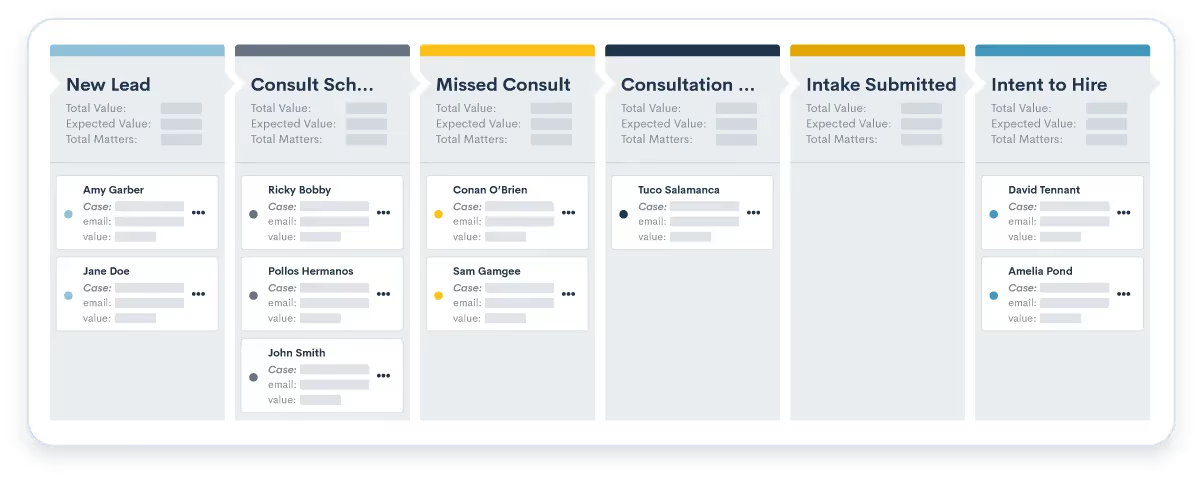
Why do law firms need a CRM?
At its most basic, a law firm CRM is a tool to help you manage your interactions with both your potential clients and current clients, but a good CRM does much more than that. It can help you automate client engagement, streamline your intake process, and keep your client data up to date.Software for law firm client relationship management enables attorneys to manage business development activities, including the client intake process, track tasks, and deadlines, and remind users of upcoming appointments. In addition, a CRM system can help generate reports which can be used to track progress and identify areas for improvement.
Does the size of a law firm matter when considering a CRM?
Ultimately, CRMs can benefit law firms of all sizes thanks to their ability to streamline operations and improve efficiency.
- For solo practitioners, CRMs can help manage and scale their law practice efficiently.
- For small law firms, CRMs can eliminate the busy work that keeps them from focusing on billable work and can help small firms scale their practice with a tech-driven approach.
- For midsize to large firms, CRMs can help deliver consistent, high-quality legal services at every step of the client journey while streamlining operations to accelerate growth.
What areas of law needs a CRM?
In today's world, a CRM can benefit nearly any area of law.
- For estate planning, a CRM can help to elevate the client experience by keeping track of important details and deadlines.
- In family law, a CRM can help attorneys handle sensitive matters efficiently, tactfully, and with the organization.
- Personal injury lawyers can use a CRM to schedule appointments and stay on top of the necessary details of each matter.
- Criminal defense lawyers can use it to give every client the representation they deserve.
- And for immigration lawyers, a CRM can help to build trust with clients and automate tedious administrative tasks.
No matter what area of law you practice, a CRM can help you to work more effectively and serve your clients better.
"Lawmatics has given me the tools I need to scale my practice and take on more volume than I ever thought possible." -- Bill Farias, Founder & Attorney, Farias Family Law, PC
What are the types of law firm CRMs?
There are four main types of CRMs: analytical, collaborative, operational, and strategic.
- Analytical CRMs focus on collecting and analyzing customer data to improve business performance.
- Collaborative CRMs help businesses improve communication and collaboration with customers.
- Operational CRMs automate and streamline business processes.
- Strategic CRMs help firms develop long-term plans for managing customer relationships.
Top 3 CRM features for law firms
When running a successful law firm, there are many moving parts, from keeping track of client communications to managing your pipeline. A good CRM can help you manage the numerous moving parts of your law firm, making it easier to run a successful business.
- Legal contact management will help you keep track of your clients in one central place so your team stays organized and up-to-date.
- Pipeline management tools can help you focus on prospective clients quickly, making the follow-up process more efficient.
- Automating client engagement means you never drop the ball on lead follow-up and consistently provide value to your clients.
How to evaluate the best CRM for a law firm
Generates Business
With so many CRMs on the market, how should you choose the best one for your firm? Perhaps the most important factor to consider is whether the CRM will actually help you generate more business. After all, what good is a CRM if it doesn’t help you bring in more clients? To that end, you should look for a CRM that has features specifically designed to help law firms market themselves more effectively.
Easy to Use
Another important consideration is the ease of use. We're not saying you aren't tech-savvy, but it's universally acknowledged that many lawyers are not particularly tech-savvy, so it’s essential to choose a CRM that is easy to implement and use daily. So look for a user-friendly CRM with a responsive client support team that offers training, enabling even the most technophobic lawyer to get up and running quickly and easily.
Simplifies Your Technology Stack
Finally, you should consider whether the CRM will simplify your technology stack or add another piece of software to an already complex setup. If you’re already using a case management system and an accounting system, for example, you’ll want to make sure that the CRM you choose integrates seamlessly with both of those systems.

Learn more about from our Sullivan Law & Associates case study.
Continue the conversation with Lawmatics
A CRM is a must for any law firm looking to manage and improve its business. At the very least, every law firm should use CRM software to keep track of client information, communications, and case history. However, not all CRMs are created equal. There are many different features available in various CRMs, so you must find one that fits the specific needs of your law firm. We can help you do that – schedule a demo with us today to see how our CRM software can benefit your practice.

A CRM helps simplify sales, marketing activities, customer service, accounting processes, and management for growing organizations. HubSpot can be an excellent CRM (customer relationship management) system for small businesses looking to enhance customer service, increase efficiency, and cut costs — but it is not to be mistaken for Small Law Firm CRM.
Why do companies use HubSpot CRM?
Companies use CRM for many reasons, but the overall goal is to improve the customer experience and increase sales. According to HubSpot’s Ultimate List of Marketing Statistics for 2022:
- Sixty-one percent of overperforming leaders say they are using a CRM to automate at least a portion of their sales process compared to 46% of underperforming leaders.
- The global CRM market is poised to reach about $113.46 billion by the end of 2027.
- Approximately 62% of marketers use CRM software for marketing reporting.
What is HubSpot best used for?
HubSpot CRM solves many challenges of business growth by automating contact management, company, and sales opportunity information and consolidating customer interactions through email, phone calls, social media, and the company’s website. HubSpot’s CRM also offers numerous free features, including:
- Reporting dashboard. HubSpot’s dashboard provides a single source of truth to connect a company’s contact, company, and deal data alongside its marketing, sales, and service information. In addition, users can build up to 300 dashboards to help team members customize their layout and track progress.
- Company insights. HubSpot’s CRM automatically populates details from its database of over 20 million businesses – all you need is a prospect’s corporate email address. Filters help users find whatever they’re looking for, whether contained in a sales call, email, note, or social media activity. Multiple users can access the information.
- Deal tracking. HubSpot's deal tracking software clarifies how much revenue is tied up in each step of the sales cycle, how much sales reps are responsible for, and details regarding new or incoming deals as they move through the pipeline.
- Pipeline management. HubSpot’s deal pipeline software is part of Sales Hub, and you can get started for free. However, for teams looking for more advanced CRM features, HubSpot's Sales Hub also offers premium features with its Starter, Professional, and Enterprise editions.
Given all these notable features, you might be wondering, “is Hubspot really free?” While HubSpot does boast a freemium version, the features and functionality necessary to adequately manage marketing, intake, and case management processes in a law firm are beyond what the business-agnostic software provides.
Is there a better CRM than HubSpot?
Although HubSpot can be a useful generic CRM for startups and small businesses, there is a better CRM than HubSpot. Law firms should consider seeking out a legal-specific CRM like Lawmatics, which is tailored to the law firm business model with bespoke features and functionality such as:
- Custom workflows. With Lawmatics’ all-in-one legal CRM, you can seamlessly move leads through the client intake process with custom marketing automation workflows. Our technology is designed to simplify the process and eliminate chaos while making a positive impression on your future clients.
- Swift, seamless intake. Lawmatics makes it easy to create your own intake process and efficiently capture the client information you need with a custom client intake form template for law firms. By establishing a clear and consistent process for client intake, your firm will save time, eliminate errors, and keep everyone in your practice on the same page.
- Instant appointment scheduling. No more asking, “What time works for you?” Instead, allow your leads and clients to book time on your calendar hassle-free with Lawmatics legal calendaring software that syncs with the cloud to manage your calendar in real-time and provides access to notes, data, and phone reminders. Clients can easily schedule and cancel meetings themselves, keeping everyone on the same page and on time.
- Targeted communications. With Lawmatics audience segmentation software, you can send personalized messaging and email drip marketing campaigns to specific groups of prospects and clients. Client list segmentation allows firms to target distinct groups of people and deliver personalized content based on their actual needs and challenges.
- Granular insights. Lawmatics visual legal data analytics allows firms to examine their data and make smarter decisions. Lawmatics law firm financial dashboard and visual analytics save you time by displaying your law firm's trends with clear visuals at both macro and micro levels. In addition, visual analytics provide greater insight into your internal processes so that you can motivate your staff in the right ways.
With these and other powerful tools, Lawmatics leverages the power of data to help law firms become more efficient and productive.
What CRM do lawyers use? Lawmatics is the #1 legal software for growing firms
Is your law firm looking to drive efficiency, attract more high-quality prospects, increase client engagement, and accelerate growth? Lawmatics is the attorney-client relationship management platform for law firms. If steady revenue growth is your goal, request a demo today.
Law firms need a customer relationship management (legal CRM) to improve relationships with customers and drive sales growth. Businesses of all sizes are reaping the benefits of a CRM that helps them onboard new clients, build engaging relationships, and consistently deliver polished client experiences.
What is CRM?
Customer relationship management (CRM) is technology businesses use to manage their interactions with current and potential customers. Some CRMs are generic while others cater to certain business verticals or even specific sizes of businesses, such as Small Law Firm CRM (Lawmatics). The most effective CRMs include powerful tools to help companies:
- Expedite growth. Once a business begins to grow, friction may result, allowing valuable leads to fall through the cracks. But all-in-one CRM platforms enable organizations to track everything in one centralized space, so nobody drops the ball on lead follow-up.
- Keep everyone on the same page. With various natively-built tools and integrations, CRMs help businesses align their sales, marketing, and service teams to centralize daily workflows and business goals around clients.
- Share information. No matter who speaks with a potential client – sales, service, or marketing professionals – information is automatically synced and updated in the CRM system, giving a team access to accurate records that can be shared within the platform.
- Gain insight. CRM platforms do more than tell a business where a lead originated. They provide actionable insight into precisely what a potential client clicks on when they receive an email marketing message, how many times a prospect opened an email, how often a lead interacted with a sales team, and more.
- Make better decisions. The data a CRM allows businesses to effectively communicate with their current audience and reach out to those who have shown interest in the past. In doing so they seize the opportunity to provide valuable guidance during the decision-making process.
With CRM in place, marketing departments can focus on creating campaigns that resonate with an audience, sales teams can offer more in-demand products and services, and efficient companies can better serve customers.
What are the benefits of CRM?
CRM software provides numerous benefits to businesses, including law firms, that want to increase efficiency and provide stellar customer service. Five of the main benefits are custom dashboards, personalized outreach, automation potential, enhanced collaboration, and reliable data and metrics.
5 benefits of CRM for law firms:
- Custom dashboards. When a business uses a spreadsheet, data must be inputted manually, an error-prone and labor-intensive process. However, a CRM does most of the work, and customized dashboards can be set up for every user with login credentials. Intuitive dashboards allow users to see the data that is most important to their unique workflows without having to sift through data or run a report.
- Personalized client outreach. A CRM continually gathers data regarding the audience, market, and industry relevant to a particular business. As a result, users can create more relevant, personalized messaging via a drip campaign – a series of automated emails triggered by specific actions directed to a particular audience.
- Automation potential. CRM platforms offer automation, which reduces the time spent nurturing leads, prioritizes which marketing qualified leads (MQL) will most likely transition into sales qualified leads (SQL), and handles routine customer questions with chatbots or other automated messaging.
- Enhanced collaboration. A cloud-based CRM platform provides an up-to-date, shared record of all customers’ conversations, interactions, and contact information. Some systems also offer built-in collaboration tools that enable multiple users to work on one file simultaneously and follow the progress of individual matters to create a seamless workflow.
- Reliable data and metrics. Data is a valuable resource for businesses; however, it’s not usable until it is organized and converted into an actionable format. A CRM system helps companies see who interacts with the organization and through what channels. It enables the team to run reports to see where opportunities exist, how they communicate with prospective and current customers, and review sales and customer service trends.
Finding clients is challenging, and once you find them, you must establish and maintain strong relationships to keep them. CRM allows businesses such as law firms to offer high-quality, consistent, and timely customer interactions at all stages within the sales pipeline.
What is the purpose of CRM at a law firm?
Strong client relationships are at the foundation of a successful law practice. According to The Client-Centered Law Firm, to thrive in today’s competitive legal environment, law firms need to be client-centered. This means they must provide a positive client experience by building trust, forming a solid working relationship, and leaving clients willing to refer others once their matter has resolved. Legal CRM platforms help lawyers attract and retain clients, grow the firm, and support continued business expansion. Lawmatics law office CRM elevates the client experience with automated processes, customizable digital intake forms, email workflows, advanced custom fields, document request templates, e-signature capability, and more. To learn more about how the Lawmatics system will help your firm’s process run smoothly, request a demo today.
In the latest episode of Legal News Reach, Lawmatics founder and CEO Matt Spiegel joined host Crissonna Tennison to discuss what it takes to set up a law firm for success. They talked about what a growth mindset looks like at modern law firms. Here are some key takeaways:
The legal experience
Law firms don’t just provide legal services; they provide legal experiences. In addition to judging attorneys by case outcome, clients judge their attorneys by less tangible metrics:
- What was attorney-client communication like?
- Did the attorney follow-up with the client in a reasonable time?
- Was the process of making an appointment and sharing documents quick and convenient?
For modern law firms to surpass client expectations, they have to consider and design for the client experience.
Your law firm as a business
The client experience is why you need to evaluate your firm’s processes as both a lawyer and a businessperson. Along with building your firm to produce legal outcomes, you need to build it to produce business outcomes:
- How is your marketing strategy targeted?
- What’s your strategy to grow the size of your firm’s staff?
- How will you secure the reviews and referrals that are crucial to acquiring new business?
When you’re balancing your legal and business priorities, the tasks pile up and the to-do list runs longer and longer. You can only get so far with manual processes. Modern law firms are capable of a dynamism that’s only achievable with a sophisticated tech stack and an understanding of a law firm as a business.
Final thoughts
Modern businesses have entered a new era of potential because of the tools at their disposal. While CRM and marketing automation platforms have been widely adopted in other industries, only recently has the legal industry gained access to similar tools that can meet the unique needs of law firms. With legal automation software like Lawmatics, you can do more while having fewer to-dos. Freeing up valuable time from administrative work allows you to design and deliver the best possible client experience.
Podcast transcript
Crissonna Tennison
Thank you for tuning into the Legal News Reach podcast. My name is Crissonna Tennison, Web Publication Specialist for the National Law Review. In this episode, I will be speaking with Matt Spiegel, founder of Lawmatics. Matt, can you tell us a little bit about your background and what led you to start Lawmatics?
Matt Spiegel
Yeah, sure. So first of all, I'm very excited to be here, so thank you guys for having me. But yes, I’m Matt Spiegel, I am the founder and CEO of Lawmatics. I was a practicing lawyer, I don't actually practice anymore, I haven't practiced in like 11 years or so, but I still have my bar card. Long story short, I had a problem at my law firm that I wanted to solve with technology, and ended up starting a company called MyCase. So I founded MyCase, back in, like 2010. For those of you that don't know, MyCase is now one of the biggest practice management software platforms on the market. So I was the original founder of that company, I also ran the company for five years. And then I left, and after a couple years doing some things unrelated to law and legal tech, I decided to come back into the legal tech space. I'm a glutton for punishment, and Lawmatics was what I decided to build. And it was really a product of what we saw when I was at MyCase. We saw the shift in the market, we saw lawyers starting to think about their law firm like a business and not just like a law firm. And when they start to do that, then they need business tools, right? They need the same kind of tools that other companies throughout industries, different genres of companies, tools that they've had forever, right? And so there was a little kernel of this idea of lawyers shifting to this mentality, you know, back in 2014. And so fast forward to 2017, we really saw this starting to become an opportunity that we thought was going to be a big one. And so we built Lawmatics to really address the business needs of a law firm and not as much of the practice management needs, right? The practice of law, we felt like that was pretty well taken care of. Our goal was to focus on the business side of it, you know, the lead management, the marketing, the automation, that sort of thing.
Crissonna Tennison
That’s awesome, and it sounds like a major change for you. When you were first starting your switch from being a lawyer to starting MyCase, what skill sets did you have already? And what skills did you have to develop along the way?
Matt Spiegel
Yeah, so it's a good question. I mean, obviously, starting a software company is pretty different than being a lawyer. But I would say that I was probably a bad lawyer. And I just was always, I always had the skill set to be a decent entrepreneur, I guess. But I was probably just a really bad lawyer. It was very different. Well, I should strike that. Because the way I approached law--I was a criminal defense lawyer. And so I was in court all the time, I was doing a lot of trials, you know, it's a very unique practice area. But I treated my law firm like a business right from the get-go. So I worked at a big law firm for like, four years, and then I started my own practice. And when I started my own practice, I was like, “I need to treat this like a business.” And I think that was the way I thought about it, even more so than being a good lawyer. And I think that was just because I was probably very entrepreneurial, even then. And so I was thinking about my law firm as like a business that I could build, not necessarily, “I'm a lawyer, I'm going to practice law.” So I think I always had that mentality, it was just manifesting itself within the confines of the legal space with starting my law firm. But as soon as I saw this need in the market for a product, which became MyCase, I kind of ran with it. It was like, “Wow, I'm building this business, a law firm, which can be big, but it's going to have a ceiling, or I can start this, like, software company, which the ceiling is unlimited.” That just felt so much more exciting to me.
Crissonna Tennison
I do think it is very interesting that you brought up the entrepreneurial mindset, because from what I've observed there does seem to be a difference between that mindset and a lawyer mindset. It's really interesting to hear you break that down a little bit.What are some challenges that you're most proud of overcoming in starting both MyCase and Lawmatics?
Matt Spiegel
What I'm most proud of, I think, is the legal tech space is not an easy space to enter. You know, there are a lot of companies that get started and not a lot of companies make it through. The fact that I've been able to build two companies in legal tech that have both been able to support these teams--like what I'm the most proud of in MyCase and Lawmatics are the teams that we built. They're the people who made the company go and at MyCase, we just had an incredible team. It was such a great culture and at Lawmatics I think it's even better, like, you know, we've built such an incredible team with with such an incredible culture, and it's such a fun place to be and to work at. And so that's a hurdle, right? It's hard to build good cultures. You know, it's hard enough to build one company, one startup that becomes successful, let alone two in the same space, especially when the space isn't the biggest space in the world. So I think for me, you know, that hurdle of coming back into the legal tech space and trying to innovate in it, I'm think I'm most proud of that. And then the fact that we've been able to build such great teams. And that has nothing to do with the legal tech space, that's just, you know, company mindset in general, company building in general. I think if I had to say what I'm most proud of it would be the teams that we've built.
Crissonna Tennison
That makes a big difference. And I feel like the teams you're able to build and the workplace culture you're able to foster really is everything when it comes to building a company.You say that you saw some problems that you thought could be solved while you were a practicing defense attorney. So what exactly were you looking for that wasn't available?
Matt Spiegel
MyCase came as a result of client communication problems. So my first company was a result of actually a State Bar complaint that I got. When I started my first law firm, I got a State Bar complaint pretty much right away. And it had nothing to do with the way I practiced, it was nothing to do with the outcome of the case, it was simply, “Hey, you didn't call me back quick enough.” Right. And this is a tale as old as time. This is like, the most common complaint at every state bar still, even 12 years later, is attorney-client communication. And so I thought there has to be a better way to communicate than like, just calling me on the phone when I'm in court all day, every day. That cannot be the answer. And so I sought to develop a client communication portal. And that is what MyCase started as. Now it evolved into something so much more powerful and such a more robust piece of software. But the initial version, the initial idea was just simply a client communication portal. And so that's how MyCase came about. Lawmatics really came about from what I observed talking to thousands and thousands of law firms in my time in MyCase, and what we saw was this shift, this idea that lawyers were starting to think about their law firms as a business, and not just the practice of law. And when I saw that, it's like these people, if they have that mindset shift, they are going to experience some challenges with how to do that. Right? If they're going to start doing marketing, if they don't have a way to measure those marketing efforts, they're going to be met with challenges, if they don't have the ability to automate touchpoints, nurture campaigns, newsletters, like all the different things that are kind of marketing 101, if they don't have that infrastructure in place, they're going to be met with a lot of challenges. We anticipated that happening. And that's sort of the problem that we look to solve with Lawmatics. And again, we weren't reinventing the wheel. Products to solve the problems that Lawmatics solves have been around for decades, products like Salesforce, or HubSpot, they've been around for a really, really, really long time, they are not new concepts. What is new is a platform that is specifically built for law firms. And that's where lawyers are a bit unique. They do and I'm not gonna say they require, but they do significantly better and they adopt more often tools that are designed for them, because they do have some unique requirements. And so that's ultimately the problem that we look to solve with Lawmatics.
Crissonna Tennison
So as a lawyer, and as a person who's running a law firm, you want to provide a great client experience, but you actually need to find clients in the first place. So what can law firms do from a marketing and client intake perspective to help this process?
Matt Spiegel
It's about the client journey, right? A law firm needs to think about, “What is the journey that a client goes through with your law firm?” and we break that journey down into three phases.Phase one is the intake phase, which is from the moment that they reach out to your law firm, by whatever means, all the way through to the point where they sign a fee agreement, and they pay you your retainer. Then you have phase two, which is an active case, you're actually handling a case for them that has a definitive start and end time. And then phase three is after the case is over. Now, they are a former client. That is a very important part of the relationship.So what Lawmatics is designed to do is help you with everything in phase one and everything in phase three, the practice management software like MyCase, they are designed to handle everything in phase two. So that journey starts from the very moment that a client reaches out to your law firm. And you have to understand that from that very moment, you have opportunities to delight your customers, and you need to think about it in terms of customer service: what kinds of service, what level of service are you providing to your client? And this is right from the get-go. So if someone reaches out to you, and they fill out a form on your website because they're interested in talking to you, and maybe they don't hear anything from you until the next day, that's not good customer service. The first impression that they're going to get is that you don't respond to things very quickly. And so that initial moment of contact, there's an opportunity to delight your customer, right, you can immediately engage them and show them that you're on top of it. And that's not something that a lot of law firms can do without the help of technology, right? You need technology to help you with those automated touch points. And so that's just one example. But every step of the journey is an opportunity to delight your customer with customer service, not law. Forget about law. Right now we're just talking about providing good bedside manner, good customer service. I have a saying that I'd love to repeat, which is that you could be the best lawyer in the world, but if you provide bad customer service, you are going to have a failing law firm. And the vice versa is true. You could be a mediocre or even a bad lawyer, but you could provide really, really excellent customer service, and you could be wildly successful. The outcome of the legal matter is not always the most important part of that relationship.
Crissonna Tennison
That's something that I never would have thought about. But that makes sense that as a lawyer, of course, obviously, you want to win your case for your client, but you really want them to feel cared for and respected and like they can get in contact with you. And yeah, that is a lot of work to keep that going, especially because being a lawyer and running a law firm is so much work.
Matt Spiegel
Some of it is totally impossible! So here's another example, let's say after the case is over, something that would be a pretty nice thing to do would be to just send your former clients a note on their birthday every year, pretty simple. But you've got 2000 old clients, how are you going to keep track of all their birthdays and make sure you're sending an email? It would take you, it would take an army to do that. So if you have a tool that can automate that whole process, all you do is click one button when you first set up the software, and then in perpetuity, every one of your former clients is going to get an email on their birthday every single year. So there's so much that you can do that you can't do manual, you have to have technology to help you do it. I think that that's really important for law firms to understand when they're looking at, “Well, what does this mean? How do I provide good customer service? Like what role can technology play?” I think it's just really important to think about things that way.
Crissonna Tennison
The last few years have been a really chaotic time, especially for growing law firms. So what kind of feedback have you gotten from users of Lawmatics during this time?
Matt Spiegel
So the feedback that we get from our customers is pretty profound. So it's two things, it's what Lawmatics has enabled them to do. And then, you know, maybe not as sexy of a response is the amount of time that Lawmatics has saved them. So obviously, a product like Lawmatics that does so much around automation is going to save you time that really can't even be put into words, the true impact can't just be measured. And you know, some law firms are saving 20 hours a week. And that's just a crazy amount of time. And the impact that has on a firm as a whole is pretty remarkable. But it's really what Lawmatics has enabled them to do. Right? I mean, Lawmatics has really enabled growth for its customers. I think that's the way to look at it. I think law firms before you know, our customers, before they used Lawmatics, it was really difficult to facilitate big growth for them. I'm not saying that law firms couldn't grow before, that's not true. But our customers were really struggling with certain aspects of it. They were getting into marketing, they were getting into intake management and thinking about things beyond just practicing law and how to attract more leads, and how to convert more of those leads into customers. But they had no way to manage it all. Maybe some of them knew what best practices were. But they couldn't actually deploy those practices because they didn't have the ability. Lawmatics has really enabled them to do the things that they've wanted to do on the lead management, the conversion side, the generating leads, it's really pretty cool to hear the stories from these law firms that were struggling before to execute on growth plans, and now are exceeding what they thought they would be able to achieve.
Crissonna Tennison
I'm curious to hear more about why it's so essential for those people who are running growing law practices to invest in quality practice management and CRM software. At this point in the game, how much do firms risk falling behind their competitors if they don't use one?
Matt Spiegel
Personally, I feel like practice management software, right, like the MyCases, the Clios, the Practice Panthers of the world right now, I feel like that's kind of table stakes, there are definitely still a lot of law firms out there that don't use a platform like that. And for those firms, there must be some valid views. And but the vast majority of firms out there will have some sort of platform in place to help them with their time and their billing and their case management. I think that that's table stakes in the industry now for the most part. But if you don't have that, if you're like doing your billing manually, that just is a colossal waste of time. And you would be falling behind the rest of the industry significantly, just because of the time that you're wasting to input billing hours and send out invoices and things like that. But as far as CRM, this actually has the potential to make you fall behind even more. So first of all, we are at the inflection point for like CRM software and law firms. It is starting to become the focus of law firms, their understanding just how valuable it is and what they can do with it. And there's a massive shift going towards this type of thing. That's one reason why, you know, if you're not on that boat, then you just fall behind technologically, but more importantly, it's the byproduct of using a product like this. It's the shift in thinking that is happening where you're really going to fall behind because what it means is that law firms are out there thinking about marketing. They're thinking about lead generation, they're thinking about how to get more business and build their law firm. That means they're going to be going out and taking leads from you if you're not also thinking about that. So it's so much more than just a piece of software that you're talking about adopting, you're talking about adopting a strategy for your business and your growth. So if you're not on board with that, you are going to fall behind in ways that you probably haven't necessarily thought of just yet.
Crissonna Tennison
That definitely makes a lot of sense. When we look at recent years, how have expectations of legal clients evolved, kind of along the lines of what you're saying, if more and more firms are starting to really reorient their thoughts toward how they run their businesses and interact with their clients? How have their expectations evolved? And what changes have you seen in law firms and their operations since you started practicing?
Matt Spiegel
What we've really seen, I think, again, to me, it's just been the wide adoption of some type of software platform and that software platform being in the cloud. So in starting MyCase, I was one of the people who was at the forefront of this shift to cloud computing in legal. I've gotten to observe this whole thing over the last, more than a decade at this point. And it's really profound. It's really cool. Right? It's a mainstay in law firms now, cloud software. And what that's enabled, operations are just easier. And there's less operative people at a law firm, I think now, right? It's just, it requires less, because so much is in software, it's automated, it's easy to access, it's just makes things more streamlined. And so we see less of a need to have operators in a law firm and the ability for lawyers to focus more on actually handling their cases. A lot of this depends on the size firm that you are at. There's a massive segmentation inside of the law firm industry, right? Like if you have solo and small law firms, they operate very differently than midsize or large law firms.
Crissonna Tennison
That kind of goes along with things that we've heard about in the past and prior conversations about CRM systems in general. Do you think that law students will have to start having practical knowledge of CRM systems as they enter the industry?
Matt Spiegel
No. I mean, it can't hurt. But no, we saw this with practice management, too. I remember at MyCase, I would go down to the law schools, and I would help teach classes on managing a law practice and practice management software and what that meant and what it was. So the concepts we were teaching, but we weren't giving them familiarity with the actual software themselves. I don't think it's difficult to pick up, I don't think it's really that critical. What I think is important is understanding the importance of these concepts to the business. But I don't think it's critical for people coming into law firms to like, have knowledge of the systems. I mean, that would be a bonus, it would be cool. I don't think it's something that is required.
Crissonna Tennison
So along those lines, would you say there's been a change in law school education, in terms of a focus on how to run a law business? Like is that something that's showing up a little bit more in legal academia than it was in the past, or maybe when you were in law school?
Matt Spiegel
So when I was in law school, it was really not a focus. Within five or six years after I left law school, it started to become a focus again, I started getting invited into law schools that actually had practice management classes, right, like how to run a law firm. To be honest with you, in the last few years, I haven't seen it as much. So I don't know if there was a small shift towards it, like 10 years ago, and now it's shifted away from it. Maybe people thought that it wasn't a practical class. I don't really know. But I don't think that we've seen a massive shift towards it in the last five or six years. I think it's valuable to be honest with you. I think everyone always says, you go to law school, and the stuff you learn doesn't necessarily help you as a subject matter. It doesn't necessarily help you, when you get out of law school. What law school does is teach you how to think like a lawyer. Right? And that's like the old cliche, but I think it's relatively true. If law school is focused on the practicalities of running a business and running a law firm. I think that would be incredibly helpful. But unfortunately, I don't have that much influence over this.
Crissonna Tennison
For our listeners who are interested in checking out Lawmatics, can you kind of take them through the process of getting started using your platform? Where can they find you?
Matt Spiegel
Finding us is very easy, anybody can go to our website, www.lawmatics.com. And from there, what we always have people do is we have them sign up for a demo. And when I say signing up for a “demo,” I use that term a little bit loosely, because what you're really doing is you're going to be talking to one of our specialists, who's really going to spend some time learning about your law firm trying to, first of all make sure that as a law firm, you're ready for a tool like Lawmatics, like Lawmatics is going to make sense for you as a law firm, and then starting to understand “What do you do currently? What are your processes like?” and then starting to show you how Lawmatics might be able to help. So when we get on this demo, it's almost like a consultation. We have a lot of best practices that we share with people during this consultation, this demo, to hopefully get these law firms thinking about things a little differently. We really like this process. And that's the most important thing for people to do is to just come to our website, sign up for that demo, you're going to learn a little bit about Lawmatics, you might learn a little bit more about your law firm and certain steps you might need to take in order to execute on some of the initiatives that you're looking to execute on at your law firm. And then we will show you how Lawmatics hopefully can help you do that.
Crissonna Tennison
That's awesome. It sounds like the Lawmatics experience can be tailored to a variety of different law firm types.
Matt Spiegel
Lawmatics is really for everyone and anyone. We see it all across the spectrum. Sometimes brand new firms that are just trying to set up their tech stack and Lawmatics is the foundation of it or law firms with several hundred lawyers who have been around for a long time, but they need to update their tech stack and they see a lot of value in it.
Crissonna Tennison
Our time is coming to a close, so are there some points you would like to showcase that align with your organization's experience?
Matt Spiegel
Lawmatics is Lawmatics, it's great if people want to check it out, I encourage them to do that. But what I encourage all lawyers to do, regardless of the software platform, is to just start thinking about your law firm a bit differently and start thinking about your law firm as, you’ve got to be good at customer service. You have to think about satisfying your customers outside of their case, you cannot think, “if I get them a great outcome, if I'm a criminal defense lawyer, and I just defended my client out of prison,” you can't just assume that that's going to be enough, that that's going to make them really happy. What you need to do--and this is a point that I was thinking about earlier that I want to bring up now--is this is what you need to remember. And if you remember this, I think it gives you a different lens to look through almost all practice areas, right? Almost all of them fit into this mold, where it is the most important thing happening in their life. If it's a criminal offense case, if it's a personal injury case, if it's a bankruptcy case, if it's a family law case, immigration, all these practice areas, like the vast majority of practice areas out there, the case that you are handling for your client, it is the most important thing that they have going on in their life. For you it's just another client, right? And so sometimes it's hard to have that perspective. But if you think about it like that, if you think “Hey, wait a second, this is the most important thing happening in their life. If I had the most important thing happening in my life right now, how would I want to be treated?” If you shift to that line of thinking I guarantee you will provide incredible customer service, and that's going to benefit your firm.
Crissonna Tennison
Yeah, that makes a lot of sense, especially because if they're dealing with something that is the most important thing in their life, and you're the person guiding them through that, then that relationship is pretty important. So thank you for kind of expanding on that a little bit more.Thank you to Matt Spiegel for taking the time to join us on the podcast to talk about Lawmatics and the different mindsets that can help a law firm be more successful. We really appreciate you joining us today.
Matt Spiegel
Yeah, thank you guys so much for having me. I really appreciate it.
Conclusion
Thank you for listening to the National Law Review’s Legal News Reach podcast. Be sure to follow us on Apple Podcasts, Spotify, or wherever you get your podcasts for more episodes. For the latest legal news, or if you're interested in publishing and advertising with us, visit www.natlawreview.com. We'll be back soon with our next episode.

Law school didn’t necessarily prepare you to run a business. If you operate a law firm, you might feel like you’re drowning in marketing jargon and business acronyms and initialisms. One increasingly common industry term is CRM or legal CRM. Here’s everything you need to know about what it means and what it does.
What is CRM?
CRM stands for Customer Relationship Management. A CRM platform is software designed for businesses to organize, track, and analyze data related to their customers: communications, notes, documents, and more. It covers the entire client lifecycle, from marketing and referral sources to soliciting reviews after a service is performed. By consolidating communications, records, and data into one central hub, businesses get both a birds-eye view of their operations and granular details necessary for day-to-day functions. Simply put, a CRM saves time, spares headaches, and impresses customers.If any specific functions of a CRM seem complicated or like a lot of work, just remember that automation is your friend. A quality CRM comes with tools like automations so that your firm can get more done while doing less work.
What are the main types of CRM?
Broadly speaking, there are 4 types of CRM systems on the market: analytical CRM, collaborative CRM, operational CRM, and strategic CRM.
1Analytical CRM
Analytical CRMs focus on using customer data to inform strategic decisions. This may have an emphasis on marketing, such as what ad campaigns drive the most engagement and convert the most prospects into customers. An analytical CRM provides insight into your customers’ behavioral trends, and in doing so identifies current strengths and opportunities. Analytics create a high-level overview necessary for businesses to be responsive to the needs of their customers. Think of an analytical CRM as a way of listening to your customers, only you’re listening to their actions instead of their words. For example, a personal injury firm could use an analytical CRM to optimize its client intake process with a deeper understanding of what causes a prospect to hire their firm.
The benefits of an analytical CRM system are in increased business efficiency. Are your current ad campaigns providing enough return on investment? Is there less demand for one of your services than you previously thought? By diving into the insights of an analytical CRM, you can target leads and prospects with segmented campaigns, increase your ROI, optimize your investments, and create customer journeys that will leave your customers satisfied.
2Collaborative CRM
A collaborative CRM is a tool for internal communications and collaboration. This is most useful if a customer will have contact with several touch points within your business. By keeping up-to-date customer data in one system, businesses can impress more of their customers with a consistent and personalized approach. The data tracked in a collaborative CRM allows your support team to see that they’re not on a call with Client #24601, but with Sandy from Palm Beach who called the billing department last week regarding a recent development in her case. Although a customer may not have a direct interaction with a collaborative CRM system, their customer experience will be shaped by the CRM’s ability to create seamless interactions across all departments. For example, a larger law firm might have a client with multiple matters spanning different practice areas. A collaborative CRM captures and presents a unified story of that client’s relationship with the entire firm. The benefits of a collaborative CRM lie in seamless experiences for both your customers and your staff. Improve real-time communication between silos, and identify opportunities to create a more robust and consistent customer experience.
3Operational CRM
An operational CRM is most concerned with facilitating business operations that grow customer relationships. Whereas an analytical CRM is about ‘seeing’ and a collaborative CRM is about ‘sharing,’ an operational CRM is about ‘doing.’ These typically feature tools like email campaigns, workflow pipelines, and automations for marketing and sales. Operational CRMs often power customer interactions like self-service appointment booking or automatic follow-up emails. A law firm that handles high volumes of consultations might prefer the task-oriented features of an operational CRM.The benefits of an operational CRM come in more personalized experiences for your customers. Automations can personalize emails and other communications with names and relevant information, without your staff needing to do extra work. In fact, your staff will save time because an operational CRM will execute manual, repetitive administrative tasks such as client intake, conflict checking, consultation scheduling, and more. Your staff can instead focus their energies on other aspects of growing the business and delivering quality service to your customers.
4Strategic CRM
A strategic CRM specializes in long term customer relationships. While an analytical CRM focuses on general trend insights, a strategic CRM provides feedback on ongoing relationships. Some common features of a strategic CRM may also be found in collaborative CRMs, like data on previous interactions with a particular customer. If your law firm succeeds because of repeat clients, a strategic CRM tells you why a client keeps coming back.The benefits of a strategic CRM, like with analytical CRMs, are in its ability to form the foundation of data-driven marketing and operations strategies. As an overview of the customer’s journey through a long term relationship, a strategic CRM offers insights on areas like marketing, sales, and customer service.
What CRM is right for me?
The answer depends on the needs of your law firm. Are you looking for a tool that helps customer acquisition? Do you need help creating a marketing strategy? Want to make sharing information easier within your organization? Do you need industry-specific features, like conflict-checking for legal matters?One thing to note: some CRM systems combine features from multiple types of CRM. The only way to know for sure if a CRM is right for you is to try it. If you’re a law firm in search of an analytical, collaborative, or operational CRM, get a demo of Lawmatics today. Our all-in-one CRM for law firms can elevate your firm’s efficiency, organization, and customer service. Lawmatics is the CRM you need it to be.


Recently, Lawmatics founder and CEO Matt Spiegel joined the Law + Finance Podcast to discuss the legal tech landscape. Learn more about the founding of Lawmatics, how new features come about, and how the needs of law firms are changing. Read the transcript below, or watch the full conversation above.
Podcast transcript
Terrell Turner
Hi, I'm Terrell Turner, the host of the Law and Finance Show, and today we have another great guest on. Now, the reason why I'm excited about this guest is because many law firms that I have talked to, ones that we do bookkeeping for, and helping them with CFO services, are really trying to figure out how do you really keep a good handle on the CRM part of your business? Just managing that pipeline, all of the data, and the insights that you need to get to make sure that you're growing your firm, and you're on top of that sales funnel, and the front end of your firm. And there's so much more value that you can get when you are using the right tool. So, today we're going to be interviewing Matt Spiegel from Lawmatics, and we're going to be talking about some amazing things that they're doing, weigh his history with being a lawyer, helping build out some of the world's most successful law technology solutions, so stay tuned for today's episode. So, without further ado, let me bring on Matt. Matt, welcome to the show. How are you?
Matt Spiegel
I'm doing well, Terrell. How are you?
Terrell Turner
I am great. I am great. Matt, now a lot of lawyers that I've talked to are, they're familiar with Lawmatics, and I've heard great things. Like I said, literally as you, and I were talking right before this, I was working with a lawyer onboarding, and they were telling me about how much they love Lawmatics. So people may be familiar with Lawmatics, but they may not be as familiar with Matt. So can you tell us a little bit about your background?
Matt Spiegel
Yes. So happy to give you some color there. So, I'm a lawyer, I still have my license. I think my parents would be very upset if they spent all this money on my legal education, and then I didn't at least keep my license, even though I don't practice anymore. So I do maintain my license. So I still technically am a lawyer, but I practiced for five years. And then long story short, I ended up starting the company called MyCase, which is most of your listeners, if they're in the legal tech, they are in the legal world. They probably know what MyCase is. So I started that company back in 2010, and I sold the company, I stayed with the company until 2015. Obviously, MyCase today, especially kind of coupled with a lot of your listeners who are interested in finance, and how it intertwines with the world of law, MyCase is now owned by LawPay. LawPay bought MyCase about, I don't know, a couple months ago.So, it's very much one of the biggest legal tech companies in the world. And so now in 2017, so I took some time off doing some other things unrelated to law, or legal tech. And then in 2017 I decided that the law firm world, the legal world, was very much missing a critical part of business management. A lot of tools had been built to help us manage our cases and to help us make sure that we get paid. That's good. But no tools had really been developed to help us run our business, and nurture our clients, and create better customer experiences. And so that's why I ended up starting Lawmatics at the end of 2017.
Terrell Turner
Awesome. Now, one other questions I'm curious about, because you hear a lot of people talk about, they went through law school, become a lawyer. You don't often hear the storyline of, you know what? I started developing legal technology. So where did that kind of come into play for you?
Matt Spiegel
I mean, I think most people in legal tech have a similar story in the sense that I scratched my own itch. So I experienced a problem. I mean, MyCase, most people don't really know, but MyCase was started as just a simple client portal. That's all MyCase was. It was not a practice management tool. It didn't do time, and billing, or all the other bells and whistles that it does now. It was very simply a tool to just share data with your client. And this was because I had a client complaint. I had a bar complaint from a client about my communication, just basically that I didn't call them back quick enough. I didn't return their calls.Even though I did, it wasn't on their time. And so I thought to myself, "This was really silly, there should be an easier way to communicate these things to my client." And doing so with technology was really the only way and there was nothing out there to do that. And so that's, ultimately, how MyCase was born. So, I think this idea of experiencing a problem, and going out, and determining that there was nothing in the market to solve that problem for me, just going out, and building a solution myself, that's ultimately how it went.
Terrell Turner
Awesome. I wonder for when it came down to Lawmatics, I mean creating another technology solution to solve a problem that not only you experienced, but probably thousands of other lawyers when it came down to that, doing the research on, hey, first, let me see if there's something else that's out there. About how many different options of different tech solutions did you end up looking at before you came to the conclusion, "Hey, you know what? No one does what I need it to do?"
Matt Spiegel
Well, luckily, I knew, right? Because I had been in this space for a long time. So, I think I had an advantage in that building MyCase. I kind of knew everything that was out on the market. I knew what solutions were there. I knew what problems were being solved and what problems hadn't been addressed yet. I also had an idea for what problems were on the horizon. Lawmatics, kind of take a step back. Lawmatics would not be possible if lawyers weren't starting to think about their law firms as more than a law firm. If they weren't thinking about their firms as businesses, then Lawmatics wouldn't make sense, because Lawmatics is a tool that helps you think about the business of your law firm, and the things that make up a good business, not just practicing law. And so if you rewind 10, 12 years ago, the legal space was not there.They were not thinking about their law firms like businesses. They were just thinking about them like law firms. They were just focusing on being a lawyer. But in 2014, 2015 when I was still with MyCase, we started to see that sentiment shift a little bit. We started to see a little kernel of this idea, this concept, of thinking about your firm as more than a law firm, and thinking about it like a business. And so now fast forward two more years, your 2017, and now that environment has really started to change, and this idea of running it like a business was starting to become much more mainstream. And so that made a tool like Lawmatics very valuable.
Terrell Turner
One of the things that, it makes me wonder, because I see a lot of parallels between how lawyers think about law firms, and even when I talk to other accountants. I mean it's just where a similar journey of, for the longest accountants did not think of the firm as I'm running a business. It's just like, "Hey, I'm just practicing accounting." I wonder, from your perspective, did you see anything that started to trigger people to open their eyes to, hey, I'm not just practicing law, I'm actually running a business that happens to practice law?
Matt Spiegel
Yeah, in my opinion, what we saw was a shift to smaller law firms, and competition. So what I think you saw was you saw lawyers, you saw a lot of lawyers leaving big firms, and going to start their own firm, become a solo lawyer, hang their shingle. Then so you now have the market flooded with more small law firms. And all those small law firms are like, "All right, we need to go and advertise. We need to go get business." So when you have more firms, you're just naturally going to have more competition to get clients. And when you have more competition, now you need to do more things than just practice law. You've got to do things you're not necessarily used to doing in order to earn that business.You have to go and get it. It's not just going to come to you before. If you're in Cleveland, Ohio, and there's 10 law firms, business is going to just come to you, you're going to have plenty. But if you're in Cleveland, Ohio and there's a thousand law firms, business is not just going to come to you. You got to fight for it. And so I think that's what happened. And that forced lawyers to start to think about things beyond just practicing law. They had to think about how to wow their customer, how to go and market, how to attract them, and then how to close them, right? They got to sell.
Terrell Turner
Gotcha. I would guess probably similar to accountants, that became a new skill that they had to learn. Now, as they're kind of learning that new skill, I mean, then having a tool that helps them kind of understand, "Hey, where is this client in that journey? Or how is that working?" How did you find creating a tool in a way where the learning curve for using Lawmatics isn't so high that they get discouraged, because they're having to learn sales, and they got to learn how to use the tool to help them. How did you approach that where it's like, "Hey, how are we going to make this learning curve for this tool?"
Matt Spiegel
That's a tricky question. I don't know that we've done that well yet. I think we're still learning. I think, well, you make the assumption that we're good at that. Maybe we're not. No, I mean, we're always getting better at that, but I think that is the tricky thing. But I think what's what we've done, one way that we approach that is, look, we've been doing this for a long time. We've worked with thousands of law firms at Lawmatics and have worked with tens of thousands of law firms at MyCase. So, we've got a lot of experience at this company now. And so when we sit down with a new customer who's like, "All right, I've never used a CRM. I've never thought about my customer journey, I've never thought about different touch points and how to nurture them. And I've never thought about when someone's case is over, how I want to continue to communicate with them for the first year, or the first five years, or every year on their birthday. I've never thought about that."So, this is a big ask of them. And so the beauty is we do know some best practices we can help. And so our approach is to actually really push them in a direction, and help them with best practices so that they're not just doing it all from scratch, and they're not relying on themselves. This is not something where they're on an island just trying to figure out what processes to implement on their own. We really want to be a partner for them, and share our experiences, couple that with what they do, and see if we can actually improve their whole process, and experience.
Terrell Turner
Awesome. Now, I'm curious for, as you develop new features, or there are different things that have come out with Lawmatics, have there been any features that you introduced that you may have been surprised how well people gravitated to it, or how well it actually connected with the pain points that the clients were experiencing?
Matt Spiegel
I think so. And I think what I would say more that I was surprised about is I think I've been surprised at how deep we ended up having to go on certain features, that I thought would be good enough at a surface level. So, a good example of that is when we first launched Lawmatics, we knew that something that was going to be very important was going to be e-signatures, right? So, being able to, as part of an intake process, it's obviously very important that you send out your fee agreement, and that they sign it, and now they're signing up with your law firm. So we needed to support those e-signatures, but we thought that, "Look, this could be pretty basic." They have their document in there, we can just give them a little word editor, and they can create their document, they can slap a signature on it, and it's going to be good.We now have this massive document assembly platform that allows you to create PDF forms, and use Microsoft Word documents, and create really robust online, almost like Google Docs. And we have conditional logic, so you can have these documents that are based upon data in your system, and merge it all in there, and it's pretty robust. And I would've never thought at the beginning that would've been a direction that we would've gone down. It seemed we would've just needed something really basic. So, I'm always fascinated with how we create what we call an MVP, for a product. It's called minimum viable product, the minimum amount that you can do for a feature to deliver value to your customer. And I'm always surprised at where we start. So where are we release an MVP, and then where that feature ends up after. And so it's always really fascinating to see.
Terrell Turner
Awesome. I gotcha. Now, I guess also thinking is, were there any features that when you first worked on that MVP version of that feature, where in your mind you were like, this is going to be the feature that really knocks it out the part, but then when you released it, you got the actual customer feedback like, "Oh, they're not as excited about this as I was."
Matt Spiegel
So, that happens all the time. That happens way more than the other side. It's way more often that we release something that we're like, "This is going to change the world." And then it's like nobody uses it. I feel like that's almost everything. And honestly, I think that that happens with almost every feature. It's like, because what's funny about law firms, and I think it's also CPAs, we actually look at law firms, and CPAs interchangeably, and we actually suspect that Lawmatics will be available for CPAs at some point down the road, because we just see it as such a similar vertical.But what I find really interesting is everyone thinks that lawyers are technologically challenged, and they're very slow to adopt technology, but you would be shocked because if that was the case, then giving them something really, really simple would be enough. But that's never how it is. You always give them an inch, and then they want a mile. And so we always release a feature that's super basic, and it's never good enough, because then they need this, and they need that, and they need this, and they need that. And so the product just has to evolve so quickly around it. And I mean that's what keeps it fun and exciting, but it's pretty funny sometimes.
Terrell Turner
It's probably pretty interesting. I mean, when you think about, you guys are helping your clients do a better job of managing the client, their client experience, but on the same hand, I mean you got to manage your own client experience about introducing those new features. Building a product that you're focused on how we help them improve their client experience, do you find that you also have to take a step back? Or do you guys have a client success team, or happiness team that's devoted to how are you improving your client's experience?
Matt Spiegel
So, we always have to think about that from our perspective, and this is where I'm glad that there are law firms that are starting to think about client experience, and client success. From my perspective as a software company, it's all I think about. And we have a massive team of customer success agents who are helping our customers, which are obviously law firms, day in, and day out. And it's a part, we view it as a competitive advantage. If we have a good customer service team, then we are better than a competitor potentially. But what's also interesting is that we will actually use Lawmatics in our own company to do things that law firms would use Lawmatics for. So, we don't just build Lawmatics, but we actually use it for ourselves because of how powerful it is. But we also use Salesforce, and we also use some other marketing automation platforms, which are designed for companies like us.Lawmatics is not designed for a big tech company. Lawmatics is designed for law firms. So we are very open with the fact that, yeah, we have a CRM, but it's not designed for us, so we're not going to use it for everything. We're going to use Salesforce, right? Because it's designed for us. But Salesforce is not designed for a law firm. It's going to be really terrible for a law firm, not to mention very expensive. So, it's really an interesting experience for us having this type of a platform as our product, and how when we use it, when we don't use it, and how we take experiences from the products that we do use, and translate that into our product that we offer to our customers.
Terrell Turner
Awesome. Now, when you mentioned about MyCase, MyCase bought, and purchase Lawmatics. From that purchase, what have you seen has been some of the synergies that's come from the combination of those two companies?
Matt Spiegel
You mean MyCase? LawPay bought MyCase, right?
Terrell Turner
Yes, yes.
Matt Spiegel
So, what's interesting there is that a big part of MyCase business, which people don't necessarily realize is payments. So, MyCase as a practice management platform, they obviously charge a monthly fee, and they can do all your time tracking and they help you do all your invoicing, but then they also have a huge part of their business called MyCase payments. So, that all the lawyers are running credit card payments, they're sending out their invoices, and the clients are paying the invoices, and MyCase is taking a portion of that processing revenue. That's natural, but they're processing an insane amount of money, a huge amount of money. It would make your head spin. So it's a big revenue source. So now you have a company like LawPay, which all they do is provide credit card processing to law firms buying that company because MyCase, a huge part of what they do are payments.So, there's a lot of synergies there. It's been a really interesting experience to sit on the outside and watch what is happening over there. I think the whole legal industry, the legal industry, as a whole, is really kind of sitting back and waiting to see what happens with that marriage. I don't know that, in my opinion, it was a little unexpected, and I think it's going to be interesting to see how that relationship plays out and where it goes. I mean, I think for the first time in a lot of years MyCase has shown some signs of life. For a while it was pretty stagnant, and now it's cool to see it moving along. From my perspective, obviously, I will always be tied to that. That's my legacy. Lawmatics is a great company, and will probably be bigger than MyCase one day, hopefully, but MyCase was my first, and so always going to kind of be remembered for that. So I do want to see it be really successful. So it's interesting to see what's happening with it.
Terrell Turner
And I'm curious for yourself now with focusing on building out Lawmatics, as you look and see what other players in legal technology are doing. One of the things that I've seen in the accounting world is vertical integration becomes a common strategy for a lot of your tech stack, or tech companies in the accounting space is when you look at Lawmatics, do you see other kind of legal technologies trying to make a vertical move into the CRM space?
Matt Spiegel
So, we don't see it that much, right? We have great relationships and integrations with most of the other legal tech companies out there, the big ones, the ones that do practice management, the companies like Cleo, and Practice Panther, and File Vine, and Rocket Matter, and Smokeball, all these companies that really have dominated the space, and we integrate with them. And so what a CRM does is so fundamentally different than what most other software in legal tech does. And it's very hard for them to just sort of say, "Oh, we want to do CRM stuff now, so we're going to go ahead and develop that." It would be a very unnatural transition. So we don't really see it. There are less than a handful of competitors out there, and most of them have actually been purchased by other companies already. And so that has of removed them from the market as a whole, and has made them very specific to the solutions that they're partnered with. So we feel like we're really the only solution out there that does what we do, and does it without any real ties to any other company.
Terrell Turner
Awesome. I love it. I love it. So a couple things before we wrap up. One of the things that I always love to hear from the founder of the company is when you think about the solution that you provide, when people are asking, "Hey, what's the pain point that you guys are addressing?" In your own words, how do you usually explain that to, "Hey, here's the pain point that Lawmatics is addressing, and here's why our customers are happy with what we provide."
Matt Spiegel
So first of all, Lawmatics, I think delivers on what I call the holy grail of value to a law firm, and CPAs act the same way. But if you're a provider of services or a product to a law firm or a CPA firm, I think that there's only two real value propositions that you can deliver, right? One, you can save time, because time is money. We bill by the hour, we're expensive. So, if I save you time, that's valuable to me. And the second thing is you can bring me more business, but those are really, the only two value props. Save me time, and bring me more business. Now, most legal software out there is designed to save you time, and then you have marketing agencies, which are designed to bring you more business, but there are very few companies that can actually deliver on both value propositions.Lawmatics helps you do that. So Lawmatics saves you an in incre... The average law firm saves 20 hours a week. It sounds crazy, but they save 20 hours a week combined, because usually we're at law firms with four or five, six lawyers, or more. We're going to save 20 hours a week, which is insane. But because of what we do, we are going to actually help you get more business with nurture campaigns helping you develop referral business, and then helping you convert more of the leads that you're getting into clients. So, that's the value prop. But at the end of the day, I think where we really help lawyers is the way we do this is by helping them deliver a better customer experience. That's what it's all about to us, is we look at the journey that a client goes through with a law firm, and we try to help a law firm delight that customer at every step of the journey.
Terrell Turner
Awesome. I mean, that's an amazing point of reference for, I guess, for all the lawyers that are listening. I mean, let's say if you charge $200 an hour as your billable, I mean, if you're saving 20 hours. I mean the tool more than pays for itself.
Matt Spiegel
Yes, very much so.
Terrell Turner
So, I mean, if people are interested in finding out more about Lawmatics, and learning more about the great things, where should they look for you guys online?
Matt Spiegel
So, very easy. Just head over to Lawmatics.com. That's where you can go, and you can check things out. You can get a demo there, see a little bit about what we do. That's great. Also, I'm always around. I love hearing from lawyers. I love getting random questions. It could have nothing to do with Lawmatics, I get asked about all kinds of stuff. MyCase is fair game law. Lawmatics is fair game. Being a lawyer is fair game. If you want to talk golf, that's fair game. So anybody can always email me matt@lawmatics.com. I get emails all the time. I'm super, super responsive. I truly do love it. It also helps me. You have no idea how many random conversations get started, and they end up turning into something that helps me grow, or helps me learn what we might need to do differently at Lawmatics. So please feel free to reach out.
Terrell Turner
Awesome. Awesome. Well, before we wrap up, one final question, if you're thinking about all the experiences you've had from MyCase to Lawmatics to being the lawyer yourself, and just growing a business, if you had to share one piece of advice for lawyers who are trying to manage, and grow a law firm, what would be that piece of advice you would want to share with them?
Matt Spiegel
I would tell them to worry less about being a good lawyer, and worry more about providing good customer service. Think about your law firm like Trader Joe's thinks about their customer service, or Amazon thinks about their customer service or Nordstrom for that matter. You go back to those places, not because they sell something that other people don't, but it's because you have a great experience when you shop with them, or when you go to their stores, or when you buy things from them. Make it the same at your law firm.
Terrell Turner
Awesome. I love it. Well, Matt, thank you so much for coming on. Thank you for being an amazing guest, and taking some time out to help us understand the value, and the benefits that Lawmatics has, and then just also your advice, and your wisdom on building a successful business. It's been a pleasure having you.
Matt Spiegel
Yeah, thank you, Terrell. I appreciate it.
Terrell Turner
If you're looking for ideas on how to manage and grow a profitable law firm, this Facebook group is perfect for you, because every week we are featuring conversations with successful lawyers, and businesses related to law firms on tips, ideas, and technology that are helping many people grow, and manage a profitable law firm. So, if you're looking for great tips and ideas, you definitely want to click the link below so you can join the conversation, and be part of the Law Firm's and Finance Facebook group.
The legal industry is in the midst of a rapidly changing technology landscape. Until relatively recently, lawyers have lacked software solutions built specifically for the unique needs of their industry, including nuanced timekeeping, billing, document security, and data collection. Lawmatics CEO Matt Spiegel recently joined the podcast Everything Except the Law to share how legal-specific software like Lawmatics can address two critical issues for legal businesses: saving time and acquiring more business.
Save time
The most direct way to save time is to have a legal software that can do your work for you. Automations save so much time that they’ve essentially become mandatory for a modern law firm. An average firm that uses Lawmatics saves 15 to 20 hours a week because they automate tedious tasks like appointment confirmations.
Increase business
In addition to saving time, automations increase your capacity beyond what you could ever do with human power alone. Take this example from Matt’s experience as a criminal defense attorney in California: you represent a client who is charged with a DUI. That client has potential to become repeat business because they want the DUI expunged from their record after California’s three year waiting period. It wouldn’t be practical for you to manually track such a timeline, stay in contact, and maintain necessary records for all of your clients with that kind of repeat potential. An automation system like Lawmatics does all that work for you. It can even automatically email that client to let them know they’ve become eligible for expungement. A CRM system like Lawmatics provides all kinds of data, like insights into how maximizing your capacity to handle repeat business increases the ratio of revenue to your client acquisition cost. You can define key progress indicators (KPI) that are relevant to your firm’s business model, and make sure you’re spending your money in the most effective way possible: what types of cases provide the most revenue, what types of cases cost the most to acquire, what marketing efforts provide the most bang for your buck. Those KPIs are essential in making strategic decisions for optimizing your firm’s business.
Key takeaway
Legal tech platforms like Lawmatics are a necessity for managing the back-end, administrative functions of your firm. They’re also necessary for creating a great experience for your clients. An automated follow-up system won’t increase repeat business if your clients have a bad experience the first time around. A CRM as powerful as Lawmatics can make each client feel like they’re your only client. Instantly confirm appointments with personalized automated emails and SMS messages. Stay top of mind with newsletters. Provide comprehensive and easily digestible billing statements. Analyze your marketing performance with detailed analytics and KPIs.If you don’t use a system like Lawmatics yet, a new era of success for your firm is still waiting. Get started by booking a free Lawmatics demo today.
Podcast transcript
Matt Spiegel
What Lawmatics does and what I think any law firm needs to have this day and age is an automation platform, right? Is automating things that are mundane, the processes that happen all the time. I got to be honest, Nick, it's crazy to me the amount of time that our customers are saving. I had no idea. Our average law firm, which has like three to five lawyers in it, right? They're saving a total of 15 to 20 hours per week.
Nick Werker
That's insane.
Matt Spiegel
Over 50% of the firms were saving that kind of a time. So automation is mandatory now.
Nick Werker
Hey everyone, welcome back to Answering Legal's Everything Except the Law Podcast. As always, I am your host, Nick Werker. If this is your first time tuning in, this is the podcast where we share expert advice on all the parts of running a law firm that attorneys weren't exactly trained for back in law school. Now in this episode, we're going to be taking a closer look at Lawmatics, one of the most popular CRM platforms for lawyers for good reason. If your practice is looking to boost its efficiency, client engagement, and number of new prospects overall, you're definitely going to want to stick around and learn more about Lawmatics. Luckily for us providing us all the details on Lawmatics today will be the platform's founder and CEO, Matt Spiegel. Matt, thank you so much for joining us today.
Matt Spiegel
Yeah, likewise Nick. Very excited to chat with you.
Nick Werker
Yeah, been looking forward to this. So can you tell our audience a little bit about Lawmatics, how the platform originally came to be? Where'd you come from?
Matt Spiegel
Yeah, good question. I guess, and the background is relevant to the discussion, but I'm a lawyer, so I cut my teeth at a big law firm and then started my own law firm. And ultimately the idea for Lawmatics or the concept of Lawmatics really came from research that we were doing at my previous company. So my previous company, which I founded out of my own law firm is My Case. So one of the biggest practice management companies out there still. I started that company in 2010 and I left the company in 2015. And so it was really, at My Case, we were dealing with thousands and thousands of law firms and doing a lot of research and trying to understand not necessarily what lawyers needed or what problems they needed to solve now, but how were they thinking, right? What was top of mind for them when it comes to their business?And really at that moment we saw the kernel of an idea and that idea was that lawyers were starting to think about their law firms as businesses and not just law firms. But this was not a mainstream idea yet. This was just sort of, like I said, it was a kernel. And this was in 2014. So then we fast forward to 2017 when I was looking to come back into the legal tech world and I just thought that the market was now ready. I thought that this idea that started as, in its infancy in 2014 was now picking up steam. And lawyers were really starting to think about their business and not just the law firm. And so we started Lawmatics really as a tool to help you focus on the business of your law firm and not on the practice of law or the management of the cases.
Nick Werker
So I'm personally curious, what was it like to... What made you... I know you said that you saw the evolution, because I agree with you, I remember that timeline in 2017 kind of being, I would say the turning point that I remember that lawyers were ready to take on technology and really build up their firms as a business. But what made you come back and what was it like leaving My Case?
Matt Spiegel
Well, so I left My Case in 2015 and then I went and just messed around for a while. I did things that were very unrelated to tech, and I guess I thought that that's what I wanted to do. I actually just took on as CEO, running a consumer electronics company, I guess is the best way to describe it. It was kind of like Nest, right? The camera product, it was like that. So it was a hardware and a software company and I thought that was what I wanted and it was just really hard and not for me. So what drove me back to legal was really just, it was time for me to start my own business again, my own startup. And I just realized that this was a space that I knew very, very well and it just kind of drew me back.And so I think that was one of the problems I had with being in the consumer tech space. I'm a consumer, but I don't know, that doesn't make me an expert. It doesn't put me in that space necessarily. And I wasn't necessarily as passionate about it. And I think the passion is really important. And so coming back into legal tech was kind of an easy transition for me, but I think I felt very strongly that, and you probably can sympathize with this, as entrepreneurs or I guess business owners in the tech world, we use tools to help us run.... We live die by tools to help us run our business. We live and die by CRM tools or business analytics tools, business intelligence tools, things like Salesforce or HubSpot or whatever dashboarding software we use. And that's been the way that we've run our businesses for 20 years.But legal wasn't quite there, but now you saw that legal was wanting to go that route and we're like, "Wait a second, they don't have these tools that we've used forever." And so it seemed just very natural to just take the best of the tools that we use and try to put it into a platform that an industry that has been technologically slow could actually use.
Nick Werker
So I couldn't agree with you more and that's why, so I want to talk about specifically Lawmatics. So you leave in 2015, you come back in 2017. I'm sure that at the reentry point in 2017, because I remember trying to get integrated with a bunch of the platforms that were around and they didn't... I could have used them. And that doesn't say much for running a law firm because I don't run a law firm. I run a pretty big corporation. So I want to ask why do lawyers need a platform like Lawmatics and why is it so important for them to invest in a quality CRM? Because it's not one of those things that is so prevalent that everybody knows which one to get and how to customize it for themselves. What is it specifically that lawyers need that Lawmatics can address?
Matt Spiegel
Well, so this is a really good, I think this is just a good holistic discussion, right? Because one, the tools to do this, you and I just talked about how we've been using tools like this for 20 years. Well, there's no reason why a lawyer couldn't use the same tool. So these tools have been around forever. It kind of highlights the fact that lawyers need software that is built for them. It's a professional service industry like legal, I think just needs products that are tailored to their way of being, right? To their processes to... They have nuanced time being, tracking your time billing. Those are important things.Signing documents, maintaining the security of documents, gathering large pieces of information, collecting data from a particular client. There's unique things that a professional service industry like legal needs. And so you look at, well, why haven't lawyers just adopted other software out there? Well, the reason is because those softwares haven't been tailored to their needs. And this is the same for any software. Forget, just forget CRM, forget Lawmatics. It's anything, right? There's a reason why lawyers use My Case or Cleo and not Fresh Books or some general platform that is designed to do invoicing, right? It's because they need things, they need trust accounting, they need certain things that are more specific to the legal world. And so every lawyer should want a software that helps them measure their business and engage their contacts, their leads and their contacts more.One thing that's really critical to remember I think, is that it's about 75% of all law firms business comes from referrals. And that's not just other lawyers, it's your own clients. So what I see, I'm sure you see the same thing, but what I see in working with so many law firms, the lowest hanging fruit, the part that lawyers are screwing up the most, is they're sitting on this gold mine of business. They've got thousands of clients that they've helped in the past and then they're not doing [inaudible 00:10:10] to engage them once their matter's over. That matters over and they're like, "All right, see ya." Right? Five years later when that person knows somebody who needs a lawyer for the same practice area, it's been five years, maybe they remember you, maybe they don't. You haven't been nurturing them, you haven't been making sure that you stay top of mind. There's so much missed opportunity. And you can't do that without software. You can't do a good job of that nurturing without software.
Nick Werker
It's not like you and me, where we get one customer and the customer stays for whatever. I think my average customer stays for two years, right? I don't really have to live and die by referrals because my customers aren't just one off things. I build a relationship with each individual customer. So it is funny to hear that you're sitting... It's funny to hear how law firms have to run differently as a business, but how it's all the same principles. If you could automate this process, you'd make so much more money just by simply nurturing the clients that you already have and telling them, Hey, when you run into a friend or a colleague or a coworker or so on and so forth in the future who needs my help don't hesitate to send them to me. And you can automate that. You can automate that by emailing them, by keeping in contact, by engaging them, by educating them. The possibilities are endless.I do want to talk about... I hate to say that the past few years have been chaotic, but I don't want to say chaotic. I want to say the past few years we've seen a great amount of change and really a shift in the mindset of law firms in their willingness to adopt software and technology for their firms. But from the source, I want to hear what type of feedback have you gotten from users of your software during this time? What are users and what are lawyers saying about Lawmatics? What have they been able to accomplish over the last few years?
Matt Spiegel
Well, first of all, I think that at least now in the legal industry, because look, I've been in the legal tech industry since late 2009. So I've been with it through thick and thin. And we started with My Case in the days when it was me, it was Jack at Cleo, it was Larry at Rocket Matter. And we were just sort of getting this whole cloud thing going. They even started it before we came along. And now at least the idea of the cloud and even practice management in the cloud is table stakes. People are okay with that. By being okay with that it's like they've accepted all other types of platforms. And so it's nice we're not having to educate people on this is why you need to use web based software anymore. We've kind of crossed that chasm. So that's very helpful because when I was starting My Case, it was not that we had to educate the whole community on, "Hey, it's okay, it's safe to use the cloud. In fact, it's safer to use the cloud than whatever it is that you're using currently."So we don't have that problem anymore. But what we've heard, really what we've heard through the last, for the few years, during the pandemic obviously, I think that's also been a good push for law firms. They almost had to use technology. If they didn't use technology before, they almost were forced to just by nature of the circumstances and by nature of what their clients now wanted of them. And what I mean is maybe they didn't want to use Zoom because they were afraid of it, right? Now they're forced to. So we've seen that forcing of technology on top of the idea that it's okay to use technology now being very commonplace. So that part of it I think has been great and wonderful for the industry as a whole.For us, what we're really seeing and what people tell us about using a software like Lawmatics, which is actually pretty incredible, it's two things. There are two value props. And actually, I'll take a step back here because it's important and I think, curious if you'll agree with me on this one. I think there are two value props as a service provider that you can deliver to a law firm. And it's really only two. You're either going to save that law firm time, which is going to... Time is money, or you're going to get them more business some way. But at the end of the day, that's really kind of it, those are only really kind of the two value props that you can provide. It's the very rare company that provides both. You guys actually interestingly, you guys probably provide both, right?
Nick Werker
Yeah. I don't want to be that guy and say that, but...
Matt Spiegel
No. But you do because you're obviously saving them a ton of time by taking phone calls off the table, letting someone else handle that. But you're also then answering the call and you're situated in a way that you're going to help them convert and get that lead, that potential new client connected quicker and hopefully a higher percentage close. Right?
Nick Werker
Yeah. And we don't generate new business. We don't help them make more money, but we do help them capitalize on the opportunities that their marketing...
Matt Spiegel
That's exactly...
Nick Werker
And goodwill have already generated.
Matt Spiegel
Yeah, that's exactly right. Lawmatics delivers on the same two value props in the same way. The amount of time... So what Lawmatics does, and what I think any law firm needs to have this day and age is an automation platform, is automating things that are mundane, the processes that happen all the time. I got to be honest, Nick, it's crazy to me the amount of time that our customers are saving. I had no idea. I actually thought that it would be the other way around, that our bigger value prop would be all the new business that we're getting because of our conversion, the intake process. We're going to help you convert more leads and we're going to nurture your past clients and that's going to bring in heaps of business. And that's true, that happens. But what's astounding is the amount of time we are looking at, we surveyed our users and our average law firm, which has three to five lawyers in it, they're saving a total of 15 to 20 hours per week.
Nick Werker
That's insane.
Matt Spiegel
And I was completely floored. And so we double checked all the data because I thought that there was, people were just clicking the wrong thing. But it was over 50% of the firms were saving that kind of a time. So automation is mandatory now. And the best example I give to tie some of the stuff we were talking about earlier together, and I ask this question all the time is, "Okay," so I have a room of lawyers and I say, "All right, who has more than 500 past clients?" Everybody raises their hand. I say, "Awesome. How many of you are communicating with all of them on their birthday?"And then all of the hands go down, right? Because how the hell are you going to do that? How are you going to send an email to every one of... You have 2000 past clients. How are you going to send an email to them on their birthday? Well, you can do it with an automation platform. It just does it for you, right? It's such an easy concept to kind of understand. And if you don't understand how sending an email to your past clients on their birthday can help you get business, then I'm not sure that we can really help you. It should be pretty easy to understand how valuable that could be.
Nick Werker
I like the idea that, because I don't do that. I don't email clients on their birthday, but I do have other automations that happen when clients reach certain milestones or.
Matt Spiegel
Yeah, exactly.
Nick Werker
It's just automated. So...
Matt Spiegel
I used to do criminal defense, and in California, when you get a misdemeanor, you can get it expunged from your record in three years. So if I get a DUI, I can't wait for that three year mark because I really want to get that thing expunged, right? That's huge. You need a lawyer's help to get it expunged. And as a criminal offense lawyer, I would charge 1,500 bucks to do an expungement, right? Here's the problem. How am I going to remember when everyone needs their expungement? I'm going to set a little calendar date three years out, and I'm going to look at my... "Oh, it's time to contact this." No, but how awesome would it have been when I was practicing criminal defense if I already have their conviction date, I'm keeping track of it in my software. So how awesome would it be if just two years and nine months after their conviction date, it just automatically sent the person an email saying, "Hey, guess what, come back. It's time to do your expungement." It would've been a printing press. I would've just been printing money.
Nick Werker
And how much money do you save on lead generation? Because you've already converted that person as a customer. They're already comfortable working with you. You don't have to go out and find new expungements. You already have pending expungements. That's your...
Matt Spiegel
That's exactly right. And it's value. So this brings us to a discussion, which I'd love to have with you, and you'll probably like it too, I guess. But the other big thing about a software Lawmatics and we haven't talked about yet is metrics, KPIs. I believe truly that if you cannot measure a marketing source that you are spending money on, then you shouldn't do it. And it might be working really well for you and taking it off the table might kill your business, but if you can't measure what's working, you shouldn't do it at all. Right? And so to come back to one of the most important metrics, I think is acquisition cost. These are things, you and me, Nick, we know that like the back of our hand, we live and die by CAC, customer acquisition cost. But lawyers don't even know what that is, but they should.If your average revenue from a customer, from a client at a law firm is 2,500 bucks, but you're spending $5,000 to get that client in marketing, well that doesn't work. So to come back to this example where it's like, all right, let's say you spent $500 to get that DUI client and you made $5,000 from them for the case. Well now if you go get another $1,500 from them, that just increases the ratio of your cost of acquisition to the revenue side, which is really, really good, big metric to pay attention to. But these metrics, these KPIs are so critical. We're trying to introduce these business defining metrics to law firms that they typically don't measure.
Nick Werker
We will be right back after this short ad.Speaker 3:When a client calls, they're really looking for immediate service. Because we have Answering Legal and we're able to see every client message and we're able to contact our clients immediately. My name is Margo Gannes and I'm a partner at Gannes and Musico. We started using Answering Legal because we were unable to answer all of our phone calls. Answering Legal has allowed my firm to get hired on numerous clients that we never would have. We get messages throughout the night and on the weekends, sometimes we're in court or we're dealing with other clients. And because of Answering Legal, my partner and I are able to address any client concerns or any new clients immediately. And it's really increased our business. Answering Legal has allowed us to service our clients in a way that their needs are met and their phone calls are answered, and we're able to spend more time doing the things that are necessary for our clients.
Nick Werker
I want to pose a question to you because I have a feeling that the answer is yes, and it seems like from what I know about Lawmatics, that the KPIs are really strong, but the insights that you can glean from the KPIs are really strong. I want to do this with a story because this is a true story. So about a week ago, a very, very, very close friend of mine called me up and he's like, "Hey, you do marketing, right?" And I said, "Yes, I do marketing." And he said, "Well, I'm trying to find another income stream..." In so many words, this guy used to be a high end waiter, he has a day job, but he just wants to make more money for his family, he needs more money. He's like, "I've been writing freelancing online, but that's not really sustainable. And I'm looking to do... I do SAT tutoring and I can do tutoring virtually, and I'm really good at it."And so I'm talking to him about, I was like, "Yeah, I could. I'll do it for you, man. I'll set up your website, I'll set up a calendar, they can book, I'll host it. Don't even worry about it. I'll do the whole thing." And he's like, "Oh, but what about Google? Can I spend money on Google? I have a friend who spends money on Google." And I was like "Off the top of my head, I don't know if each of those clicks that we would generate for you is going to be more or less or profitable for you based on what you try. I know nothing about your business. I can't tell you if you're going to make more money than it's going to cost me to bring you a client. On the flip side is I can't even tell you what it would cost in any space on what it would would cost you, nor the amount of time that it would take either you or me to generate an ad or..."So I want to know, because I think that this is kind of true, is lawyers have different types of cases that might take a certain amount of time. So the return on spend or the revenue that you might make versus the amount of time that it takes you to complete that case could be different. And each different medium has a different cost. So is there a way to cross reference all of that and see where I should be spending more money here to get this type of criminal defense case, and I should be spending more money over here to get this type of criminal defense case, because this one might take me a little bit more time, but the spend on this platform is way lower. So can you optimize where you should spend-
Matt Spiegel
Absolutely.
Nick Werker
... Your money on?
Matt Spiegel
Absolutely. Again, this is where... And we can geek out over metrics and stuff, but my view is you need to be able to slice and dice. You need to be able to slice and dice your data however you want. I view it as you need to be able to ask whatever question you want of your data. So if I want to ask that question, which is like, "Okay, which type of criminal defense case is more valuable to my business?" You should be able to ask that question of your data and get an answer. And I think that's pretty fundamental. I mean, well, most fundamental would be just general source tracking. I'm spending this much money on an AdWords campaign and this is the ROI that I'm getting. But being able to slice and dice that ROI and analyze the revenue that you're generating from a particular matter, a particular type of case, and how much time you're spending on it, these are all things that you should be able to look at in many different ways.
Nick Werker
Yeah, you're right. I just geeked out and tried to ask you a complicated question because I get excited about... Because I have that... I can do that. I can find a certain type of law firm that I get from this certain type of ad and they only use... Obviously I want people to use more minutes, but I find a certain... I can only find, say I charge by the minute, I can find bigger customers in one place, but I find a lot more smaller customers in another place. And what's more valuable to me and how much does it cost to obtain each one? And where should I be doing that? So I just get nerdy.
Matt Spiegel
I mean I'll be like... I mean, you should see our data. I'll be like, "Hey listen, I want to know what... Is a lead more valuable if it comes from Google after 4:00 PM on a full moon."
Nick Werker
Yep.
Matt Spiegel
Right? I mean, we'll get crazy with our data.
Nick Werker
I run into that problem a lot too, where I'm like, "Am I overthinking this? Am I putting too much? Is it just random?" There's no trend for the full moon, but I want to know.
Matt Spiegel
It's really, to me it's all about, you do have to be a little careful, I think is good advice to share with law firms. It's like you want to make sure that you have some statistical relevancy. So if you're looking at a particular data set and you're trying to drill down into numbers and your sample set is two cases or something, it might not be statistically relevant. So you want to make sure you have enough sample set that you're getting data to make a decision off of, right?
Nick Werker
Totally. Don't change your entire strategy because you've got one big whale or... You know what I'm saying? And don't quit before the miracle happens too.
Matt Spiegel
That's exactly right.
Nick Werker
You have to give yourself, I would say, ample opportunity in order to and sample size, what's statistically relevant for my stats people out there in order to make decisions. But I want to talk about clients because I think we sort of give lawyers in the past six to 12 months, a lot of people are like, "Oh, lawyers are doing so good. They've caught up, they took on the technology, they did this." But I give more credit to the law firms that have become what I'll call client centric. And what I think is becoming a term now. How have the expectations of legal clients evolved in the recent years and why might law firms need a platform like Lawmatics in order to meet those expectations?
Matt Spiegel
So look, this is my bread and butter. This is what, when I go around and talk to bar associations, this is what I talk about. It's about thinking about customer service. I think customer service can outweigh performance in the courtroom or results in matters. It's just as simple as that. And so you need to take a look at the customer experience, the service that you provide. I call it the path to delightenment, which is looking at this client journey and trying to figure out every step of the journey, what opportunities do I have to delight my client or my potential client? And that's starts from the very get go. When they call, do you answer right away?It's as simple as that. And it goes all the way through how you communicate with them, how you make them feel. You got to remember something. And almost everybody who's listening to this, and almost every one of our customers and probably every one of your customers, Nick, they do a certain type of law. It's going to be personal injury, it's going to be bankruptcy, it's going to be criminal defense, it's going to be estate planning, it's going to be family law, it's going to be immigration. That's like majority of it. The case that you are representing them on, this is the most important thing happening in their life.
Nick Werker
That's right.
Matt Spiegel
Categorically. To you, it's just another matter. Put yourself in their shoes. This is the most important thing happening in their life. How do you think they want to be treated? Put yourself in their shoes and think about it that way. And it will change the way you think about customer experience, customer service and what you do at your firm I think.
Nick Werker
I love that synopsis. And at the risk of being chastised by my friends and colleagues and my family members, I'm a very anecdotal person. I like to tell stories. I play a lot of slow pitch softball. Because that's what I'm capable of, not no shame to my slow pitch guys out there.
Matt Spiegel
I love it.
Nick Werker
But I've always worked under the assumption that it's really easy to market a good product. And over the years people will compliment me, "Oh, you're doing a great job marketing this, that." And I'm like, "Nah, dude. It's so easy to market a good product." It's because we have a good product and it's not necessarily the truth. In essence, all that I offer is a call center. And yes, my people really, I do believe in my people. And that's my point is that the people who run this organization top to bottom are superior. And that's what customer service is it's a person to person connection. So when I play softball, they have these bats are made out of this crazy material. You hit the ball and it makes the ball go farther. And if you can get an extra 20, 30 feet out of a hit that turns a ball, that somebody catches into a home run. So you want to maximize the amount of feet that you can hit a ball. And there are bat companies out there that make the best bats on the market.
Matt Spiegel
And there are people that will pop a top off that bat and shave it so that you get even more...
Nick Werker
Oh, they'll shave it. Oh, that's dangerous. But these companies, there's one specific, I'm not going to name them because I don't want to be sued because I don't know if they'll come after me. This is a small podcast, but I'm not going to do that. They make the best bat on the market and they have the worst customer service of anybody I've... Like, it's almost as bad as airplane like airlines, right? Well, you're calling them up and be like, "Hey, my bat it cracked, it did this, it did that." So on and so forth. And they tell you, "Sell it." Right? "We're not going to replace it, try to get the money." They're insane. So yeah, they might have a great product, but if their customer service is terrible, I'm not going to buy, even if I get the extra... I don't care how good of a lawyer you are, if somebody calls you up and you say, "I'm the best, blah, blah, blah, blah, blah." No, you're a jerk, right?
Matt Spiegel
Totally.
Nick Werker
Your customer service sucks. I can't get ahold of you. I don't know what to expect. I'm not going to hire you, right? Because I have a level of expectation that I need you to meet. So you summarize that beautifully. I want to ask you, because I think most lawyers have a general idea of the benefits that they get from a CRM like yours. Not totally the automation and the analytics, but I think we've covered that. I do want to ask you, are there any under the radar features that Lawmatics provides that attorneys should be aware of?
Matt Spiegel
I think... Well, it's hard because it depends on the firm. I think that email marketing is under the radar to a lot of firms, even though it shouldn't be, right? And Lawmatics provides all that, email campaigns, newsletters, all that kind of action is handled inside of Lawmatics. So while it's not under the radar to us, it may be under the radar to a lot of law firms out there. Lawmatics now offers some time and billing components. So we've kind of gone down that road a little bit. It's certainly not nearly as robust as My Case or a Cleo is, but to a lot of law firms out there, it's plenty. And it actually just allows you to live in Lawmatics for the entire life cycle, which is a pretty cool thing.
Nick Werker
Well, and the more data that you can collect inside of Lawmatics, the more robust that your insights can be, right?
Matt Spiegel
That's exactly right.
Nick Werker
You need an email, but it's all right there. You can cross reference that with the whole entire life cycle of a lead, to a customer, to a returning customer.
Matt Spiegel
And just the fact that we're an automation platform and we have this beautiful automation engine means that anything we do, we can plug into that engine, which means things like time and billing and a lot of other things, document management, all that stuff can just be automated.
Nick Werker
So I'm going to selfishly ask you for a sneak peek. Is there anything that you can tell us about platform development? Something coming out, maybe?
Matt Spiegel
We are this week, so I'm not sure when this is going to go, but this week or next week we're going to launch a feature that seems small, but it's maybe one of the biggest features we can launch in a while, which is we're giving... So Lawmatics has booking platform built in, so you can send out a link and people can book meetings with you. We're now going to have the ability to tie that to a required payment. So if you want to charge for a consultation, which so many people are doing now, you could limit it so that they can't actually reserve that appointment until they've made a payment. And that all goes through our platform. It's automated and it's really fantastic. So that's one that we're really excited about.Another one that we're in the process of releasing right now... So email is a really tricky thing. Lawmatics is ESP, it's an email service provider. Getting email delivered, man, it keeps me up at night. It's not... When you have thousands of law firms and they're all sending... I mean we're sending millions and millions of emails every month. Making sure that that gets delivered is really hard. One way that we can solve that though is by sending email through someone's own outbox. Not the mass emails. That's going to get you black...We don't want to get you blacklisted. So we don't want to all of a sudden have 5,000 emails go from your outbox in Google. But the critical emails in Lawmatics like sending out an invoice or sending out a document that needs to be signed or sending out a form that needs to be filled out or a booking link, very easy to send those directly through your outbox. So now you're not even... You worry not about sending through Lawmatics IP, the IP address and spam issues or anything like that. It's literally you sit down at your computer and hit compose. It goes through your own outbox.
Nick Werker
Interesting.
Matt Spiegel
This is a really big feature and we actually will be releasing the feature for mass campaigns. What we do in that situation is we throttle it. So we only send one email every 30 seconds. So it could take a while, but at least you know that you're going to have no issues with deliverability. So this is, these are the things that we think of sometimes. It's not a super sexy feature that actually makes the most impact.
Nick Werker
Totally understand. I'm excited for that. I like the idea of throttling because I need email throttling, so I don't know how, but I'm going to hit you up for help. So instead of asking like, "Oh, why should lawyers... Where should they go to get, to check out Lawmatics?" For anybody who's listening to this, who's interested in trying Lawmatics, can you sort of explain the process of getting started using the platform?
Matt Spiegel
So this is an area that we care a lot about. So we put a lot of effort into onboarding. So when you come onto Lawmatics, the thing is it's a Ferrari, right? But not everybody knows how to drive a stick shift in a Ferrari. So we will really walk through and we will help you think about your processes and help you develop the automations that you really want. It would be unfair of us to sit a lawyer down and say like, "Hey, just go do email marketing." Not going to know what to do. So we really help and an onboarding process for us can, it takes 30 to 45 days. We really spend time working with you and making sure that you're going to be set up for success on the platform.
Nick Werker
Love it. Matt, I would like to thank you so much for joining me on the show today. Really appreciate you being here.
Matt Spiegel
Yeah, Nick, thank you so much for having me. It's good to talk one on one, but I look forward to being on more panels with you too like we've done in the past.
Nick Werker
Yeah, same here. So for anybody who's listening, we hope you enjoyed this conversation. We will be back with another episode of Everything Except the Law soon. Be sure to check out previous episodes on the show on Apple Podcast, Spotify, Anchor, the Answering Legal YouTube channel. Links to everything covered in today's conversation can be found in the description of this episode, including the link to get started with Lawmatics. We hope to see you next time everyone.
Lawmatics CEO Matt Spiegel joined Adriana Linares on the podcast New Solo. They discussed the purpose of a CRM (client relationship management) software and why client relationships matter, even after a matter has concluded. Here are some highlights:
Why do I need a CRM for my law firm?
In any kind of consumer-driven law, from family law to personal injury, your client’s matter is likely the single most important thing going on in their life. With a client relationship management software, your firm can make each client feel like they have your full attention.Whether you’re a large or solo firm, relationships matter. A previous client might return with new business or refer a new client, so continue communication after their matter has concluded. Consider sending a newsletter or even personalized birthday cards to keep in touch. A CRM brings clients within reach and keeps them there.With a CRM like Lawmatics, you can create an intake process customized to your firm and practice area. Automations enable you to engage new leads immediately after they reach out — whether you’re in court, bed, or the Bahamas. Track and bill your time, send documents, analyze your marketing results, and free up valuable time. No matter your firm size, a CRM is critical to increasing bandwidth.
What’s the difference between a CRM and case management software?
A CRM and case management software are not necessarily the same thing. The difference lies in the specific features a software offers.Practice management primarily focuses on features like time & billing and document management. These tools are cornerstones of the work that goes into managing an active case. A CRM has tools needed to manage a client regardless of the status of their matter or how many matters they have. It focuses on features like client communication, emails, forms, and marketing.To put it simply, practice management tools help you practice law; a CRM helps you run the business. If no one software has every feature you want, research what softwares or platforms integrate to create a seamless solution for your firm.
What should my law firm’s intake process look like?
Any law firm’s client intake process should be easily repeatable and consistent. It should also plan for contingencies.What if a new lead contacts your firm but doesn’t follow through with scheduling a consultation? What if they ghost your firm after their consultation? Not every new client will have a perfectly linear intake path, so your firm’s intake process should anticipate different branches of a client’s journey. Identify the spots where a lead might fall through the cracks, and make a plan to re-engage them.
Takeaways
Running a law firm is a lot of work. Between working active cases, consulting potential new clients, organizing marketing efforts, and taking care of administrative business, a modern law firm isn’t built to run manually. As much as possible, get your CRM or case management software to do your work for you. Automations can not only make your intake process more efficient and consistent, they give your firm the bandwidth it needs to anticipate and respond to any contingency.If you’re evaluating your firm’s processes around client relationship management, ask yourself three questions: is my intake process consistent? Have I planned for contingencies? Is this as efficient as possible? If you answer ‘no’ to any of these questions, then it’s probably time to look for a CRM.
Podcast transcript
Adriana Linares
Hi everyone, it's time for another episode of New Solo on the Legal Talk Network. My name is Adriana Linares, I'm your hostess, I hope with the mostest, thanks for joining me today. We are going to have another round of wine questions with my guests today.If you have listened to our last episode, I was having a little bit of fun because I've been taking a professional wine course in New Orleans. I want everybody to know I graduated top of my class. I'm going to quiz my guest today. Matt Spiegel. Hi Matt.
Matt Spiegel
Hi Adriana. How are you?
Adriana Linares
I'm great. What do you do. Where do you work? I'm kidding.
Matt Spiegel
What do I do? I don't know anymore.
Adriana Linares
No, I think you do. Let me help. So everyone, Matt Spiegel is a name that might be familiar to you. If it's not, you are certainly familiar with products of the past and products of the current that Matt has developed.He's a legal technology expert. He's a lawyer as well. You were the original founder of MyCase. You grew up that baby, you let it leave the house and you created a new baby called Lawmatics, and I want to thank you so much for becoming a new sponsor of New Solo.
Matt Spiegel
Yes, thank you. So we're very happy about that. I feel like that was a long time coming for us and we're very fortunate enough to be in a position to be able to do that, which I like. And yes, I did. I am the original founder of MyCase. I did grow it up and then let it leave the house and then go from house to house, to house to house.
Adriana Linares
It's still couch surfing. We don't know if it's found a permanent home yet, but it's still couch surfing.
Matt Spiegel
Exactly right. It really took after me in college, just like trying to find places to live.
Adriana Linares
Well you must be very proud of that baby because it has certainly gone off grown up and become a very successful product out there. And I know we have lots of listeners that use MyCase and they have you to thank for it. I like MyCase a lot. So Lawmatics though is not necessarily new anymore, but I think you should definitely tell everybody what Lawmatics does and the things they can use it with.
Matt Spiegel
So we just technically celebrated our five year birthday.
Adriana Linares
I was guessing five years, mentally.
Matt Spiegel
And it's weird, right? Because I think it doesn't feel like five years and obviously the whole pandemic thing just fast forwarded time, and has definitely created this wonky sense of the past.So it doesn't feel like five years, but I go back and I think about it and it's just been a lot, and we've built this massive product and what it's become, it's definitely exciting to me.I had no idea what we were going to really build when we started to build it. And so to see what it's become now is pretty exciting and I'm pretty happy with where we're at. Although, and again, while it does feel it's been a long time and five years feels like a long time, it also feels like we're just getting started. So I think that's why there's definitely a bit of a dichotomy there.
Adriana Linares
Are we still calling it a CRM or have you grown it to a point where it's beyond a CRM, it's like a platform?
Matt Spiegel
We refer to it as a platform, but like-
Adriana Linares
Okay.
Matt Spiegel
... I mean Salesforce is a platform and Salesforce is a CRM. I think we still have this problem where people don't know what a CRM is or-
Adriana Linares
Yes, and that's where I was going. Please tell us.
Matt Spiegel
If you look at the definition of what a CRM stands for, is like customer relationship manager, right? Management.
Adriana Linares
Client.
Matt Spiegel
Client, customer, whatever you want to call it, right? It's a relationship management tool. Well to me, everything that you do for your business, when it comes to your clients, is part of managing that relationship. So obviously, nurturing that relationship through intake process, that is part of the relationship management. Nurturing them after their case is over with newsletters and trip campaigns, that's obviously-
Adriana Linares
Staying connected, top of mind.
Matt Spiegel
Same thing. That is very much relationship management. But there are a lot of other things that are relationship management too. You could argue that helping them manage their case, whether maybe even billing them, to getting paid, managing their documents, that's part relationship management as well. So to me, I view CRM as all encompassing, is pretty much everything. Anything that you really need to manage your business. If your business deals with customers or clients.
Adriana Linares
And I should say, just to give you more credibility than you already have, you practiced law for a long time. Well, not that long because you're not that old.
Matt Spiegel
Five years. Five years.
Adriana Linares
You practiced law. So you came from the background of understanding what it's like to run a law firm from the backend, not necessarily just the practical side. So you've got experience running a law firm, you started a practice management system and now we've got Lawmatics that's a CRM.I think a year or two ago, someone asked me for a newsletter or magazine something, "What do you think is going to be the biggest trend of..." It was either 2020 or 2021? May have even been 2022 when they asked me and I said, "Well, it's probably CRM." Because I talked to so many lawyers that what I get asked about repeatedly today, isn't the cloud anymore? Woo, we're over that. We're on the cloud, we believe in the cloud, we got there.The two hottest things that I hear about right now, are attorneys asking me about, client relationship managers and document assembly, which back to your point is if you can start the relationship with a client where you're gathering data, gathering information digitally in something like an intake system, a CRM, and then you're able to push that data digitally from the intake form all the way to the final bill that you're sending out, then you're managing your client relationship and using technology to make it smooth and seamless.So as far as Lawmatics goes, because I do always like to talk about pricing and people are going to wonder, and you're a sponsor, so we're going to say, "Go to Lawmatics and check them out." Tell us about pricing a little bit when it comes to Lawmatics.
Matt Spiegel
So pricing is pretty straightforward. We're kind of like anything else in the market where it's generally going to be based off of the number of users that you have in the platform.I'm a big believer in playing around with pricing, but I'm also a big believer in value pricing. And what that means is really you want to price your product off of the things that deliver, the perceived value that your customer looks at. And what I mean by that is, a law firm tends to think about how successful they are by the number of people they have.And that's not necessarily the best measure, but tends to be the way it is. It's not necessarily how many cases they have, it's really more how many people do they have. So because they look at people as a big measure of how well they're doing and how big their law firm is, then we base our pricing off of that.That's what I mean by value based pricing. And so we continue that trend. We've experimented in the past with doing pricing based off of the number of cases that you have. And again, we just, lawyers didn't necessarily attribute the same value to that and it was difficult.
Adriana Linares
Oh that's interesting.
Matt Spiegel
So we charge like 250 bucks basically per month. And that comes with three users and a bunch of other great stuff. And then if you need to add users on beyond that, it's just as user pricing.And then we have another tier when you get to 10 users, that changes the pricing a little bit as we do serve everywhere from the solo law firm all the way up to firms with, we have a firm with 500 lawyers, so we really run the gamut there, which is also something that's pretty unique about what we do, is that we serve segment to the market that not a lot of other products can span across. And so yeah, that's kind of how our pricing is structured. We have little add-ons here and there, but generally speaking it's the user based pricing.
Adriana Linares
That's the starting point. And so at $250 a month, is that whether you're one or three people?
Matt Spiegel
Yeah. If you're one, you're paying $247, if you're three, you're paying $247, after that, you pay more. And what we find is there are very few true solos out there. Even if you are true solo, I can promise you, you spend 240... In fact, the true solos probably save more money using Lawmatics than the people who have three or four lawyers.
Adriana Linares
I cannot have conversations today where somebody says to me, "$67 a month, that's really expensive," or $250 because I want to say, "We should have had this conversation 15 years ago," because my number would not have been in the double or even the low triple digits.We would've been having a conversation in the thousands of dollars about the server and the software and the maintenance and the upkeep that you would need.So when something sounds expensive to you attorneys, I want you to think about one billable hour a month that you would pay equivalent to a product like this and what it would save you in time and energy and duplication and reducing risk in making mistakes, because the more tech savvy and digital you are, the less mistakes you can possibly make. I won't say you won't make.So I think that's very reasonable, especially what CRMs can do. Before we break off, move on to our next segment where I want to ask you to teach us a little bit more about CRMs and what to look for and a little more open... Not necessarily about Lawmatics, but if you're shopping for a CRM, here's what you're looking for. That's what I want to ask you about next. But before I do that, I have a quiz question for you, Matt. You told me you were a wine guy.
Matt Spiegel
I love wine, but I did something very strategic, which is I became a wine guy and then found friends who were really rich and really like wine. And that's the best place to be.
Adriana Linares
You're a baller man. I just want to grow up and be Matt Spiegel and get to go golfing-
Matt Spiegel
No, you just want to go. Yeah, I'm telling you the key is to just make friends with people who spend a lot of money on wine.
Adriana Linares
Yeah. Because I don't ever see myself paying $300. I'd rather buy myself a little Hermes bracelet than a bottle of wine. So you're right, I need those friends. And listeners, if you are that friend, let me know. I'll come-
Matt Spiegel
Hit you up.
Adriana Linares
... Hit me up. Okay. Matt, a Roaja, R-O-A-J-A is, multiple choice: a method of making sherry, a wine from Spain, a rust colored wine or a grape type?
Matt Spiegel
So I do actually notice, I know it's a wine from Spain because when I was 16, I spent a summer in Spain and you can drink at 16. Insane.
Adriana Linares
So civilized.
Matt Spiegel
Yeah,
Adriana Linares
We'll be right back. We're going to listen to some messages from some sponsors.
Joshua Linen
Here's a fact. When it comes to sharing documents with lawyers, clients prefer online options. I'm Joshua Linen, lawyer and resident at Clio. And this is just one finding from our recent legal trends report.It's not surprising that at least 62% of law firms support electronic documents and esignatures today because that's what clients want. Our data shows that email, secure client portals and online file sharing all outran physical mail in terms of how clients want to receive and share documents.Today's services reduce the time it takes to get a simple signature from days to seconds, making it more convenient for you and your clients to work together.For more on how today's clients prefer to work with their lawyer, download Clio's Legal Trends report for free at clio.com/trends. That's Clio spelled C-L-I-O.com/trends.
Adriana Linares
All right, we're back. In our first segment, I wanted to ask you about Lawmatics. I want people to... If they haven't thought about getting a CRM, I want to help them understand what a CRM will help them with insofar as managing their practice.And look, I could talk about this all day, but I've got the actual expert in front of me. So when somebody says, "What do I need a CRM for? I'm just a solo practitioner, or we're a small firm, five people, we don't need to spend money on a CRM. I got a person that does that." What is your answer and your response to that? Encourage people to look into CRMs.
Matt Spiegel
Well, I usually have some questions for them and it's pretty simple, right? Well first of all, it's asking, "Do you know what is the average percentage of business for law firms that come from referral?" Or I'll just straight up ask them, I'll say, "Okay, that's great. Where does most of your business come from?"And they're going to say, referrals.
Adriana Linares
Of course.
Matt Spiegel
It's 75% of law firm business comes from referrals, generally across the board. And so then I say, "Okay, awesome. This means that all your former clients are important to the success of your law firm."So then I say, "Great, do you have 500 former clients?" Most of them say, "Oh, I've got a lot more than that." I say, "Awesome, what are you doing every year on their birthday?" And they say, "What do you mean?"
Adriana Linares
Nothing?
Matt Spiegel
Well, are you sending them a card? Are you sending them an email? They're like, "No, how would we-"
Adriana Linares
Text message?
Matt Spiegel
"Yeah, we have 1500 clients. How are we going to inform our clients? How are we going to send them all a message on their birthday?" And then I say, "Well, first of all, how are you going to generate referral business?" You ushered these clients through the most important thing in their life.Because most law firms, most consumer law firms, whatever that client is going through, is the most important thing that is happening in their life at that time. So whether you like it or not, you are an integral part of their life, at least for a period of time.And so you want them to refer business to you, you want them to have a good experience. I think at least acknowledging their birthday, maybe sending them an email would be the right thing to do. You can't do that without a CRM. It's impossible.The reason why you don't do it, is not because you don't want to do it, it's because you don't have the bandwidth to do it. You don't have the capability to go checking a calendar every single day of the year and then filling out a card and putting it in the mail.So you need a system to help you do that. So that's, I think a very top level example of how I would respond to that question. But I think it's really just holistically, it's helping lawyers understand and get them to think a little differently in the sense that, forget about this as a law firm and think about this as a business.You're a business that provides a product. Your product is legal services. But as a business that provides a product, customer service is the most important thing. I don't care about the outcome. I really don't.I think that you could be the best lawyer in the world and have an unsuccessful practice because you provide terrible customer service. So people are going to like, "Yeah, I got a good outcome." But all they're going to think about is how you are just a total ass hole. And the flip side is true too. You could be a mediocre lawyer, maybe even a bad lawyer, but you could provide an amazing customer experience and you're going to be very successful.
Adriana Linares
And let me put a positive spin on this, which is you could actually lose the case, but if you established a good relationship with your client, and they saw how hard you worked and every effort you made and they were part of that process with you, they're probably going to... Of course we might be disappointed in the outcome, but you still may have done a good job and they would recognize that and still refer you business.I mean, I can't think of a bigger compliment that attorney could get, which is, "we lost my case, but he's still a great attorney and I would still hire her." And I think that CRM, that client relationship managing part is critical, especially when that happens. Not if or when, but if you happen to lose a case, which happens every case, somebody's got to win and somebody's got to lose, if you're nurturing and managing that relationship in a way where they understand how hard you worked, how hard your team worked, you're going to win.
Joshua Linen
Yeah, I agree with you completely. And I think lawyers lose sight of that. They think that, "Oh, I'm just a lawyer, I'm just going to represent them and they're going to be happy." They don't think about the customer service side of it. To me having a CRM, it doesn't necessarily solve all the problems. It doesn't necessarily mean that now you're just going to provide good service. I don't want anybody to think that. But what it does say is that it's a priority to you.
Adriana Linares
A lot of attorneys lose sleep at night wondering where a case is in the process or did I remember to, where are we in the workflow? A lot of the management of, and a lot of that can be done through a case management system. So help us understand the difference or if there isn't one or the integrations with, if you've got a case management system, do you automatically have a CRM? If you have a CRM, do you automatically have a case management system?
Matt Spiegel
So I would say, if you have a practice management system, you do not automatically have a CRM.
Adriana Linares
I agree.
Matt Spiegel
And I would say that if you have a CRM, you don't necessarily also have a practice management system, I think that that depends on the product. But I think if we look at the traditional definition of what these platforms are, I would look at practice management... And I know that practice management tends to focus on a couple things; it's time and billing and it's document management. Those are the two big things that kind of go into managing a case. Managing inactive case.And I look at it as practice management are tin theory are the things that maybe should help you practice law better or do your job of lawyering better. And some of those things that we traditionally think as being practice management actually falls more in line with being a CRM.So it's just that I think the terminology in the legal space is a little out of whack. We're not going to change that necessarily, it's been kind of the case for a long time. When people think practice management, they think of something very specific. But I think that what practice management should be are tools that help you practice law and CRM are tools that help you run the business.
Adriana Linares
So let me see if I can help because this is the way I look at it. If you don't mind my injecting the way I think about it, which is, there's the beginning kind of how a case starts, how you gather the information, how you engage, and then once you've got past a conflict check and now they've signed the engagement letter and you've got a client, you have to have a way to manage dates, deadlines, details, parties, tasks, notes and documents.To me, you are now managing the case, managing the matter and you might have one client with six matters. And that's what your case management system helps you do. Your CRM helps you manage that client regardless of where they are in the process and no matter how many matters they have.And then to me, I have to say this because it's just me. I don't think you get good document management in every case management system. So a lot of times when I'm helping a law firm start, that's one of the first things we decide, do you need net documents? Because OneDrive isn't going to cut it, Clio Drive isn't going to cut it, Box isn't going to cut it. So to me, document management isn't always part of a case management system. So a lot of times I think law firms need three systems. The thing is they have to talk to each other.
Matt Spiegel
I don't disagree with you at all. I think that document management specifically is one that probably falls a little bit outside the traditional purview of a CRM.
Adriana Linares
Especially with emails now.
Matt Spiegel
But emails to me very much falls within CRM. Because anything that is communicative, is important to be kind of tracked and managed in your CRM. Documents can kind of go either way.So I think a good CRM will have some level of document management available, but it shouldn't necessarily be what you would be used to seeing in something like NetDocs. You should be able to tie a CRM in.Like if you look at Salesforce, Salesforce is the epitome of a CRM. It's the biggest. Most law firms are not going to use Salesforce, it would be insane. But as a tech company, we're going to use Salesforce.I don't think ever managed a document in Salesforce, ever. That's just not what it's designed for. It would have a great plugin to do that or another company that it would tie into, but it's not designed to do that. It's not really part of the relationship with the client himself. Now you may take documents from some other product and share them with the client through your CRM, that's something that the CRM would handle because again, that's communicative. But the document management itself is probably an external tool.
Adriana Linares
Yeah, it can be. Before we take another quick break, let me ask you another question, Matt Spiegel. True or false? A super Tuscan is another name for a magnum.
Matt Spiegel
False.
Adriana Linares
Super false.
Matt Spiegel
Magnum is just a giant amazing bottle of wine.
Adriana Linares
Two in one.
Matt Spiegel
Who doesn't want a giant Magnum?
Adriana Linares
I wish I had my cheat sheet in front of me, but when we were learning about wine sizes in wine school, there's your standard 750 liters bottle that we all can imagine that a magnum is two of those and then they get bigger and they all have these great biblical names. The Nebuchadnezzar, the Methusa. So it's kind of fun and funny. Good job. That's two out of three for you.
Matt Spiegel
I love this question though because you're like, I love the creativity there. You're like super Tuscan. Someone might think that this is a Tuscan wine just supersized and that's how they call them giant, it's just super.
Adriana Linares
That is a good question. And just real quick, a super Tuscan is a wine from Tuscany that breaks their laws and rules and blends in other grapes other than the sangiovese grapes. So the winemakers got aggravated with all the rules and the laws that these governing bodies of Tuscany were saying you can and can't do with wines.So they're like, "Screw you, we're going to make something new and it's going to be called Super Tuscan."
Matt Spiegel
I love it.
Adriana Linares
I do too. We like rule breakers around here. We'll be right back. We're going to listen to some messages from some sponsors.Bill for lawyers notice cloud-based business banking is ideal for running a solo or a small law firm. Notice audit ready IOLTA accounts save you time. Reconcile down to the penny with their three way reconciliation report. Assign all money in and out of your IOLTA to a specific client matter.You can even print checks right from your desk. Business checking trust accounts and great service. Visit trustnota.com/legal. Nota, banking built for law firms like yours. Terms and conditions may apply.LAWCLERK is where attorneys go to hire freelance lawyers. Whether you need a research memo or a complicated appellate brief, our network of freelance lawyers have every level of experience and expertise.Signing up is free and there are no monthly fees. Only pay the flat fee price you said. Use rebate code New Solo to get a hundred dollars Amazon gift card when you complete your next project. Learn more @lawclerk.legal.All right, I'm back with Matt Spiegel and I want to talk about intake, Matt, because do you think that Lawmatics starts with intake? Like CRMs start with the intake process. You've got to have someone that you're communicating with in order to push them through the flow. I feel like a lot of attorneys, and I think this is the type of thing you don't learn in law school and you just figure it out later. Well, I've got to have an intake system, what does that mean and how do I create a good one?
Matt Spiegel
So an intake system to me is really, it's something that every client will go through, so it's something repetitive. I guess every law firm probably has a process even if you don't think that you do-
Adriana Linares
mm-hmm . Or if it's bad.
Matt Spiegel
Or if it's bad.
Adriana Linares
You might have one, but it's probably bad.
Matt Spiegel
But basically it's like, "Okay, when a new lead comes in, I do this and then if they do this, I do that. And if they do this, I do something else." And it's understanding all the different ways that people can go with whatever your process is. And everybody could be a little bit different.I think a good example of an intake process and probably a pretty standard one out there is, somebody calls your law firm or they come to your website and they raise their hand, they're like, "I want to learn more about your firm, or I need a lawyer." And the next step is, "Okay, well let's talk." So you just schedule a consultation. I think that's the typical process is lead comes in, let's get them scheduled for a consultation, and then maybe before they come in for that consultation, you want to capture some information from them so that you can review it before meeting with them.That's a process, that's an intake process that is Lead comes into my website, fills out a form, they get a link to book a consultation with me, after they book the consultation, I send them a confirmation email, after that, like a day or a couple hours before, I send them another form to fill out so I can learn about their case before they come in and talk to me. That's a process.Now, what can happen with that process is it can go a number of different ways. What if that lead comes in and they don't book an appointment? Well, now I need a process for that. I need a process to get that person re-engaged, get them to book a consultation with me. So you have different branches that can go in different directions and those branches could then get someone to come back to the main process or they could kind of spin off down some other processes that you have.But a good intake process will understand the perfect linear journey that a client will go through. And it will account for all of the different spots in that linear journey that somebody can fall through, like all the cracks that somebody can fall through, and it will have processes there designed to catch them.
Adriana Linares
And it will be automated and not require a lot of humans. Can we talk about that too?
Matt Spiegel
Sure.
Adriana Linares
So the thing is, when you have that sort of question and answer tree, "Did the lead come in? Yes. Where did they come from? Website. If website, then this. If they walked in the door, then this. If referred by a client, by a old client or best referral that we've got, then this."That should be spelled out in through a CRM so that if you hire somebody brand new, they're not sitting there figuring out which branch to take this lead through, the system helps them do it, or it helps you do it when we are busy and you don't want to have to figure it out or remember.
Matt Spiegel
So I think repetition is really important and building a process, being able to repeat it the same way. I read a book when I started my law firm called The E-Myth.
Adriana Linares
The Attorney E-Myth or did you do E-Myth or did you read The Attorney E-Myth ?
Matt Spiegel
I just read E-Myth.
Adriana Linares
Oh, find The Attorney E-Myth, it's really interesting. But go, go. I got it. I love E-Myth.
Matt Spiegel
Yeah, with me. And so the whole idea of that book is like, it's like how to build a franchise, how to build this business that is just repeatable. Every experience is the same. And I took this very literally, and I remember at my firm, I was like, "Okay, you know what? Every lawyer, every person that comes in for a consultation is going to get a folder. They're going to get the same folder, it's going to have my logo on it's going to have my business card in the same place. It's going to have this on the right side, it's going to have this on the left side."And I would just do it every time. It's this repeatable process, it's a habit. And that's important to building a good process. Now the thing is, if you keep that manual, you're not going to do it. It's not going to be the same every time you're going to skew. The only way to keep it very repeatable and to keep it the same every single time is to have it automated. Not to mention that it saves you an incredible amount of time.
Adriana Linares
And resources.
Matt Spiegel
But if you automate it, everything is the same. And when everything is the same, you can measure and you can experiment. You have relevant data that you can go off of to determine whether something is working or not. If you're doing something a little different every single time, then you have no idea what's working and what's not.
Adriana Linares
I feel like every small business owner, especially me, has gone through that with my website, with newsletters... I never knew what worked. Everything kind of worked and I survived. So I just kept doing random things and never had a process until I had... I actually use a CRM called Vcita that I really like. So yeah, so I think that makes a lot of sense. But someone has to also, you can't take advantage of a tool that you're paying a lot of money, for if you don't sit down and actually create those systems and those processes.
Matt Spiegel
So you got to sit down and write them out.
Adriana Linares
Write them out, and then you put them into the system, which isn't hard these days. All the little robots are so hard.
Matt Spiegel
No, it's super easy. But also my recommendation too, you can take it so far and you can get up to a certain point, but the company, like Lawmatics is a good example and a lot of other software companies are the same way. But we know what we're doing. We work with thousands and thousands of attorneys. We see what works, we see what doesn't, and we will help you. You can take your processes a certain... Get it most of the way there and then we can help you understand some best practices and just push it over the goal line, or maybe think about something in a way that you haven't thought about it before, which could be really helpful.
Adriana Linares
One of the things I want to make sure I say out loud to listeners is if you intake form is in Microsoft Word, or if it's a PDF file, that's really nice and it's fillable form unless you can export that data into a system, you are putting the information that you're initially collecting from a client to what I call, "Data prison."And a CRM is designed so that let's say someone lands on your website, they fill out a form, they answer a couple of questions, that data gets put into the CRM, the CRM notifies you that a new lead came in, then... I don't know how automated this part gets, but is the next step automatically to create the opportunity for an appointment or is the next step that they have to answer a few more questions?Or is the next step that you send them another document through the CRM in a format that can capture the data and be used so that if they do become a client? You move them from the potential client file into the existing client file and all that data moves with them.Your goal in building your law firm, should be that data only gets entered one time ever somewhere. And then from that point forward, it just flows through the process of working the case, closing the case.When they come back, the information that's relevant to their second matter or their third matter is still in there, you don't have to ask them again, you don't have to repeat that. You're just looking for the new information.So I hope this encourages everyone to look at CRMs if you haven't, to consider getting one. And then Matt, tell us real quick, are they standalone, do they integrate? What am I looking for if I'm looking for a CRM for the first time?
Matt Spiegel
So there are definitely CRMs that you could get away with standalone and maybe not need any other piece of software. But to me, my recommendation is, a good CRM will be very, very good at what it does, which is CRM. And then it will leave some of the other stuff to other platforms, whether it's integrating with Clio, in MyCase, PracticePanther, Filevine, Smokeball, Rocket Matter, whatever.So a good system will integrate with those. And a lot of other things. You might want an integration with Google AdWords because you're spending a lot of money on marketing. You might want an integration with CallRail, because you're doing call tracking. So firms that are a little bit more sophisticated when it comes to marketing and tracking, which I think all firms should be, but that's a different story-
Adriana Linares
I agree.
Matt Spiegel
... for a different day. But a CRM is going to help you track all of your marketing efforts. That's a big part of what a CRM will do. A good CRM.
Adriana Linares
If listeners have been listening to this for a while, especially toward the end of the year, here's a reason you want a CRM. If there's nothing else that convinces you holiday mailing cards.
Matt Spiegel
Totally.
Adriana Linares
So if I could solve one problem for every law firm on this planet, whether it's one or 1000, whether they are in Greece or in Boise, Idaho, it's figuring out who gets one, not three from every attorney in the firm, a holiday mailing card.In the old days, we would print out and then pass around and everybody would put their initials next to which client they wanted their card for and stuff. It's so much easier today guys, stop working so hard and so manually find technology that helps, that makes your life easier, that helps you run your practice easier. Matt, I've had you here a long time. I'm going to ask you one more question.
Matt Spiegel
Yeah. Let's see if I can go three for three.
Adriana Linares
What is a Cremant month? This is cremant and the E has a little dash over the top.
Matt Spiegel
Oh, now I know.
Adriana Linares
A type of Sherry, A. B, a type of sparkling wine. C, a method of filtering wine or D, none of the above.
Matt Spiegel
So I really don't know, but it just sounds to me like it's something sparkling, probably because I don't know what it is and I'm not a big sparkling guy. That would be my guess.
Adriana Linares
Well you did a good deductive reasoning because Cremant sounds French, and a type of sherry is Spanish wine. And they said, What is a cremant? Which means it's probably not a method of filtering wine and it's never none of the above. So you got it exactly right, a french sparkling wine that did not come from the champagne region is known as a cremant.
Matt Spiegel
Have you ever had a cremant?
Adriana Linares
I have. Sure.
Matt Spiegel
Is it delicious?
Adriana Linares
They are.
Matt Spiegel
Okay, I'll have to try one.
Adriana Linares
Yeah, and they're obviously all very different, whether you like them dry or sweet and they're great. But yeah, I've been trying a lot of wines. Again, remember I'm trying to become a big girl with my wines.
Matt Spiegel
Yeah, you should. I like that.
Adriana Linares
Matt, I appreciate you coming on so much and thank you for becoming a sponsor of New Solo. I hope everybody goes out, takes a look, signs up for a demo, learns more about Lawmatics. Tell them where they can find, friend, follow you and do those very things.
Matt Spiegel
Yes.
Adriana Linares
How do they get in to your CRM?
Matt Spiegel
I appreciate you Adriana, always. And you can just come check us out lawmatics.com. Also, I'm always available. I love when lawyers, if they just have random questions, business related, customer service related, just anything.It's really cool sometimes, I'll just hear from random lawyers being like, "Hey, just curious, what are your thoughts on this?" Just email me matt@lawmatics.com. I'm super responsive and I love getting messages.
Adriana Linares
You are very generous with your time. I have sent you people in the past where I've been like, "I have no idea. This is such a great question for Matt Spiegel. Can I introduce you to him?" You say that and you mean it.So yeah, everyone, if you have some questions, please reach out to Matt. Thank you so much for listening to another episode of New Solo. If you have liked what you've heard today, please think about giving us a five star review. But honestly, you know what I'd rather you do, I'd rather you forward New Solo to another attorney who you think would be able to learn from it.I get a lot of nice compliments about New Solo. It's not about me, it's about my guests and all the information that they bring. So if you think another attorney could benefit from what we talk about here, share the show with them. Thanks so much, Matt. I will see you soon and everyone else see you in the next episode of New Solo.